Description
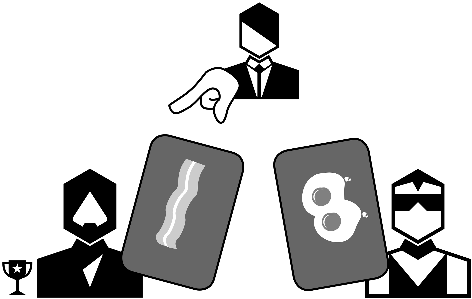
One player, the judge, decides the outcome of the Action.
Discussion
The standard use of this resolution mechanism is in games where players are performing a task, and there are no objective criteria as to which is best, so one player acts as Judge to select the winner. For example, in Apples to Apples, one player is the Judge, and the other players select one of their noun cards to match an adjective card. The Judge then selects which they think is closest. Similarly, in The Big Idea, players use noun cards to pitch products that fulfill a need, and the Judge selects which they like the most. In these games, the role of Judge either rotates around the table in a regular fashion or passes to the player who won the last round. The latter is a type of balancing mechanism as the Judge usually cannot score, so it gives other players an opportunity to close the gap (VIC-18). This Player Judge mechanism allows players to tailor their answers to the Judge’s preferences. The best implementations of this system have anonymous responses, as in Apples to Apples. In games where it is known which player goes with which answer, the Judge may go against the spirit of the game, and deliberately not select players due to their score, rather than the intrinsic worth of their submission. Personal relationships that
are outside of the game may also impinge (like someone giving preferential treatment to a spouse). While this mechanism is typically seen in lighter games, so this may not be that much of an issue, it is still a consideration, particularly when playing with children who may be more emotionally involved. Some games, like Say Anything, sidestep this issue by having the players bet on which answer the Judge will select. This makes it impossible for the Judge to game the system and keeps players more involved in the game.
Sample Games
Apples to Apples (Kirby and Osterhaus, 1999) The Big Idea (Ernest, 2000) Cards Against Humanity (Dillon, Dranove, Halpern, Hantoot, Munk, Pinsof, Temkin, and Weinstein, 2009) Say Anything (Crapuchettes and Pillalamarri, 2008)
描述
一名玩家,裁判(Judge),决定行动的结果。
讨论
这种解决机制的标准用途是在玩家执行一项任务的游戏中,对于哪一个是最好的没有客观标准,所以一名玩家充当裁判来选择获胜者。例如,在《Apples to Apples》中,一名玩家是裁判,其他玩家选择他们的一张名词卡来匹配一张形容词卡。然后裁判选择他们认为最接近的一张。同样,在《The Big Idea》中,玩家使用名词卡来推销满足需求的产品,裁判选择他们最喜欢的。在这些游戏中,裁判的角色要么以常规方式在桌子周围轮换,要么传递给赢得上一轮的玩家。后者是一种平衡机制,因为裁判通常不能得分,所以这给了其他玩家缩小差距的机会(VIC-18)。这种玩家裁判(Player Judge)机制允许玩家根据裁判的喜好调整他们的答案。该系统的最佳实现具有匿名回应,如在《Apples to Apples》中。在知道哪个玩家提供哪个答案的游戏中,裁判可能会违背游戏精神,故意不选择玩家,因为他们的分数,而不是他们提交的内在价值。
游戏之外的个人关系也可能产生影响(比如某人给予配偶优惠待遇)。虽然这种机制通常出现在较轻松的游戏中,所以这可能不是什么大问题,但这仍然是一个考虑因素,特别是在与可能情感投入更多的孩子一起玩时。一些游戏,如《Say Anything》,通过让玩家下注裁判将选择哪个答案来回避这个问题。这使得裁判不可能玩弄系统,并使玩家更多地参与游戏。
游戏范例
Apples to Apples (Kirby and Osterhaus, 1999) - 《Apples to Apples》 The Big Idea (Ernest, 2000) - 《The Big Idea》 Cards Against Humanity (Dillon, Dranove, Halpern, Hantoot, Munk, Pinsof, Temkin, and Weinstein, 2009) - 《反人类牌》 Say Anything (Crapuchettes and Pillalamarri, 2008) - 《Say Anything》