Description
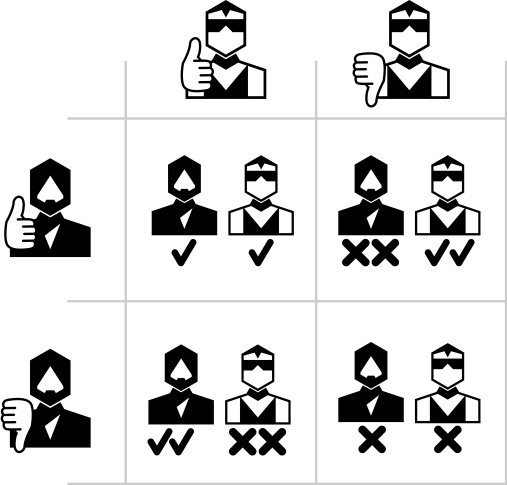
Each player has a choice between Cooperating or Defecting. The total payoff is maximized if both players Cooperate, but if one Defects and the other Cooperates, the Defector will score more individual points.
Discussion
The Prisoner’s Dilemma (PD) is one of the core Resolution mechanisms. Players choose to either cooperate with each other or defect. A typical payoff chart is shown in the diagram above. Since the payoffs if both defect or cooperate are equivalent for both players, this system only works if there are more than two players, even if only two are involved in the PD. If there are only two players, neither gains ground if they select the same option, so picking Defect is always the correct strategy. As indicated by the traditional choice names of Cooperate and Defect, the PD brings elements of trust to the forefront and strong elements of Yomi (UNC-01). This can lead to emotional investment by the players, or reaction
to being betrayed, particularly in longer games where the outcome can have a significant impact on player position. An example of this is Diplomacy, a 6–8 hour game of conquest in Europe. The players representing Austria and Italy start with two key spaces and armies, Venice and Trieste, adjacent to each other at the start of the game, the only such situation among the seven players. In Diplomacy, players write down orders and reveal them simultaneously (TRN-09, for more on Simultaneous Action Selection). After the initial negotiation phase, Italy and Austria need to decide if they will move away from their common border (Cooperate) or invade (Defect). If both Cooperate, it can set them up for a reasonable start and good long-term relationship. If both Defect, no one loses a home supply center, but it will sow distrust and put them behind the other players as their forces will not have moved. And if one Cooperates and the other Defects, a home supply center will be lost, putting one player at a significant disadvantage. While Diplomacy frequently creates high emotional moments like this, the Prisoner’s Dilemma does not always need to involve such high stakes. For example, in Hoity Toity, players in the Auction House may choose to purchase an item, play a Tief card to steal money, or a Detective card to catch a thief. While this is fundamentally an RPS mechanic (RES-07), if multiple players choose Tief, they cancel out and no thieves gain any benefit. This adds elements of a PD, but in a lighter way as there is no negotiation in Hoity Toity, and for players the stakes are much lower. Another example of this is Incan Gold, where each turn players need to decide simultaneously if they are continuing to explore an abandoned temple in search of treasure or will return home. Sometimes earlier treasures and artifacts may be left behind players, to be scooped up by players who leave the cave. In particular, artifacts create a PD, as they are only gained if a single player chooses to leave the temple. If multiple players leave the cave on the same turn, none gain the artifacts. This implementation also tends to be light as there are potential benefits for both staying and leaving, and no negotiation prior to selection. Cosmic Encounter introduces the PD through Negotiation cards. Conflict is resolved by both attacker and defender selecting a Number card from their hand. The player with the highest Number card plus Force strength wins the battle. Players also have the option to play a Negotiate card, if they have one, instead of a Number card. If both players Negotiate, they are allowed to negotiate a deal, which can be mutually beneficial. However, if only one Negotiates, that player automatically loses, and the player and their allies lose all their
involved forces. In an interesting twist, the player who chose a Negotiate card in this situation gains a small compensating benefit but not Allies. Tus, inviting Allies to join you in a battle where you know you will play a Negotiate is its own form of Defection, building a secondary PD into the core mechanism. Dead Last has two players dividing up four loot cards and adds a third option to the classic PD. In addition to Share and Steal (Cooperate/Defect), players may also choose Grab One, which guarantees exactly one loot card, possibly leaving three for the opponent.
Sample Games
Cosmic Encounter (Eberle, Kittredge, Norton, and Olatka, 1977) Dead Last (Grosso and Patton, 2016) Diplomacy (Calhamer, 1959) Fantasy Business (Boelinger, 2002) Hoity Toity (Teuber, 1991) Incan Gold (Faidutti and Moon, 2005) Zombie in My Pocket (Lee, 2010)
描述
每个玩家都要在合作或背叛之间做出选择。如果两个玩家都合作,总收益最大化,但如果一个背叛而另一个合作,背叛者将获得更多的个人点数。
讨论
囚徒困境(Prisoner’s Dilemma, PD)是核心解决机制之一。玩家选择彼此合作或背叛。典型的收益图如上图所示。由于如果双方都背叛或合作,对双方玩家的收益是相等的,所以只有在超过两个玩家的情况下,该系统才有效,即使只有两个人参与PD。如果只有两个玩家,如果他们选择相同的选项,谁也得不到好处,所以选择背叛总是正确的策略。正如合作和背叛的传统选择名称所表明的那样,PD将信任元素推向前台,并带来强烈的Yomi元素(UNC-01)。这可能导致玩家的情感投入,或者对
背叛的反应,特别是在结果会对玩家地位产生重大影响的较长游戏中。这就是《外交》(Diplomacy),一个6-8小时的欧洲征服游戏的一个例子。代表奥地利和意大利的玩家在游戏开始时以两个关键空间和军队威尼斯和的里雅斯特相邻开始,这是七个玩家中唯一的情况。在《外交》中,玩家写下命令并同时揭示(TRN-09,了解更多关于同时行动选择的信息)。在最初的谈判阶段之后,意大利和奥地利需要决定他们是远离共同边界(合作)还是入侵(背叛)。如果双方都合作,它可以为他们建立一个合理的开始和良好的长期关系。如果双方都背叛,没有人失去家乡补给中心,但这会播下不信任的种子,并使他们落后于其他玩家,因为他们的军队没有移动。如果一方合作而另一方背叛,将失去一个家乡补给中心,使一名玩家处于明显的劣势。虽然《外交》经常制造这样激动人心的时刻,但囚徒困境并不总是一定涉及如此高的风险。例如,在《Hoity Toity》中,拍卖行的玩家可以选择购买一件物品,打出一张小偷卡来偷钱,或者一张侦探卡来抓小偷。虽然这根本上是一个RPS机制(RES-07),但如果多个玩家选择小偷,他们会相互抵消,没有小偷获得任何利益。这增加了PD的元素,但方式较轻,因为在《Hoity Toity》中没有谈判,而且对玩家来说风险要低得多。这方面的另一个例子是《印加宝藏》(Incan Gold),每回合玩家需要同时决定是继续探索废弃的神庙寻找宝藏还是回家。有时较早的宝藏和神器可能会被玩家留下,被离开洞穴的玩家捡起。特别是,神器创造了一个PD,因为只有当一个玩家选择离开神庙时才能获得它们。如果多个玩家在同一回合离开洞穴,没人能获得神器。这种实现也往往很轻,因为留下来和离开都有潜在的好处,而且在选择之前没有谈判。《Cosmic Encounter》通过谈判卡引入了PD。冲突由攻击者和防御者都从手牌中选择一张数字卡来解决。拥有最高数字卡加部队力量的玩家赢得战斗。玩家还可以选择打一张谈判卡,如果他们有的话,而不是数字卡。如果双方都谈判,他们可以协商达成一项互惠互利的协议。然而,如果只有一方谈判,该玩家自动输,该玩家及其盟友失去所有
参与的部队。在一个有趣的转折中,在这种情况下选择谈判卡的玩家会获得少量补偿利益,但盟友不会。因此,邀请盟友加入一场你知道你会进行谈判的战斗本身就是一种背叛形式,在核心机制中构建了次级PD。《Dead Last》有两个玩家瓜分四张战利品卡,并在经典PD中增加了第三个选项。除了分享和偷窃(合作/背叛)外,玩家还可以选择抓取一张(Grab One),这保证正好一张战利品卡,可能给对手留下三张。
游戏范例
Cosmic Encounter (Eberle, Kittredge, Norton, and Olatka, 1977) - 《星际遭遇战》 Dead Last (Grosso and Patton, 2016) - 《这一票干完就金盆洗手》 Diplomacy (Calhamer, 1959) - 《外交》 Fantasy Business (Boelinger, 2002) - 《Fantasy Business》 Hoity Toity (Teuber, 1991) - 《贵族神偷/神偷世家》 Incan Gold (Faidutti and Moon, 2005) - 《印加宝藏》 Zombie in My Pocket (Lee, 2010) - 《口袋丧尸》