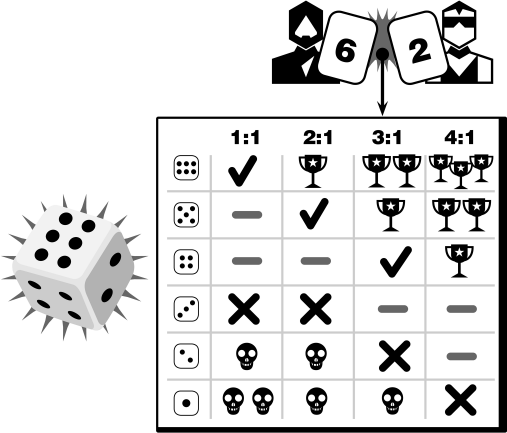
Description
The Attacker and Defender each total their strength. This is then expressed as a ratio and is used to index into a Combat Results Table (CRT). A dice roll then determines the result of the conflict.
Discussion
Pioneered in the earliest war games, the CRT has become a staple of the genre. CRTs are typically indexed by calculation the ratio of the attacker’s strength to the defender’s. For example, if the attacker has a strength of 8, and the defender has a strength of 4, the 2:1 column would be used, as 8 is 2 times 4. Typically, these are rounded down in favor of the defender, so a 9–4 attack would also be resolved on the 2:1 column (Illustration 4.1). Once the correct column is determined, a die is rolled to determine the final result. In war games, this is typically some combination of force eliminations, damage, or retreats. The use of the CRT gives the designer a lot of control over potential results. It is possible to have a tightly grouped range of outcomes from one to six or a wild variation. In addition, the designer has many hooks to apply
other effects. For example, the attacker or defender strength can be modified, the final die roll can be modified, or the column used can be shifted left or right. This flexibility has led to its continued popularity in the war-gaming community. Designs have taken the CRT in a wide variety of directions. Squad Leader eschews strength ratios and simply has the column chosen by the firepower of the attacker. It also includes a mechanism called Cowering, where if doubles are rolled (two dice are rolled in Squad Leader), the column used is shifted one to the left, to a weaker column. Elite troops are typically immune to Cowering. This is a good example of the opportunities CRTs offer to differentiate and apply various effects. Some games have the column selected by a differential between Attacker and Defender rather than a ratio. This has the benefit of simplicity, as division can be confusing when the strengths get large. Differentials are less realistic, however, as they will treat a 10–8 attack the same as a 3–1 attack. But, if the values are bounded within a reasonable range, differential CRTs can give a lighter feel. Some games use charts with various conditions as columns to resolve Actions and random events. Down with the King has charts that players roll on to determine the result. For example, there are separate charts for Gambling, Seducing, and Carousing. The solitaire game B-17: Queen of the Illustration 4.1 Combat Results Table from The Guns of August. The modified die roll is cross-indexed with the Combat Odds.
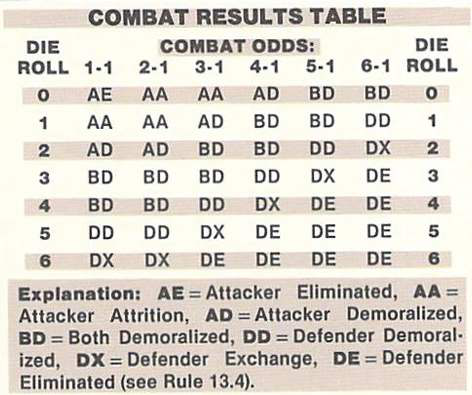
Skies includes charts for damage from German fighters, bombing accuracy, and the result of crew member injuries. While charts can encapsulate a large amount of information and give a lot of flexibility to the designer, they can be intimidating to players and tedious to use and are considered old-fashioned. However, in the right situations, they can be quite useful.
Sample Games
B-17: Queen of the Skies (Frank and Shelley, 1981) Down with the King (Rahman and Rahman, 1981) France 1944: The Allied Crusade in Europe (Herman, 1986) The Guns of August (Beyma and Davis, 1981) Gettysburg (Roberts, 1958) Squad Leader (Hill, 1977)
描述
攻击者和防御者各自合计他们的力量。然后将其表示为比率,并用于索引战斗结果表(CRT)。然后通过掷骰子决定冲突的结果。
讨论
由最早的战争游戏开创,CRT已成为该类型的主流。CRT通常通过计算攻击者力量与防御者力量的比率来进行索引。例如,如果攻击者的力量为8,防御者的力量为4,则使用2:1列,因为8是4的2倍。通常,这些比率向下取整以利于防御者,因次9-4的攻击也将在2:1列上解决(插图4.1)。一旦确定了正确的列,就会掷骰子来确定最终结果。在战争游戏中,这通常是部队消除、伤害或撤退的某种组合。CRT的使用赋予设计师对潜在结果的大量控制权。可能有一组紧密的结果范围从一到六,或者有巨大的变化。此外,设计师有许多挂钩来应用
其他效果。例如,可以修改攻击者或防御者的力量,可以修改最终的掷骰结果,或者可以将使用的列向左或向右移动。这种灵活性导致其在战争游戏社区中持续流行。设计将CRT带向了各种各样的方向。《Squad Leader》避开了力量比率,只是根据攻击者的火力选择列。它还包括一个名为“畏缩”(Cowering)的机制,如果掷出双倍(在《Squad Leader》中掷两个骰子),使用的列向左移动一格,移动到较弱的列。精锐部队通常对畏缩免疫。这是CRT提供的区分和应用各种效果的机会的一个很好的例子。有些游戏通过攻击者和防御者之间的差值而不是比率来选择列。这有简单的好处,因为当力量变大时,除法可能会令人困惑。然而,差值不太现实,因为它们会将10-8的攻击视为与3-1的攻击相同。但是,如果值在合理范围内,差值CRT可以给人一种更轻松的感觉。有些游戏使用以各种条件作为列的图表来解决行动和随机事件。《Down with the King》有玩家掷骰来确定结果的图表。例如,赌博、诱惑和狂欢有单独的图表。单人游戏《B-17: Queen of the Skies》
插图4.1 《八月炮火》中的战斗结果表。修改后的掷骰结果与战斗几率交叉索引。
包括德国战斗机的伤害、轰炸精度和机组人员受伤结果的图表。虽然图表可以封装大量信息并赋予设计师很大的灵活性,但它们可能令人生畏,使用起来繁琐,并且被认为是过时的。然而,在适当的情况下,它们可能非常有用。
游戏范例
B-17: Queen of the Skies (Frank and Shelley, 1981) - 《B-17: Queen of the Skies》 Down with the King (Rahman and Rahman, 1981) - 《Down with the King》 France 1944: The Allied Crusade in Europe (Herman, 1986) - 《France 1944: The Allied Crusade in Europe》 The Guns of August (Beyma and Davis, 1981) - 《八月炮火》 Gettysburg (Roberts, 1958) - 《盖茨堡》 Squad Leader (Hill, 1977) - 《班长》