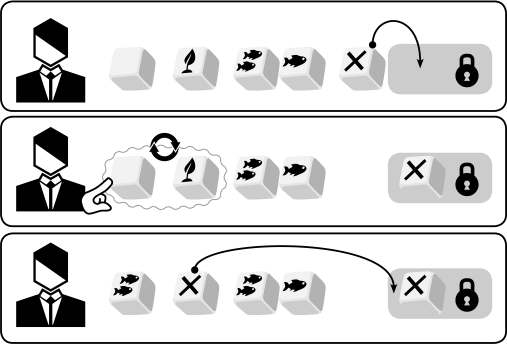
Description
Dice may be rerolled or may be locked, preventing rerolling.
Discussion
Many people are first exposed to the idea of Rerolling through the classic game Yahtzee. After rolling, the player may choose to reroll any number of dice and may do this twice, for a total of three throws. Yahtzee illustrates some typical characteristics of reroll systems: • When dice are rerolled you must take the result (you can’t go back to the first result) • You can reroll dice regardless of whether they were rerolled or not There are variations on this, of course, but this is typical. From a straightforward perspective, where you are interested only in how high the number rolled is, assuming the player rerolls anything that is less than a “4,” the reroll will add, on average, 0.75 to the final number. While it is similar in result to a +1 modifier, rerolls are experienced differently by the player. First, the player is choosing whether to reroll or not. This gives them finer-grained control and gives more tactical nuance to the act of rolling than just gaining a set modifier. Also, rolling dice can be
inherently exciting, and rerolls make that happen more frequently. Finally, modifiers (as discussed in RES-02), even +1 modifiers, add to player cognitive load. Just looking at the die result is simpler. However, unlike modifiers, rerolls can result in the final result being worse than the initial roll. Whether this is desirable for the experience is a decision that needs to be determined by the designer. The opposite mechanism to rerolling is Locking. In a Locking mechanism, certain die faces cannot be rerolled. Tey are stuck on that face for the remainder of the turn. Having a combination of rerolls and locks brings a Push-Your-Luck mechanism (UNC-02) to the table, as players need to risk improving their results by locking more dice. Zombie Dice is one of many games to implement this combination, as shotgun blast results are locked, and getting three shotgun blasts in total ends your turn with a bust. Escape: The Curse of the Temple uses locked dice in a real-time dice rolling game to force players to interact with each other (to help unlock the dice of other players) and, in general, to disrupt the players’ flow and force them to make some tough decisions.
Sample Games
Cosmic Wimpout (Swilling, 1975) Escape: The Curse of the Temple (Ostby, 2012) King of Tokyo (Garfield, 2011) Yahtzee (Lowe, 1956) Zombie Dice (Jackson, 2010)
描述
骰子可以重掷(Rerolling)或被锁定(Locking),防止重掷。
讨论
许多人最初是通过经典游戏《快艇骰子》(Yahtzee)接触到重掷的想法的。掷骰后,玩家可以选择重掷任意数量的骰子,并且可以这样做两次,总共三次。快艇骰子说明了重掷系统的一些典型特征: • 当重掷骰子时,你必须接受结果(你不能回到第一个结果) • 无论骰子是否被重掷过,你都可以重掷骰子 当然也有变体,但这很典型。从直接的角度来看,如果你只对掷出的数字有多高感兴趣,假设玩家重掷任何小于“4”的东西,重掷平均会给最终数字增加0.75。虽然结果类似于+1修正值,但玩家对重掷的体验不同。首先,玩家正在选择是否重掷。这给了他们更细粒度的控制,并且比仅仅获得设定的修正值给掷骰行为带来了更多的战术细微差别。此外,掷骰子本身就
令人兴奋,而重掷让这种兴奋更频繁地发生。最后,修正值(如RES-02中讨论的),即使是+1修正值,也会增加玩家的认知负荷。只看骰子结果更简单。然而,与修正值不同,重掷可能导致最终结果比初始掷骰更差。这对于体验来说是否可取是设计师需要决定的决定。与重掷相反的机制是锁定。在锁定机制中,某些骰子面不能重掷。它们在回合的剩余时间内被卡在那一面。结合重掷和锁定为桌面带来了运气推送机制(UNC-02),因为玩家需要冒着锁定更多骰子的风险来改善他们的结果。《Zombie Dice》是实施这种组合的众多游戏之一,因为霰弹枪爆炸结果被锁定,总共获得三次霰弹枪爆炸会使你的回合以失败告终。《Escape: The Curse of the Temple》在实时骰子游戏中使用了锁定骰子,迫使玩家相互互动(帮助解锁其他玩家的骰子),并且通常扰乱玩家的流程并迫使他们做出一些艰难的决定。
游戏范例
Cosmic Wimpout (Swilling, 1975) - 《Cosmic Wimpout》 Escape: The Curse of the Temple (Ostby, 2012) - 《逃离:圣庙的诅咒》 King of Tokyo (Garfield, 2011) - 《东京之王》 Yahtzee (Lowe, 1956) - 《快艇骰子》 Zombie Dice (Jackson, 2010) - 《Zombie Dice》