Description
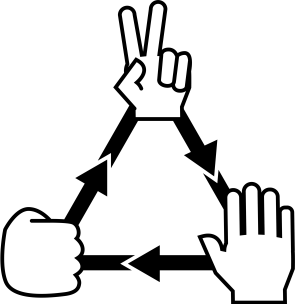
There are three possible options, and they are cyclically superior (A beats B, B beats C, and C beats A).
Discussion
Rock, Paper, Scissors (RPS) is one of the core resolution mechanisms. Unlike High Number or Stat Check, it is intransitive. A transitive relationship means that if A beats B and B beats C, then A beats C. For example, simply comparing strengths leads to a transitive relationship. Adding intransitive elements to conflict resolution leads to interesting and novel decisions for the players. For example, many Napoleonic war games treat the relationship between infantry, cavalry, and artillery as intransitive. Infantry beats cavalry (defending in a square), cavalry beats artillery, and artillery beats infantry. Note that “beats” in this context means “has an advantage over.” It does not typically mean wins 100% of the time. Age of Mythology: The Board Game is an example of this type of system. There are a variety of ways to implement an RPS-based resolution system. Some games, like Secret Labyrinth and Darkover, have players secretly select one of three options (literally, RPS in the case of Secret Labyrinth), reveal, and compare. Others will give bonuses or penalties to players based on their choices, such as a modifier in a High Number system (RES-01), varying the number of dice to be rolled, or changing or adding target icons.
One system that is infrequently used is Intransitive Dice. In this implementation, there are three different dice with varying values on the faces. These are mathematically designed so that, on average, die A will roll higher than die B, die B higher than die C, and die C higher than die A. Typically, the advantage is around 55–45, so it can be difficult to engineer a dominant advantage, but over the course of many rolls, the player who gets the best matchups will come out ahead. The RPS mechanism can also arise indirectly from the interaction of player choices. For example, in Hoity Toity, players who go to the Auction House may choose to play a Cash card, to buy an artifact; a Tief, to steal a Cash card; or a Detective, to catch a Tief. Similarly, in Nobody But Us Chickens, players can play a Chicken for points, a Fox to catch a Chicken, or a Dog to catch a Fox. If there are more than three players, the interactions and choices can get complex for players to decide, while being easy to resolve. Hoity Toity has the additional wrinkle that if multiple players select Tief, they cancel out, which has shades of the Prisoner’s Dilemma (RES-08) and Sealed Bid with Cancellation (AUC-05). Many games extend a hierarchical system by including a wrap-around with the weakest piece defeating the strongest. For example, in Stratego, the Marshall is the strongest piece, but it can be defeated by the Spy, the weakest. Similarly, in Frank’s Zoo, the Elephant is the strongest card, but it is defeated by the Mouse. This adds a beneficial layer of uncertainty to these games. Stratego without the possibility of losing your Marshall would be a much poorer game.
Sample Games
Age of Mythology: The Board Game (Drover, 2003) Darkover (Eberle, Kittredge, and Olatka, 1979) Frank’s Zoo (Matthäus and Nestel, 1999) Hoity Toity (Teuber, 1991) Nobody but Us Chickens (Nunn, 2003) Secret Labyrinth (Kobbert, 1998) Stratego (Mogendorff, 1946)
描述
有三种可能的选项,它们循环优越(A胜B,B胜C,C胜A)。
讨论
“石头、剪刀、布”(Rock, Paper, Scissors, RPS)是核心解决机制之一。与“高数值”或“属性检定”不同,它是非传递性的。传递关系意味着如果A胜B,且B胜C,那么A胜C。例如,简单地比较力量会导致传递关系。将非传递性元素添加到冲突解决中会给玩家带来有趣和新颖的决定。例如,许多拿破仑时代的战争游戏将步兵、骑兵和炮兵之间的关系视为非传递性的。步兵胜骑兵(方阵防御),骑兵胜炮兵,炮兵胜步兵。请注意,在这种情况下,“胜”意味着“有优势”。它通常不意味着100%获胜。《Age of Mythology: The Board Game》就是这种类型系统的一个例子。有多种方法可以实现基于RPS的解决系统。有些游戏,如《Secret Labyrinth》和《Darkover》,玩家秘密选择三个选项之一(在《Secret Labyrinth》的情况下的确是RPS),揭示并比较。即使这样,也会根据玩家的选择给予奖励或惩罚,例如在“高数值”系统(RES-01)中的修正值,改变掷骰数量,或改变或添加目标图标。
一种不常用的系统是非传递性骰子。在这个实现中,有三个不同的骰子,其面上的值各不相同。这些在数学上设计为,平均而言,骰子A掷出的点数高于骰子B,骰子B高于骰子C,骰子C高于骰子A。通常,优势约为55-45,因此很难设计出显着的优势,但经过多次掷骰,获得最佳对决的玩家将领先。RPS机制也可以从玩家选择的互动中直接产生。例如,在《Hoity Toity》中,去拍卖行的玩家可以选择打出“现金”卡购买神器,“小偷”来偷取现金卡,或“侦探”来抓小偷。同样,在《Nobody But Us Chickens》中,玩家可以打出“鸡”来获得分数,“狐狸”来抓鸡,或“狗”来抓狐狸。如果有三个以上的玩家,这种互动和选择对玩家来说可能会变得复杂,但易于解决。《Hoity Toity》还有一个额外的特点,如果多个玩家选择小偷,他们会相互抵消,这带有“囚徒困境”(RES-08)和“带取消的密封竞价”(AUC-05)的影子。许多游戏通过包含弱胜强的循环来扩展等级系统。例如,在《陆军棋/斗兽棋》(Stratego)中,元帅是最强的棋子,但它可以被最弱的间谍击败。同样,在《Frank’s Zoo》中,大象是最强的牌,但它被老鼠击败。这为这些游戏增加了一层有益的不确定性。如果没有失去元帅的可能性,《陆军棋》将是一个糟糕得多的游戏。
游戏范例
Age of Mythology: The Board Game (Drover, 2003) - 《神话时代:棋盘游戏》 Darkover (Eberle, Kittredge, and Olatka, 1979) - 《Darkover》 Frank’s Zoo (Matthäus and Nestel, 1999) - 《法兰克的动物园》 Hoity Toity (Teuber, 1991) - 《贵族神偷》 Nobody but Us Chickens (Nunn, 2003) - 《Nobody but Us Chickens》 Secret Labyrinth (Kobbert, 1998) - 《Secret Labyrinth》 Stratego (Mogendorff, 1946) - 《陆军棋》