Description
Players must add, remove, or rearrange objects from a stack, a balancing contraption, or a playing surface.
Discussion
Dexterity mechanisms generally test both physical skill and the ability to evaluate the consequences of the physical act. Flicking games (see [flicking reference]) test both the flicking itself and the judgment of accuracy, angles, and ricochets. Stacking and balancing games test the steadiness of a player’s hands, as well as their judgment about fulcrums, levers, weights, and densities. Somewhere between balancing and flicking lies pushing and sliding, which we will also discuss in this section. Note that while most games in this section are properly dexterity games (and a subset of RES-10 Physical Action), there are some notable exceptions. While stacking and balancing games have existed in an oral culture for thousands of years, two of the most well-known modern stacking games
are Jenga and Blockhead! Each is an example of two primary approaches to creating stacking games. Jenga uses uniform (though not perfectly identical) pieces, while Blockhead! uses pieces in a variety of odd shapes and sizes, with unusual angles and non-level planes. The advantage of using more uniform pieces is that the tower can typically reach much higher heights than can be achieved with non-uniform pieces. Non-uniform stackers, like Animal Upon Animal, offer up interest in how odd shapes, angles, and even curves can support and counterbalance one another. Catch The Moon tries to capture the best of both worlds by asking players to stack ladders in a jumble. The ladders are similar but not identical, and players roll a die to determine whether the new ladder must touch one or two ladders or if it must be the highest ladder in the jumble after it is placed. These simple instructions, and the varied opportunities for how ladders can hook and support one another, create structures that are both tall and compelling to behold. Jenga and its many spiritual successors, like Rhino Hero, have players perform both a removal and an addition to the tower. In Jenga, players must remove a block from the tower before adding it to the top of the tower. In Rhino Hero, the tower is built out of two kinds of cards: folded cards played as walls and flat cards played as roofs. The flat cards show an action that is triggered when the roof is played onto the tower, and one such action requires the next player to remove the eponymous wooden rhino meeple from wherever it is in the tower and to place it on top. The physics of removing this dense, heavy object—relative to the cards themselves, anyway—to place it at the top of a wobbly, swaying structure are tricky, to say the least! Yura Yura Penguin takes this concept even further by offering more objects to stack, including ice crystals, penguins of different shapes and sizes, and even a polar bear. Stacking and balancing typically take center stage in a design, but hybridizing the mechanism is also possible. Kapitän Wackelpudding has players stacking wooden shapes onto a small ship, and then pushing it around the board, pick-up-anddeliver-style, to various ports. Goods that fall off of the ship are negative points, and at the end of the game, the player who knocked off the fewest goods wins. MegaCity Oceania has players constructing futuristic skyscrapers out of opaque and translucent plastic pieces that are piled on top of cardboard tiles and then sliding the tiles to join the rest of the skyscrapers already on the board. Players build and place skyscrapers to score points based on specifications in building contracts, adjacency to other tiles, and overall building height. If a building loses pieces during its journey to the central area, the player is penalized with a loss of their turn.
In Tokyo Highway, players use wooden cylinders and popsicle sticks to create roadways that pivot and loop over and under one another. Tey then add cars to these roadways—a privilege granted by successfully accomplishing the feat of crossing over another roadway as the highest crosser or crossing under it as the lowest crosser. The winner is the player who places all their cars, but even placing cars is fraught with peril. At any point, knocking over anything will cause a player to take penalties. Tokyo Highway differs from most balancing games in that the challenge is less about balance and more about positioning. The wooden roads balance reasonably solidly on the flat sides of the cylinders, and building roadways is not particularly challenging. However, maneuvering your fingers and wooden pieces through the thicket of roadways that quickly springs up and positioning your body to maintain stability in order to place roadways in scoring configurations are quite challenging. In some ways, the game is the inverse of Jonchets or its modern successor, Pick-Up Sticks, in which players remove narrow wooden sticks from a jumble, without causing any other sticks to move. Both games require intense concentration and fine motor skills but are less about finding balance and equilibrium in a structure. There is a danger in creating hybrid games. Players may be frustrated by strategizing properly but losing because of failures of dexterity. Or, players may find the physical aspects of the game more compelling and fun than the strategy. In some cases, the dexterity aspects of the game simply may not work well and consistently enough to work as a game, rather than as an activity. Coaster Park, a game about assembling cardboard roller coasters and running a steel ball bearing through them, suffered greatly from this. Players assumed that the game was signifying, for example, that the largest starting hill would generate sufficient momentum through gravity alone to climb the next-highest hill or to complete the loop-the-loop but, in fact, it took quite a bit of skill in flicking the marble—to say nothing of carefully assembling and angling the joints between sections—to make the roller coasters work at all. For many players, the difficulty of the physical mechanism made the game as a whole unplayable as intended, but for many players, the issue was not simply the difficulty, but their expectation that the game was not a dexterity challenge at all and that the roller coaster was a novelty and a gimmick, not a gameplay mechanism. Another hybrid, Terror in Meeple City (nee Rampage), has players as kaiju monsters who seek to destroy buildings made of meeples that hold up tiers of cardboard tiles. Players can use one of several techniques, including flicking, dropping, and even blowing air from their mouths, to try and dislodge the meeples and destroy the tower. Scoring is relatively complex and includes variable scoring cards that define how sets of different colored meeples score,
penalties for allowing meeples to escape the city, and penalties for being struck by other monsters. While Terror in Meeple City is quite ambitious in directly translating a kaiju attack into a dexterity board game, perhaps the most ambitious hybrid dexterity game is Beasts of Balance, an app-supported game featuring a virtual world. In Beasts of Balance, a central platform, called the Plinth, has an NFC (Near Field Communications) reader that can scan and read the specially shaped, oversized plastic creatures that are stacked atop it. The Plinth also keeps track of the weight of the objects piled on top of it. When players add a creature to the Plinth, the app displays that creature being added to one of three regions in a virtual world. Adding multiple creatures to a region can lead to the breeding of hybrid creatures, and some creatures prey on others. The dynamic environment and evolving creatures are all virtual, while players interact with that world almost solely through stacking creatures and special objects on the Plinth. When anything comes dislodged from the Plinth, it must be re-stacked within a few moments, as the Plinth recognizes the overall change of weight in the stack. These moments do pro-vide opportunities for rearranging the stack. Note also that Beasts of Balance is a cooperative game (though a competitive variant is included in the rules), and we will return to this point later. Stacking and balancing games are close cousins to Push-Your-Luck games (see UNC-02) in that players are uncertain about the exact impact of their actions on the physical equilibrium of the game. Causing a collapse is similar to busting and, typically, safe moves evaporate as the game progresses. Auctions are one method designers use to give players control over risk, and a series of very similar games offer several approaches to implementing an auction in this context. In Bausack, there are a variety of stacking shapes. The active player chooses one and offers it to another player, who may accept it and add it to their personal structure or discard a bean to avoid it. A player without beans can no longer avoid a block, and players are eliminated when their structures collapse. In Bandu, the core gameplay is the same, but the auction element is even stronger. The active player chooses a block and selects to run a “Use” or “Refuse” auction. The winner of a Use auction or the loser of a refuse auction places the piece. This game offers quite a lot of agency to the players, in selecting the piece up for auction, evaluating whether it is relatively easy or difficult to place for each player, given the current state of their tower, and deciding on the auction type to hold. In Sac Noir, there are several additional variations on this same gameplay, including building a shared central tower, a set of more difficult shapes, and additional auction types.
Balancing games often include a central contraption whose instability defines the underlying physics of the game. Unlike the level, though small, stage of the Plinth in Beasts of Balance, Topple features a plastic, tiered platter that looks something like a step pyramid that balances on a long plastic pole, or perhaps the skirt of a ballerina’s tutu as they stand on pointe. Players play plastic counters onto the “board” and score points for creating rows and stacks of the same color. When a player causes a topple, all the other players are awarded points. Other interesting central contraptions include the wire hanger structure of Suspend, the anthropomorphic and eponymous waiter in Don’t Tip the Waiter, and the giant wooden pirate ship featured in Riff Raff. Like hybrids mentioned earlier, Topple is something like Connect Four combined with physics. Leverage features a board balanced on a fulcrum, like a teeter-totter. Play is similar to both Checkers and Chinese Checkers but for two players only. Players move, jump, and capture using pawns of three different weights and sizes. As players advance their pawns, the equilibrium of the board shifts, sometimes causing the board to rest on one player’s side. That player must remove one or more special scoring pawns from their back row until the board reaches equilibrium again and is suspended in mid-air again. When a player runs out of scoring pawns to remove, they lose when the board touches down on their side again. A similar, more broadly available game is Rock Me Archimedes, which features this same teetering board and central mechanism. In both Leverage and Rock Me Archimedes, there is no dexterity element of any kind. Placing and moving pieces is not a challenge of execution, and accidentally toppling pieces lies outside the scope of the rules and is not penalized. The skills being tested, beyond the spatial and tactical skills of maneuvering pawns on the board, are skills of evaluation of weight and equilibrium. These may be the exceptions to the general rule of balancing games as dexterity games. Indeed, in most games, there are specific rules about how the pieces may be handled: with one or two hands, within some time limit, and more. In Lift It!, players cannot use their hands at all and instead strap a crane to their heads, using a headband, to build structures together. Rules like this point to a general concern for accessibility in balancing games. Balancing games are particularly difficult to make accessible to players with various physical limitations, be they limited vision, mobility challenges, or unsteady hands that can accompany normal aging. However, balancing games do provide affordances for managing skill differentials among players, such as playing with an off-hand. Stacking and balancing games appeal to designers who are designing for younger audiences, precisely because of how easy they are to explain. While
most games abstract complex systems, these games leverage simple physical phenomena that can be understood even by the very young. There are some developmental and psychological realities, however, that designers should consider when creating games for families and younger players. For instance, while many stacking games end with a collapse, which can be a cathartic and hilarious moment, this can be a devastating moment for younger children, a moment of deep frustration and even anguish. Adults are not immune to these feelings, which may explain why cooperative stacking and balancing games have emerged in recent years. Menara is a cooperative stacking game in which failures are punished by making players stack to an even higher height to win. This intensification of difficulty is a common trope in cooperative games but is novel in the genre of stacking games. Turning these games into co-ops appears to take some of the stings out of failure and amplifies the aspects of social fun, rather than mastery, in the game. Creating physical games requires designers to focus sharply on the specifications of the materials of the game pieces. Teir weight, shape, the friction of their surfaces, and the ease with which they can be manipulated in hand all play an enormous role in how they work in the game. Manufacturing considerations need to be taken into account quite early in the process, relative to non-physical games. The overall weight and size of these games can be a major limiting factor in terms of the game’s marketability and price point (Illustration 4.7). Illustration 4.7 The stacking in Junk Art can be both challenging and aesthetically pleasing.
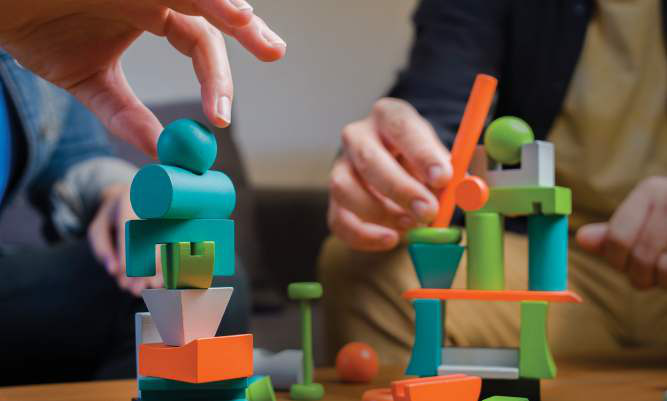
Finally, we will note that many games of this kind feature multiple modes of play and variants. There are many small and simple twists that can give rise to unique play experiences within the same framework of pieces. Junk Art, a highly regarded recent design, features 12 different rules variants on “city cards,” representing a kind of world tour that players embark on. The game even contains three blank city cards, inviting players to make up their own variants. This speaks of the essential simplicity and infinite variety of stacking and balancing as a pastime and vehicle for fun.
Sample Games
Animal Upon Animal (Miltenberger, 2005) Bausack (Zoch, 1987) Beasts of Balance (Buckenham and Fleetwood, 2016) Blockhead! (D’Arcey, 1952) Catch The Moon (Riffaud and Rodriguez, 2017) Coaster Park (Almes, 2017) Don’t Tip the Waiter (Collicott, 2014) Jenga (Scott, 1983) Junk Art (Cormier and Lim, 2016) Kapitän Wackelpudding (McGuire and McGuire, 1994) Leverage (Slimp, 1977) MegaCity Oceania (Draper and Fox, 2019) Menara (Richtberg, 2018) Coaster Park (Almes, 2017) Pick-Up Sticks (Unknown, ~1850) Rhino Hero (Frisco and Strumpf, 2011) Riff Raff (Cantzler, 2012) Rock Me Archimedes (Buchanan, 2012) Suspend (Uncredited, 2012) Terror in Meeple City (Bauza and Maublanc, 2013) Tokyo Highway (Shimamoto and Tomioka, 2016) Topple (Tibault, 1983) Yura Penguin (Ryoko, 2019)
描述
玩家必须从堆栈、平衡装置或游戏表面添加、移除或重新排列物体。
讨论
灵巧机制通常测试身体技能和评估身体行为后果的能力。弹指游戏(见[弹指参考])测试弹指本身以及对准确性、角度和反弹的判断。堆叠和平衡(Stacking and Balancing)游戏测试玩家手的稳定性,以及他们对支点、杠杆、重量和密度的判断。介于平衡和弹指之间的是推和滑,我们将在本节中讨论。请注意,虽然本节中的大多数游戏都是名副其实的灵巧游戏(也是RES-10物理动作的一个子集),但也有一些值得注意的例外。虽然堆叠和平衡游戏在口述文化中已经存在了数千年,但最著名的两个现代堆叠游戏
是《叠叠乐》(Jenga)和《Blockhead!》。每一个都是创建堆叠游戏的两种主要方法的例子。《叠叠乐》使用统一(虽然并非完全相同)的块,而《Blockhead!》使用各种奇怪形状和大小的块,具有不寻常的角度和非水平面。使用更统一的块的优点是,塔通常可以达到比使用非统一块能够达到的更高的高度。非统一堆叠游戏,如《动物叠叠高》(Animal Upon Animal),提供了奇怪的形状、角度甚至曲线如何相互支撑和平衡的趣味。《Catch The Moon》试图通过让玩家将梯子堆叠成一团来捕捉两全其美的效果。梯子相似但不相同,玩家掷骰子来确定新梯子是必须接触一个还是两个梯子,或者是放置后必须是堆中最该的梯子。这些简单的说明,以及梯子如何钩住和支撑彼此的各种机会,创造了既高大又引人注目的结构。《叠叠乐》及其众多的精神继承者,如《犀牛英雄》(Rhino Hero),让玩家对塔进行移除和添加。在《叠叠乐》中,玩家必须从塔中移除一个块,然后再将其添加到塔顶。在《犀牛英雄》中,塔由两种卡牌建成:折叠卡作为墙壁,平面卡作为屋顶。平面卡显示了当屋顶打到塔上时触发的行动,其中一项行动要求下一个玩家从塔中的任何地方移除同名的木制犀牛米宝并将其放在顶部。移除这个致密的重物——反正相对于卡牌本身而言——并将其放在摇摇晃晃的结构顶部的物理过程是棘手的,至少可以这么说!《Yura Yura Penguin》通过提供更多的堆叠物体将这一概念更进一步,包括冰晶、不同形状和大小的企鹅,甚至北极熊。堆叠和平衡通常在设计中占据中心位置,但混合机制也是可能的。《Kapitän Wackelpudding》让玩家将木制形状堆叠在一艘小船上,然后像提取和交付风格一样将其推向版图上的各个港口。从船上掉下来的货物是负分,在游戏结束时,击落最少货物的玩家获胜。《MegaCity Oceania》让玩家用不透明和半透明的塑料片在纸板瓦片上堆叠出未来的摩天大楼,然后滑动瓦片以连接版图上已有的摩天大楼。玩家建造和放置摩天大楼以根据建筑合同中的规格、与其他瓦片的相邻关系和整体建筑高度得分。如果建筑物在前往中心区域的旅途中丢失碎片,玩家将受到失去回合并受惩罚。
在《Tokyo Highway》中,玩家使用木制圆柱和冰棒棍创建相互翻转和循环的道路。然后他们将汽车添加到这些道路上——这是一项特权,通过成功完成作为最高跨越者跨越另一条道路或作为最低跨越者在其下方跨越的壮举而授予。获胜者是放置所有汽车的玩家,但即使放置汽车也充满危险。在任何时候,击倒任何东西都会导致玩家受到惩罚。《Tokyo Highway》与大多数平衡游戏不同,因为挑战不在于平衡,而更多在于定位。木制道路在圆柱的平坦侧面平衡得相当牢固,修建道路并不特别具有挑战性。然而,操纵你的手指和木块穿过迅速涌现的道路丛林,并调整你的身体以保持稳定性,以便将道路放置在得分配置中是非常具有挑战性的。在某些方面,游戏是《Jonchets》或其现代继承者《挑竹签》(Pick-Up Sticks)的逆向,在那里面,玩家从一堆乱堆中移除狭窄的木棍,而不会导致任何其他木棍移动。这两款游戏都需要高度集中注意力和精细运动技能,但不太在于在结构中寻找平衡和均衡。创建混合游戏存在危险。玩家可能会因正确制定策略但因灵巧失误而输掉而感到沮丧。或者,玩家可能会发现游戏的物理方面比策略更引人注目和有趣。在某些情况下,游戏的灵巧方面可能根本无法很好地一致地作为游戏运作,而不是作为一个活动。《Coaster Park》是一款关于组装纸板过山车并让钢珠穿过它们的游戏,深受其害。玩家认为游戏在暗示,例如,最大的起始山丘仅通过重力就能产生足够的动力来爬上下一个最高的山丘或完成回环,但事实上,它需要相当多的弹射大理石的技巧——更不用说仔细组装和调整各部分之间的接头角度——才能让过山车根本运作起来。对于许多玩家来说,物理机制的难度使整个游戏无法按预期进行,但对于许多玩家来说,问题不仅仅在于难度,还在于他们的期望是游戏根本不是灵巧挑战,过山车是一个新奇事物和噱头,而不是游戏机制。另一个混合游戏,《Terror in Meeple City》(原名《Rampage》),让玩家扮演怪兽,试图摧毁由米宝支撑着多层纸板瓦片制成的建筑物。玩家可以使用几种技术之一,包括弹射、掉落甚至从嘴里吹气,试图将米宝移走并摧毁塔。得分相对复杂,包括定义不同颜色米宝组合如何得分的可变计分卡,
允许米宝逃离城市的惩罚,以及被其他怪物击中的惩罚。虽然《Terror in Meeple City》非常有野心,直接将怪兽攻击转化为灵巧桌面游戏,但也许最有野心的混合灵巧游戏是《Beasts of Balance》,这是一款以虚拟世界为特色的应用程序支持的游戏。在《Beasts of Balance》中,一个名为底座(Plinth)的中央平台具有NFC(近场通信)阅读器,可以扫描和读取堆叠在其上的特殊形状的超大塑料生物。底座还跟踪堆积在其上的物体的重量。当玩家向底座添加生物时,应用程序会显示该生物被添加到虚拟世界中的三个区域之一。向一个区域添加多个生物可能导致杂交生物的繁殖,一些生物会捕食其他生物。动态环境和进化的生物都是虚拟的,而玩家几乎完全通过在底座上堆叠生物和特殊物体来与该世界互动。当任何东西从底座上掉落时,必须在几分钟内重新堆叠,因为底座会识别堆栈总重量的变化。这些时刻确实提供了重新排列堆栈的机会。另请注意,《Beasts of Balance》是一款合作游戏(尽管规则中包含竞争变体),我们将稍后回到这一点。堆叠和平衡游戏是运气推送游戏(见UNC-02)的近亲,因为玩家不确定他们的行动对游戏物理平衡的确切影响。导致坍塌类似于爆牌,通常,安全移动会随着游戏的进行而消失。拍卖是设计师用来让玩家控制风险的一种方法,一系列非常相似的游戏提供了在这种情况下实施拍卖的几种方法。在《Bausack》中,有各种堆叠形状。当前玩家选择一个并将其提供给另一个玩家,后者可以接受并将其添加到他们的个人结构中,或者弃掉一颗豆子来避免它。没有豆子的玩家再也不能避免一个块,当他们的结构倒塌时,玩家就被淘汰了。在《Bandu》中,核心玩法相同,但拍卖元素更强。当前玩家选择一个块并选择进行“使用”或“拒绝”拍卖。使用拍卖的赢家或拒绝拍卖的输家放置该块。这款游戏为玩家提供了相当多的代理权,包括选择要拍卖的块,评估对于每个玩家来说放置它是相对容易还是困难(鉴于他们塔的当前状态),以及决定举行的拍卖类型。在《Sac Noir》中,同一玩法还有几个额外的变体,包括建造共享的中央塔,一套更难的形状以及额外的拍卖类型。
平衡游戏通常包括一个中央装置,其不稳定性定义了游戏的潜在物理学。与《Beasts of Balance》中虽然小但水平的底座舞台不同,《Topple》具有一个塑料分层盘片,看起来像一个阶梯金字塔,平衡在一根长塑料杆上,或者像芭蕾舞演员踮起脚尖时穿的芭蕾舞短裙。玩家将塑料计数器放到“版图”上,并通过创建相同颜色的行和堆来得分。当一名玩家导致倾倒时,所有其他玩家都会获得分数。其他有趣的中央装置包括《Suspend》的衣架结构,《Don’t Tip the Waiter》中拟人化和同名的服务员,以及《Riff Raff》中的巨大木制海盗船。就像前面提到的混合游戏一样,《Topple》有点像《四子棋》(Connect Four)与物理学的结合。《Leverage》具有一个平衡在支点上的版图,像跷跷板。游戏玩法类似于《国际跳棋》和《波子棋》,但仅限两名玩家。玩家使用三种不同重量和大小的棋子移动、跳跃和捕获。随着玩家推进他们的棋子,版图的平衡发生变化,有时会导致版图靠在一名玩家的一侧。该玩家必须从他们的后排移除一个或多个特殊计分棋子,直到版图再次达到平衡并再次悬浮在半空中。当一名玩家用完可移除的计分棋子时,当版图再次触及他们一侧时,他们就输了。一个类似且更广泛可用的游戏是《Rock Me Archimedes》,它具有相同的摇摇欲坠的版图和中央机制。在《Leverage》和《Rock Me Archimedes》中,没有任何形式的灵巧元素。放置和移动棋子不是执行的挑战,意外推倒棋子在规则范围之外,不受惩罚。除了在版图上操纵棋子的空间和战术技能外,正在测试的技能是评估重量和平衡的技能。这些可能是平衡游戏作为灵巧游戏的一般规则的例外。事实上,在大多数游戏中,都有关于如何处理棋子的具体规则:用一只手或两只手,在一定时限内,等等。在《Lift It!》中,玩家根本不能用手,而是用头带将起重机绑在头上,一起建造结构。像这样的规则指出了平衡游戏中对可访问性的普遍关注。平衡游戏特别难以让具有各种身体限制的玩家访问,无论是有限的视力、行动挑战还是伴随正常衰老的不稳定手。然而,平衡游戏确实提供了管理玩家之间技能差异的启示,例如用非惯用手玩。堆叠和平衡游戏吸引了为年轻观众设计的设计师,正是因为它们很容易解释。虽然
大多数游戏抽象了复杂的系统,但这些游戏利用了甚至是非常年幼的孩子也能理解的简单物理现象。然而,设计师在为家庭和年轻玩家制作游戏时应考虑一些发展和心理现实。例如,虽然许多堆叠游戏以坍塌告终,这可能是一个宣泄和滑稽的时刻,但这对于年幼的孩子来说可能是一个毁灭性的时刻,一个深深的沮丧甚至痛苦的时刻。成年人也不能幸免于这些感觉,这可能解释了为什么近年来出现了合作堆叠和平衡游戏。《Menara》是一款合作堆叠游戏,失败会受到惩罚,让玩家堆得更高才能获胜。这种难度的加剧是合作游戏中的常见桥段,但在堆叠游戏类型中很新颖。将这些游戏变成合作游戏似乎消除了一些失败的刺痛感,并放大了游戏中社交乐趣而不是精通的方面。创造物理游戏要求设计师敏锐地关注游戏棋子材料的规格。它们的重量、形状、表面的摩擦力以及在手中操纵的容易程度都在它们如何在游戏中发挥作用方面起着巨大的作用。相对于非物理游戏,需要在早期就考虑到制造因素。这些游戏的整体重量和尺寸可能是游戏适销性和价格点的主要限制因素(插图4.7)。插图4.7 《Junk Art》中的堆叠既具有挑战性又在美学上令人愉悦。
最后,我们将注意到,许多此类游戏具有多种游戏模式和变体。许多小而简单的转折可以在相同的棋子框架内产生独特的游戏体验。《Junk Art》是近期备受推崇的设计,在“城市卡”上有12种不同的规则变体,代表玩家踏上的一种世界巡演。游戏甚至包含三张空白城市卡,邀请玩家编造他们自己的变体。这说明了堆叠和平衡作为一种消遣和乐趣载体的本质简单性和无限多样性。
游戏范例
Animal Upon Animal (Miltenberger, 2005) - 《动物叠叠高》 Bausack (Zoch, 1987) - 《巴贝奇》 Beasts of Balance (Buckenham and Fleetwood, 2016) - 《Beasts of Balance》 Blockhead! (D’Arcey, 1952) - 《Blockhead!》 Catch The Moon (Riffaud and Rodriguez, 2017) - 《Catch The Moon》 Coaster Park (Almes, 2017) - 《Coaster Park》 Don’t Tip the Waiter (Collicott, 2014) - 《Don’t Tip the Waiter》 Jenga (Scott, 1983) - 《叠叠乐》 Junk Art (Cormier and Lim, 2016) - 《垃圾艺术》 Kapitän Wackelpudding (McGuire and McGuire, 1994) - 《Kapitän Wackelpudding》 Leverage (Slimp, 1977) - 《Leverage》 MegaCity Oceania (Draper and Fox, 2019) - 《MegaCity Oceania》 Menara (Richtberg, 2018) - 《Menara》 Pick-Up Sticks (Unknown, ~1850) - 《挑竹签》 Rhino Hero (Frisco and Strumpf, 2011) - 《犀牛英雄》 Riff Raff (Cantzler, 2012) - 《Riff Raff》 Rock Me Archimedes (Buchanan, 2012) - 《Rock Me Archimedes》 Suspend (Uncredited, 2012) - 《Suspend》 Terror in Meeple City (Bauza and Maublanc, 2013) - 《Terror in Meeple City》 Tokyo Highway (Shimamoto and Tomioka, 2016) - 《Tokyo Highway》 Topple (Tibault, 1983) - 《Topple》 Yura Penguin (Ryoko, 2019) - 《Yura Penguin》