Description
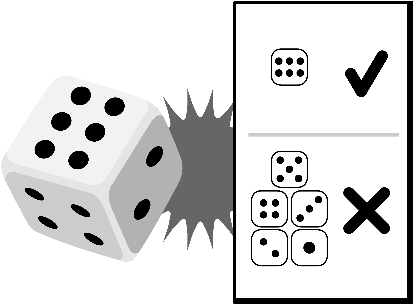
There is a target number required to succeed at some tests. A random number is generated (by card draw, die roll, etc.), which is compared to the target. If it meets or exceeds the target, the action succeeds.
Discussion
This mechanism goes by a variety of names, including Task Check, Skill Check, and others. It is commonly used in role-playing games, such as Dungeons & Dragons, where a player makes a roll against a stat or target number. Typically, if it is lower than the target, the action succeeds. Stat Check is frequently used in battle games, like Axis & Allies, where each type of unit has a target number that it is trying to meet or exceed to score a hit. Warhammer uses a similar system with six-sided dice and rates units as, for example, 2+, 3+, or 4+, if it needs to roll a 2 or higher, 3 or higher, or 4 or higher. The group of minis (or single mini) is then rated for how many dice it gets to roll. One attack may be rolling 8 dice for a 4+ and another might be 5 dice for a 3+. Target numbers may be modified based on characteristics of the defender, such as terrain or special armor, but the rolls are typically not opposed by the defender, as in the High Number Mechanism. The defender may get to respond but as a separate check. For example, in Warhammer, defending figures may be able to cancel hits by making a Saving Roll of 3+. Performing a series of Stat Checks not only lengthens the game
but also increases tension and can simplify the rules as modifiers and other effects are localized. Some games keep the target number the same but differentiate units by the type of dice rolled. For example, in the 1986 Fortress America, the target number is always a “5” or greater. But some units roll a six-sided die, some an eight-sided die, and others a ten-sided die. This makes it easier for the player to perform combat, as there is only one target number to remember. In the 2012 reprint, this was simplified further by simply having “hit” or “miss” symbols on the relevant dice, so only two sides of the six-sided die have the Hit symbol, but four sides of the eight-sided die do. While this system was a visual improvement, it was more opaque as to the strengths of the dice. Players would have to examine all sides of the dice and memorize their odds, which was fiddlier than with the target number system. Some games combine a Stat Check with a High Score system. One example is the miniatures game Infinity. The Infinity mechanism has each player trying to roll below their stat using a 20-sided die but higher than their opponent. For example, let’s say two units are shooting at each other and one has a skill of 17 and the other a skill of 12. First, a player is only eligible to hit if they roll less than or equal to their target. If only one player succeeds on the Stat Check, that player hits their opponent. If both miss, then there is no effect. If both hit, then the player with the higher roll (but still below the target) succeeds and the other fails. Combining systems like this gives a compact and fluid method for a variety of results. Stat Checks can incorporate modifiers. The same considerations that are discussed in High Number apply here.
Sample Games
Axis & Allies (Harris, Jr., 1981) Dungeons & Dragons (Arneson and Gygax, 1977) Europe Engulfed (Evans and Young, 2003) Fortress America (Uncredited, 1986) Infinity (Rodriguez, 2005) Nexus Ops (Cantino and Kimball, 2005) Titan (McAllister and Trampier, 1980) Warhammer Age of Sigmar (Uncredited, 2015)
描述
某些测试需要一个目标数字才能成功。生成一个随机数(通过抽牌、掷骰等),将其与目标进行比较。如果达到或超过目标,则行动成功。
讨论
这种机制有多种名称,包括任务检定(Task Check)、技能检定(Skill Check)等。它常用于角色扮演游戏,如《龙与地下城》,玩家根据属性或目标数字进行掷骰。通常,如果低于目标,则行动成功。属性检定(Stat Check)经常用于战斗游戏,如《轴心国与同盟国》,其中每种类型的单位都有一个目标数字,它试图达到或超过该数字以获得命中。《战锤》使用类似的六面骰子系统,并将单位评级为,例如,2+、3+或4+,如果它需要掷出2或更高、3或更高或4或更高。然后,这组微缩模型(或单个微缩模型)根据它可以掷多少个骰子进行评级。一次攻击可能是掷8个骰子寻求4+,另一次可能是5个骰子寻求3+。目标数字可以根据防御者的特征进行修改,例如地形或特殊装甲,但掷骰通常不受防御者的反对,如在高数值机制中。防御者可能会做出回应,但作为单独的检定。例如,在《战锤》中,防御模型可能能够通过进行3+的豁免检定来取消命中。执行一系列属性检定不仅延长了游戏时间
但也增加了紧张感,并且可以简化规则,因为修正值和其他效果是本地化的。有些游戏保持目标数字不变,但通过掷出的骰子类型来区分单位。例如,在1986年的《Fortress America》中,目标数字总是“5”或更大。但有些单位掷六面骰子,有些掷八面骰子,还有一些掷十面骰子。这使得玩家更容易进行战斗,因为只有一个目标数字需要记住。在2012年的重印版中,这一点通过在相关骰子上简单地设置“命中”或“失误”符号得到进一步简化,因此六面骰子只有两面有命中符号,但八面骰子有四面。虽然这个系统在视觉上有所改进,但对于骰子的强度来说更加不透明。玩家必须检查骰子的所有面并记住几率,这比目标数字系统更麻烦。有些游戏将属性检定与高分系统相结合。一个例子是微缩模型游戏《Infinity》。《Infinity》机制让每个玩家试图用20面骰子掷出低于其属性但高于对手的点数。例如,假设两个单位互相射击,一个技能为17,另一个技能为12。首先,玩家只有在掷出小于或等于其目标时才有资格命中。如果只有一个玩家在属性检定上成功,那个玩家就会击中对手。如果两者都失误,则没有效果。如果两者都命中,则掷出较高点数(但仍低于目标)的玩家成功,另一个失败。结合这样的系统为各种结果提供了一种紧凑流畅的方法。属性检定可以包含修正值。在高数值中讨论的相同考虑因素在这里也适用。
游戏范例
Axis & Allies (Harris, Jr., 1981) - 《轴心国与同盟国》 Dungeons & Dragons (Arneson and Gygax, 1977) - 《龙与地下城》 Europe Engulfed (Evans and Young, 2003) - 《Europe Engulfed》 Fortress America (Uncredited, 1986) - 《Fortress America》 Infinity (Rodriguez, 2005) - 《Infinity》 Nexus Ops (Cantino and Kimball, 2005) - 《Nexus Ops》 Titan (McAllister and Trampier, 1980) - 《泰坦》 Warhammer Age of Sigmar (Uncredited, 2015) - 《战锤:西格玛时代》