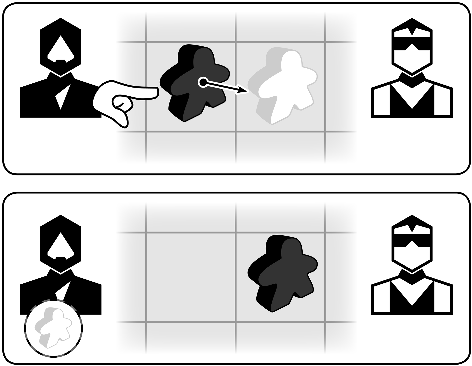
Description
Pieces are captured when another piece occupies or passes over their space.
Discussion
This is one of the oldest conflict resolution mechanisms, going back thousands of years. Typically combined with a movement system, a token is affected in some way when another enters its space. For example, it may be captured (Chess, Checkers), be sent back to start (Parcheesi, Trouble, Sorry!, Backgammon), or switch sides (Shogi). In order to make capturing challenging and meaningful, the movement of pieces needs to be restricted in some fashion. Chess and Shogi allow pieces to move to defined squares, while the Parcheesi family of games uses a randomizer and the moved piece must, typically, move the full amount. More information about Movement schemes is in Chapter 10, but a few features are worth noting here. In most cases, the moving piece will make the capture on its final space of movement. This is particularly true of games where movement is controlled by a randomizer, with pieces typically needing to land on an opposing piece by exact count to make a capture. There are exceptions,
of course. Sorry! has specific areas where a piece may slide through multiple spaces, sending all pieces encountered back to start, and in Checkers pieces make jumps to capture and can string together multiple jumps as a single move. Motion is not a requirement for this mechanism. Trough the Desert allows players to claim Palm Trees for points by extending a chain of camels across the board. Camels do not move once placed, but players may only add to chains in certain ways. Expedition has a similar chain mechanism, as players attempt to “capture” certain cities on the board to earn points. Tash-Kalar: Arena of Legends has players placing pieces on the board, trying to achieve certain patterns. When those patterns are realized, enemy pieces may be captured. While not truly Static Capture, there are games that feature pushing as a means to capture, including Abalone. In these games, there are typically restrictions on which pieces can move and be captured. In these games, pieces or groups of pieces may push other pieces, typically with the intention of pushing them off the board or into a dead space. Because of the physical nature of pushing, particularly chain pushing, the physical design of the board and pieces usually facilitates the mechanism. Abalone has a grooved board that makes it easy to push marbles in the six hexagonal directions.
Sample Games
Abalone (Lalet and Levi, 1987) Backgammon (Unknown, 3000 bce) Checkers (Unknown) Chess (Unknown, ∼1200) Expedition (Kramer, 1996) Onitama (Sato, 2014) Parcheesi (Unknown, 400) Shogi (Unknown) Sorry! (Haskell, Jr. and Storey, 1929) Tash-Kalar: Arena of Legends (Chvátil, 2013) Trouble (Kohner, Kohner, and Kroll, 1965) Trough The Desert (Knizia, 1998)
描述
当另一个棋子占据或穿过棋子的空间时,棋子被捕获。
讨论
这是最古老的冲突解决机制之一,可以追溯到几千年前。通常与移动系统结合,当另一个代币进入其空间时,代币会受到某种影响。例如,它可能会被捕获(国际象棋、国际跳棋),被送回起点(Parcheesi, Trouble, Sorry!, 双陆棋),或者转换阵营(将棋)。为了使捕获具有挑战性和意义,需要以某种方式限制棋子的移动。国际象棋和将棋允许棋子移动到定义的方格,而Parcheesi系列游戏使用随机发生器,被移动的棋子通常必须移动全额。有关移动方案的更多信息在第10章中,但这里值得注意几个特征。在大多数情况下,移动的棋子将在其最终移动空间进行捕获。对于移动由随机发生器控制的游戏尤其如此,棋子通常需要通过精确计数据落在对手棋子上才能进行捕获。当然也有例外。
《Sorry!》有特定区域,棋子可以在其中滑过多个空间,将遇到的所有棋子送回起点,而在国际跳棋中,棋子通过跳跃进行捕获,并且可以将多个跳跃串联成单次移动。运动不是该机制的要求。《穿越荒漠》(Through the Desert)允许玩家通过在版图上延伸骆驼链来索取棕榈树以获得分数。骆驼一旦放置就不会移动,但玩家只能以特定方式添加到链中。《Expedition》有类似的链机制,因为玩家试图“捕获”版图上的某些城市以赚取分数。《Tash-Kalar: Arena of Legends》让玩家在版图上放置棋子,试图实现特定的图案。当这些图案实现时,敌方棋子可能会被捕获。虽然不是真正的静态捕获(Static Capture),但有些游戏以推作为捕获手段,包括《大王鲍》(Abalone)。在这些游戏中,通常对哪些棋子可以移动和被捕获有限制。在这些游戏中,棋子或棋子组可能会推动其他棋子,通常意图将它们推出版图或推入死角。由于推的物理性质,特别是连锁推,版图和棋子的物理设计通常有助于该机制。《大王鲍》有一个凹槽版图,使得在六个六边形方向上推动弹珠变得容易。
游戏范例
Abalone (Lalet and Levi, 1987) - 《大王鲍》 Backgammon (Unknown, 3000 bce) - 《双陆棋》 Checkers (Unknown) - 《国际跳棋》 Chess (Unknown, ∼1200) - 《国际象棋》 Expedition (Kramer, 1996) - 《Expedition》 Onitama (Sato, 2014) - 《Onitama》 Parcheesi (Unknown, 400) - 《印度十字戏》 Shogi (Unknown) - 《将棋》 Sorry! (Haskell, Jr. and Storey, 1929) - 《Sorry!》 Tash-Kalar: Arena of Legends (Chvátil, 2013) - 《Tash-Kalar: Arena of Legends》 Trouble (Kohner, Kohner, and Kroll, 1965) - 《Trouble》 Trough The Desert (Knizia, 1998) - 《穿越荒漠》