Description
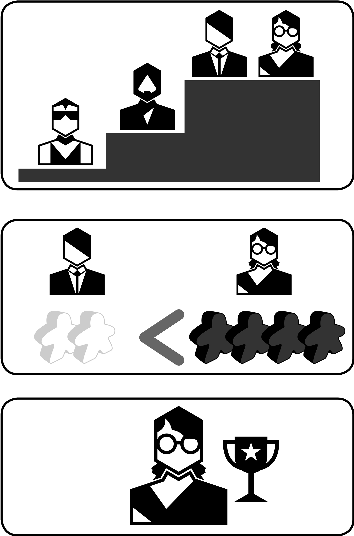
If a resolution results in a tie, players look to an alternate means to break it.
Discussion
While we include this in Resolution, this is a meta-mechanic that can apply to Victory, Auctions, and many other mechanisms. While there are a wide variety of tie-breaking mechanisms, they typically fall into one of these categories: • Resource: The player with the most or least of a particular resource will break the tie. For example, in Trade on the Tigris, if the score is tied at the end of the game, the game is won by the player with the fewest Barbarian tokens. If these are also tied, the win goes to the player with the most Culture tokens. In a two-player game, this resource may take the form of a Priority token, with the player holding the Priority token
breaking the tie, and then passing the token to their opponent. This is similar to the Possession arrow in basketball. • Positional: The player in a specific position in the turn order, or on a track, will break the tie. A common tiebreaker is for the player who is closest to the First Player will break the tie. As another example, in Rising Sun, the player who is higher on the Honor track wins the tie. In conflict games that use dice to resolve, ties will go to the defender. Risk works this way, for example. If the defender rolls a 6, they will win regardless of what the attacker rolls. Most often ties go to the defender, but in some games that want to encourage aggression, ties may go to the attacker. • Random: Players roll off or use some other randomization means to break the tie. This can be exciting but time-consuming. For certain tiebreakers, most notably if players are tied at the end of the game, breaking the tie randomly will be unsatisfying for players. • Secondary Values: Components have a unique secondary value that is used to break ties. For example, in Libertalia, the role cards have a number on them that says when in sequence they should be played. For example, the Monkey card is #2 and is executed before the Cabin Boy which is #5. If two players both play a Monkey, they both have #2 on them. However, to resolve the tie, there is a smaller Flag number on each card, which is unique between all players. For example, one player has a 3 Flag on their Monkey card, while another has a 5, so the 3 would go first. The flag numbers are distributed so that on average each player will win the same number of ties. This gives a quick and simple way to break ties. The procedures described above, as in Libertalia and Rising Sun, determine which player wins the tie. However, some games award a tie-breaking ability to a specific player, who then decides which player is chosen. For example, in A Game of Trones, the player that wins the auction for the Trone gains the ability to decide who wins all ties. This immediately brings Negotiation elements into the game (ECO-18), as players can lobby the player who resolves ties. It is also possible to not have a tiebreaker. For in-game resolutions, ties may be resolved as friendly or unfriendly. A friendly resolution means that all tied players gain the benefit of the action. If the leader in a particular category scores ten points, for example, if players are tied, they all score the ten
points. In unfriendly ties, tied players receive a reduced award or no award at all. Either way, all players are treated equally. For the final victory, some games do not offer tiebreakers and have the players share in the victory. This may or may not be acceptable to players depending on the likelihood of ties and the length and seriousness of the game. If possible, tiebreakers for final victory should reward the players who have had a harder route to win, for example, by going last in the turn order, by acquiring a harder-to-obtain resource, or by using fewer resources overall.
Sample Games
A Game of Trones (Petersen and Wilson, 2003) Libertalia (Mori, 2012) Rising Sun (Lang, 2018) Risk (Lamorisse and Levin, 1959) Trade on the Tigris (Engelstein and Sturm, 2018)
描述
如果解决结果是平局,玩家会寻找另一种打破平局的方法。
讨论
虽然我们将此包括在解决机制中,但这是一种元机制,可以应用于胜利、拍卖和许多其他机制。虽然有各种各样的打破平局的机制,但它们通常分为以下几类:
• 资源:拥有最多或最少特定资源的玩家将打破平局。例如,在《Trade on the Tigris》中,如果游戏结束时分数持平,则拥有最少野蛮人代币的玩家获胜。如果这些也持平,则胜利归于拥有最多文化代币的玩家。在双人游戏中,此资源可能采取优先级代币的形式,持有优先级代币的玩家
打破平局,然后将代币传给对手。这类似于篮球中的拥有权箭头。
• 位置:回合顺序中特定位置的玩家或轨道上的玩家将打破平局。一种常见的决胜局是距离首位玩家最近的玩家打破平局。作为另一个例子,在《Rising Sun》中,荣誉轨道上较高的玩家赢得平局。在使用骰子解决的冲突游戏中,平局归于防御者。例如,《Risk》就是这样运作的。如果防御者掷出6,无论攻击者掷出什么,他们都会赢。通常平局归于防御者,但在一些想要鼓励侵略的游戏中,平局可能会归于攻击者。
• 随机:玩家掷骰子或使用其他随机手段来打破平局。这可能很令人兴奋,但也通过耗时。对于某些决胜局,最明显的是如果在游戏结束时玩家平局,随机打破平局会让玩家感到不满意。
• 次要值:组件具有用于打破平局的唯一次要值。例如,在《Libertalia》中,角色卡上有一个数字,说明它们应该按什么顺序打出。例如,猴子卡是#2,在大副(#5)之前执行。如果两名玩家都打出猴子,他们都有#2。然而,为了解决平局,每张卡上都有一个较小的旗帜数字,这在所有玩家之间是唯一的。例如,一名玩家的猴子卡上有3号旗帜,而另一名玩家有5号,所以3号先走。旗帜数字的分布使得平均而言每个玩家将赢得相同数量的平局。这提供了一种快速简单的打破平局的方法。
上述程序,如在《Libertalia》和《Rising Sun》中,确定哪个玩家赢得平局。然而,一些游戏将打破平局的能力授予特定玩家,然后由该玩家决定选择哪个玩家。例如,在《权力的游戏》(A Game of Thrones)中,赢得铁王座拍卖的玩家获得决定谁赢得所有平局的能力。这立即将谈判元素带入游戏(ECO-18),因为玩家可以游说解决平局的玩家。也有可能没有决胜局。对于游戏中的解决,平局可以作为友好或不友好的解决。友好解决意味着所有平局玩家都获得行动的利益。例如,如果特定类别的领先者得分十分,如果玩家平局,他们都得分十
分。在不友好的平局中,平局玩家获得减少的奖励或根本没有奖励。无论哪种方式,所有玩家都受到平等对待。对于最终胜利,有些游戏不提供决胜局,并让玩家分享胜利。这取决于平局的可能性以及游戏的长度和严肃性,玩家可能接受也可能不接受。如果可能的话,最终胜利的决胜局应该奖励那些获胜路线更艰难的玩家,例如,通过在回合顺序中最后行动,通过获得更难获得的资源,或通过使用更少的资源。
游戏范例
A Game of Trones (Petersen and Wilson, 2003) - 《权力的游戏》 Libertalia (Mori, 2012) - 《Libertalia》 Rising Sun (Lang, 2018) - 《旭日战魂》 Risk (Lamorisse and Levin, 1959) - 《Risk/风险》 Trade on the Tigris (Engelstein and Sturm, 2018) - 《Trade on the Tigris》