Description
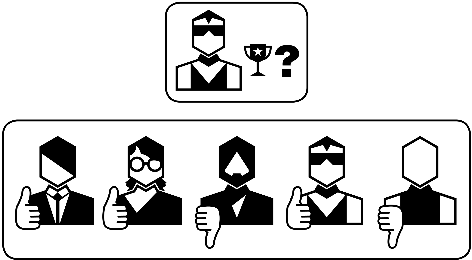
Players vote on whether a proposed action will occur or not.
Discussion
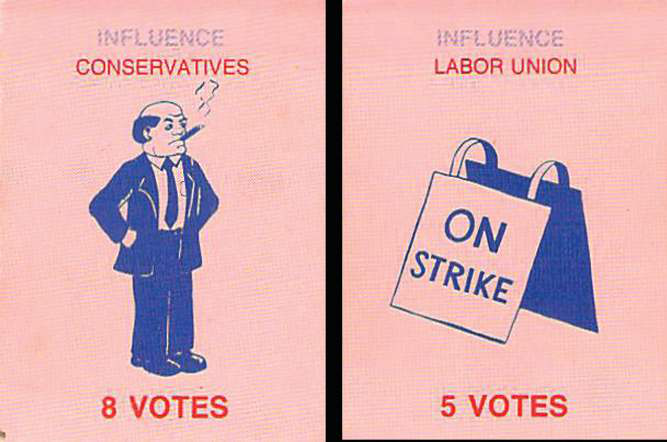
The Voting mechanism is often used in games with a political theme, although some, like Die Regeln Wir Shon, are more abstract. In some games, each player gets one vote. In others, players may have multiple votes that they can apply. Voting is in many ways an Area Majority mechanism (ARC-02), except that players are either on the “Yay” or on the “Nay” sides, rather than only able to win something individually. This can lead to shifting coalitions of players on either side of an issue, as interests align and diverge, underscoring the political nature of this resolution means. The item being voted on can fit at various levels in the game. In Junta, players are voting to decide whether the budget proposed by El Presidente passes and the money is distributed to the players. This is an example of a sub-system of the game that links to other key mechanisms. The Republic of Rome is similar in that players are voting on which characters should gain offices, how wars are conducted, and even the execution of characters. These decisions then feed into other systems to propel the game forward (Illustration 4.6). Some games have players vote on actual changes to the rules themselves. Democrazy and Das Regeln Wir Shon are prime examples of this, as
players play cards that contain possible game rules, and players vote on them. Proposing rules that help several players, including yourself, but yourself a little bit more, is a key skill in the game and can lead to intriguing and exciting game play. These rules changes range from what actions are available to players, how resources can be exchanged, how the game ends, and what contributes toward victory. Galactic Destiny, which includes a Galactic Senate mechanism, also has players vote on new rules to be added, but these are not the core of the game. Tey impact what actions players may perform, and what is legal or illegal. As mentioned earlier, some voting games, like Das Regeln Wir Shon, give one vote to each player, and a simple majority wins. However, there are other variations. In Junta and Republic of Rome, the players represent factions, and so they may have control of various characters or blocks of voters that give them more than one vote. If players are powerful enough, they may even be able to pass anything they want. Some games vary from simple majority in votes. In Article 27: The UN Security Council Game, a unanimous vote is required for a measure to pass. Bribery and other inducements are encouraged to get players to vote your way. Illustration 4.6 Two voting cards from Junta. Unlike many voting games, players do not get an equal number of votes.
While voting systems can be dynamic and interesting, they also encourage negotiation, which can make this mechanism very time-consuming. This should be carefully considered by the designer when determining if it is appropriate for the player experience desired.
Sample Games
Article 27: The UN Security Council Game (Baden, 2012) Battlestar Galactica: The Board Game (Konieczka, 2008) Das Regeln Wir Schon (Schmiel, 1994) Democrazy (Faidutti, 2000) Galactic Destiny (Mauro, O’Maoileoin, Pulis, and Pulis, 2007) Hoax (Eberle, Horn Jr., Kittredge, and Olatka, 1981) Junta (Goldberg, Grossman, Marsh, Marsh, Tsao, and Vrtis, 1978) The Republic of Rome (Berthold, Greenwood, and Haines, 1990) The Resistance (Eskrisdge, 2009) Werewolf (Davidoff and Plotkin, 1986)
描述
玩家对提议的行动是否发生进行投票(Voting)。
讨论
投票机制通常用于具有政治主题的游戏,尽管有些游戏,如《Die Regeln Wir Shon》,更加抽象。在一些游戏中,每个玩家获得一票。在其他游戏中,玩家可能拥有多张可以使用的选票。投票在许多方面是一种区域多数机制(ARC-02),不同之处在于玩家要么站在“赞成”一边,要么站在“反对”一边,而不是只能单独赢得某些东西。随着利益的一致和分歧,这可能会导致任一方面的玩家联盟发生变化,强调了这种解决手段的政治性质。被投票的项目可以适应游戏的各个层面。在《Junta》中,玩家投票决定总统提出的预算是否通过,以及资金是否分配给玩家。这是链接到其他关键机制的游戏子系统的一个例子。《The Republic of Rome》类似,玩家投票决定哪些角色应该获得职位,如何进行战争,甚至处决角色。这些决定随后进入其他系统以推动游戏向前发展(插图4.6)。有些游戏让玩家对规则本身的实际更改进行投票。《Democrazy》和《Das Regeln Wir Shon》就是很好的例子,因为
玩家打出包含可能游戏规则的卡牌,然后玩家对它们进行投票。提出帮助几个玩家(包括你自己),但对你自己更有利一点的规则,是游戏中的一项关键技能,可以导致有趣和激动人心的游戏玩法。这些规则更改范围包括玩家可以使用哪些行动,如何交换资源,游戏如何结束,以及什么有助于胜利。《Galactic Destiny》包括一个银河参议院机制,也让玩家投票决定添加新规则,但这些不是游戏的核心。它们影响玩家可以执行哪些行动,以及什么是合法或非法的。如前所述,一些投票游戏,如《Das Regeln Wir Shon》,给每个玩家一票,简单多数获胜。然而,还有其他变体。在《Junta》和《The Republic of Rome》中,玩家代表派系,因此他们可能控制各种角色或选民集团,这使他们拥有一张以上的选票。如果玩家足够强大,他们甚至可以通过他们想要的任何东西。有些游戏在选票上不同于简单多数。在《Article 27: The UN Security Council Game》中,一项措施需要全票通过才能通过。鼓励贿赂和其他诱惑来让玩家按你的方式投票。
插图4.6 来自《Junta》的两张投票卡。与许多投票游戏不同,玩家获得的选票数不相等。
虽然投票系统可能是动态和有趣的,但它们也鼓励谈判,这可能使这种机制非常耗时。设计师在确定它是否适合所需的玩家体验时应仔细考虑这一点。
游戏范例
Article 27: The UN Security Council Game (Baden, 2012) - 《第27条:联合国安理会》 Battlestar Galactica: The Board Game (Konieczka, 2008) - 《太空堡垒卡拉狄加》 Das Regeln Wir Schon (Schmiel, 1994) - 《Das Regeln Wir Schon》 Democrazy (Faidutti, 2000) - 《Democrazy》 Galactic Destiny (Mauro, O’Maoileoin, Pulis, and Pulis, 2007) - 《Galactic Destiny》 Hoax (Eberle, Horn Jr., Kittredge, and Olatka, 1981) - 《Hoax》 Junta (Goldberg, Grossman, Marsh, Marsh, Tsao, and Vrtis, 1978) - 《Junta/军政府/总统万岁》 The Republic of Rome (Berthold, Greenwood, and Haines, 1990) - 《罗马共和国》 The Resistance (Eskrisdge, 2009) - 《抵抗组织》 Werewolf (Davidoff and Plotkin, 1986) - 《狼人杀》