Description
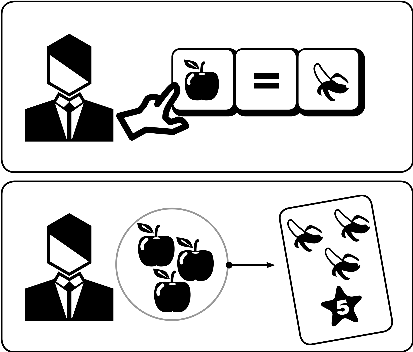
A collection of Abilities that are acquired separately and synergize together.
Discussion
Earlier, in Set Valuation (SET-01), we discussed using sets as resources or as direct point-scoring elements. Here, we focus on sets as game verbs and adverbs, as elements that provide actions (verbs) or buffs (adverbs) to actions. Combos are an emergent aspect of gameplay, in that they aren’t explicitly explained in the rules, even though effective play usually requires finding strong Combos. For designers who wish to cultivate this kind of play in their games, there are some best practices to follow. Games with Combo potential usually have a modular, black-box approach to actions, which tend to be direct and non-contingent. It also helps to have a few types of resources and a variety of domains within which game elements can exist. Finally, more open turn structures, with more options for how to play, help create a Combo dynamic. Card games like Seasons illustrate this well. Cards can exist in a deck, a hand, or in play. Actions that move cards from the deck to the hand create a chain that allows another play. Resources that can be converted into effects, or more resources, create the possibility of virtuous spirals. And the existence of dice opens up a whole dimension of possibilities for altering die faces and rerolling dice.
Combos exist in many games, perhaps most famously in Magic: The Gathering. However, when played in constructed formats, where players build their own decks before play, the set-collection aspect of the game exists largely in the purchasing of cards. In draft formats, however, players who can identify and select synergistic cards are in essence defining and collecting sets. What makes this type of set collection different from the set collection of a game like Coloretto is that the sets in Magic: The Gathering are not predefined or fixed. While the designers have certainly intended many of the powerful effects of certain card combinations, by not explicitly declaring these combinations as sets, they preserve the joy of discovery for players. In Kemet, acquiring tiles that enhance your movement ability can synergize with a tile that forces your opponent to take casualties before a battle commences. Together, these two Abilities make for a potent combination that allows you to project force across the board. Kemet has many other synergies hiding among the power tiles that players can acquire. Many games have these kinds of Combos, and identifying and assembling a Combo and then running it is the core of the gameplay. Many so-called engine-building games are precisely this: getting together a few elements that create a virtuous cycle of increasing productivity. Some games have you building actual engines, like Steampunk Rally, while in others, the engine is more metaphoric, such as the combinations of Abilities and scoring that you can build in Race for the Galaxy. In Orléans, a specific set of workers is required to trigger taking an action. The 7th Continent has a crafting system that allows players to combine cards, and Evolution features a similar system to provide creatures with traits and even to create multiple species with complementary Abilities that model symbiotic biological relationships. Glory to Rome and its spiritual successor, Mottainai, can best be described as games that challenge players to assemble a set of cards that add up to a game-breaking Combo. We’ll end by reflecting that set collection is dynamic, a pattern common to many games that are instantiated by a number of mechanisms, including those that define acquisition, usage, and valuation. Like with Auctions (Chapter 8), at some point, we begin to observe set-collection elements within nearly every game. That observation, though interesting, may not be useful to the working designer. The set collection as a concept may be everywhere, but the set collection as a mechanism exists in fewer places.
Sample Games
The 7th Continent (Roudy and Sautter, 2017) Coloretto (Schacht, 2003) Glory to Rome (Chudyk, 2005) Kemet (Bariot and Montiage, 2012) Magic: The Gathering (Garfield, 1993) Mottainai (Chudyk, 2015) Orléans (Stockhausen, 2014) Race for the Galaxy (Lehmann, 2007) Seasons (Bonnessée, 2012) Steampunk Rally (Bishop, 2015)
描述
单独获得并协同发挥作用的一组能力(Combo Abilities)。
讨论
此前,在集换式计分(Set Valuation,SET-01)中,我们讨论了将集合用作为资源或直接计分元素。在这里,我们专注于将集合作为游戏动词和副词,即为动作提供动作(动词)或增益(副词)的元素。连击(Combo)是游戏玩法的一个新兴方面,因为即使有效游戏通常需要找到强大的连击,规则中也没有明确解释它们。对于希望在他们的游戏中培养这种玩法的设计师,有一些最佳实践需要遵循。具有连击潜力的游戏通常对行动采取模块化、黑盒子的方法,这些行动往往是直接的和非偶然的。拥有几种类型的资源和游戏元素可以存在的各种域也是有帮助的。最后,更开放的回合结构,以及更多的玩法选择,有助于创造连击动态。像《季节》(Seasons)这样的纸牌游戏很好地说明了这一点。卡牌可以存在于牌堆、手牌或游戏中。将卡牌从牌堆移动到手牌的动作创建了一个允许另一个游戏的链条。可以转化为效果或更多资源的资源创造了良性螺旋的可能性。骰子的存在开辟了改变骰子面和重掷骰子的可能性的全新维度。
连击存在于许多游戏中,也许最著名的就是《万智牌》(Magic: The Gathering)。然而,在构筑赛制中,玩家在比赛前建立自己的套牌,游戏的集合收集方面主要存在于购买卡牌中。然而,在轮抽赛制中,这也是许多其他卡牌游戏的情况,能够识别并选择协同卡牌的玩家本质上是在定义和收集集合。这种类型的集合收集与像《Coloretto》这样的游戏的集合收集不同之处在于,《万智牌》中的集合不是预定义或固定的。虽然设计师当然意图让某些卡牌组合产生强大的效果,但通过不明确宣布这些组合为集合,他们保留了玩家发现的乐趣。在《Kemet》中,获取增强移动能力的板块可以与强制对手在战斗开始前造成伤亡的板块协同作用。这两个能力共同构成了一个强大的组合,使能够在整个版图上投射力量。《Kemet》在玩家可以获取的能力板块中隐藏着许多其他协同作用。许多游戏都有这类的连击,识别和组装连击然后运行它是游戏玩法的核心。许多所谓的引擎构建游戏正是如此:将几个能创造生产力不断提高的良性循环的元素聚集在一起。有些游戏让你构建实际的引擎,比如《Steampunk Rally》,而在其他游戏中,引擎更具隐喻性,比如你可以在《银河竞逐》(Race for the Galaxy)中构建的能力和计分的组合。在《奥尔良》(Orléans)中,需要一组特定的工人才能触发采取行动。《第七大陆》(The 7th Continent)有一个制作系统,允许玩家组合卡牌,而《Evolution》具有类似的系统,为生物提供特征,甚至创建具有模拟共生生物关系的互补能力的多个物种。《Glory to Rome》及其精神继承者《Mottainai》可以最好地描述为挑战玩家组装一组加起来打破游戏的连击卡牌的游戏。最后我们要反思的是,集合收集是动态的,这是许通过定义获取、使用和计分等多种机制实例化的多游戏的共同模式。就像拍卖(第8章)一样,在某种程度上,我们开始在几乎每个游戏中观察到集合收集元素。这一观察虽然有趣,但对在职设计师可能没有用。作为概念的集合收集可能无处不在,但作为机制的集合收集存在于较少的地方。
游戏范例
The 7th Continent (Roudy and Sautter, 2017) - 《第七大陆》 Coloretto (Schacht, 2003) - 《变色龙/Coloretto》 Glory to Rome (Chudyk, 2005) - 《罗马荣光》 Kemet (Bariot and Montiage, 2012) - 《Kemet》 Magic: The Gathering (Garfield, 1993) - 《万智牌》 Mottainai (Chudyk, 2015) - 《Mottainai》 Orléans (Stockhausen, 2014) - 《奥尔良》 Race for the Galaxy (Lehmann, 2007) - 《银河竞逐》 Seasons (Bonnessée, 2012) - 《季节》 Steampunk Rally (Bishop, 2015) - 《蒸汽朋克拉力赛》