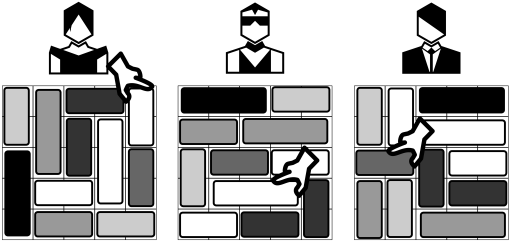
Description
A family of mechanisms in which players cover a grid or fill a space using a variety of shapes.
Discussion
There’s a rich mathematical background to how different shapes can fill a two-dimensional plane or a three-dimensional volume and, as a result, many games operate on this basic framework. Undoubtedly, some of these are not really set-collection games, but many are. In Patchwork, players are trying to acquire the set of tiles that will allow them to fully tessellate their 9 × 9 grids. Tiles have a calculable valuation: each tile covers some number of spaces, and each uncovered space is −2 Victory Points (VPs). Tiles may also feature buttons, which are worth 1 VP per payout space that will be activated. However, simply adding up these values doesn’t give the true value of the tile, because how well it fits on the board, and which other pieces it allows to still be placed is crucially important too. In this manner, the game is a set-collection game: the value of the tiles is greater than the sum of the parts. The Princes of Florence has a similar mechanism, with players acquiring differently shaped tiles to fit into their palazzos. Since pieces can’t be moved once placed, players are forced to plan ahead. It also changes the valuation of tiles for different players, as some shapes will be more valuable for certain players. In A Feast for Odin, various-shaped goods and treasures are added to grids to try to cover as many spaces as possible. The way the tiles are laid also determines income, VPs, and bonuses. All are mediated through a variety of grids. GridCoverage games sometimes take advantage of the underlying grid itself to create
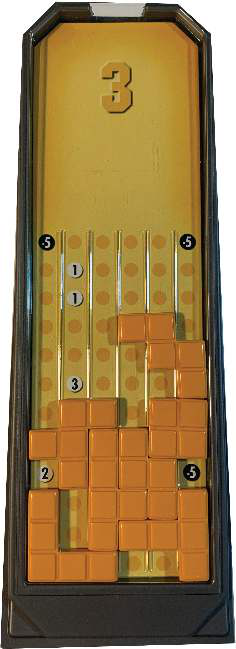
another dimension of value. In Bärenpark, players lay polyominoes on top of icons in a grid made of a series of square tiles. These icons allow players to draw tiles of different sizes, shapes, and point values for future play. In addition, players are incentivized to fully cover each square grid tile sooner rather than later, since the value of completing a grid tile declines after each player completes one. Admittedly, Grid-Coverage games don’t always involve set-collection in any recognizable way, like Blokus and Ubongo. Ubongo is strictly a speedpuzzle game, where players are trying to solve Grid-Coverage puzzles using standard tiles faster than their opponents. Blokus has a placement rule that restricts where pieces may be placed: pieces of the same color may only touch at corners. Similar placement restriction rules underlie many spatial games. There may be other lenses through which to consider these games, like AreaMajority/Influence (ARC-02) (Illustration 12.3). Illustration 12.3 Tetris-style pieces are added to the board in FITS, as players attempt to cover as many dots as possible while leaving the white bonus dots exposed.
Other examples of games about packing shapes into a defined space include Pack & Stack and You Need Drew’s Truck. In these games, players are trying to pack Tetris-style pieces into trucks as efficiently as possible. FITS, Brikks, and Rolltris are more obviously based on Tetris, as players attempt to organize pieces that “drop” from the top edge of the grid. While typically leaving spaces uncovered is bad, FITS has special bonus spaces that score more when left open, similar to bonuses in A Feast for Odin. NBMR9 extends Grid Coverage into three dimensions. Tiles are worth more as they are stacked on top of other tiles, but they may only be stacked if they are fully supported with no overhang.
Sample Games
Bärenpark (Walker-Harding, 2017) Blokus (Tavitian, 2000) Brikks (Warsch, 2018) Cottage Garden (Rosenberg, 2016) A Feast for Odin (Rosenberg, 2016) FITS (Knizia, 2009) NMBR9 (Wichman, 2017) Pack & Stack (Eisenstein, 2008) Patchwork (Rosenberg, 2014) The Princes of Florence (Kramer, Ulrich, and Ulrich, 2000) Ubongo (Rejchtman, 2003) You Need Drew’s Truck (Young, 2003)
描述
玩家使用各种形状覆盖网格或填充空间的机制家族(Grid Coverage)。
讨论
关于不同形状如何填充二维平面或三维体积有丰富的数学背景,因此,许多游戏都在这个基本框架上运行。毫无疑问,其中一些并不是真正的集合收集游戏,但许多是。在《拼布艺术》(Patchwork)中,玩家试图获取允许他们完全镶嵌9×9网格的板块组。板块具有可计算的估值:每个板块覆盖一定数量的空间,每个未覆盖的空间是-2胜利点数(VP)。板块还可能有纽扣,每个被激活的支付空间值1 VP。然而,简单地把这些值加起来并不能给出板块的真实价值,因为它在板上贴合得如何,以及它允许放置哪些其他碎片也是至关重要的。这种方式下,游戏是一个集合收集游戏:板块的价值大于部分之和。《佛罗伦萨王子》(The Princes of Florence)有类似的机制,玩家获得不同形状的板块以适应他们的宫殿。由于碎片一旦放置就不能移动,玩家被迫提前计划。这也改变了不同玩家对板块的估值,因为某些形状对某些玩家更有价值。在《奥丁的盛宴》(A Feast for Odin)中,各种形状的商品和宝藏被添加到网格中,试图尽可能多地覆盖空间。铺设板块的方式也决定了收入、VP和奖金。所有这些都是通过各种网格进行调节的。网格覆盖(Grid Coverage)游戏有时利用底层网格本身来创造
另一个价值维度。在《熊公园》(Bärenpark)中,玩家将多格骨牌放在由一系列方形板块组成的网格中的图标之上。这些图标允许玩家抽取不同大小、形状和点值的板块用于未来游戏。此外,玩家被激励尽早完全覆盖每个方形网格板块,因为在每个玩家完成一个之后,完成网格板块的价值会下降。诚然,网格覆盖游戏并不总是以任何可识别的方式涉及集合收集,比如《格格不入》(Blokus)和《乌邦果》(Ubongo)。《乌邦果》严格来说是一个速度谜题游戏,玩家试图比对手更快地使用标准板块解决网格覆盖谜题。《格格不入》有一个限制碎片放置位置的放置规则:相同颜色的碎片只能在角处接触。类似的放置限制规则是许多空间游戏的基础。可能有其他视角来考虑这些游戏,如区域多数/影响力(Area Majority/Influence,ARC-02)(插图12.3)。
插图12.3 俄罗斯方块风格的碎片被添加到《FITS》的版图上,因为玩家试图覆盖尽可能多的点,同时将白色奖励点暴露在外。
关于将形状打包到定义空间中的其他游戏示例包括《Pack & Stack》和《You Need Drew’s Truck》。在这些游戏中,玩家试图尽可能有效地将俄罗斯方块风格的碎片装入卡车。《FITS》、《Brikks》和《Rolltris》显然更基于俄罗斯方块,因为玩家试图组织从网格顶部边缘“落下”的碎片。虽然通常留下未覆盖的空间是不好的,但《FITS》有特殊的奖励空间,当保持开放时得分更多,类似于《奥丁的盛宴》中的奖励。《NMBR9》将网格覆盖扩展到三维。随着板块堆叠在其他板块之上,它们的价值更高,但只有当它们得到完全支撑且没有悬垂时才能堆叠。
游戏范例
Bärenpark (Walker-Harding, 2017) - 《熊公园》 Blokus (Tavitian, 2000) - 《格格不入/Blokus》 Brikks (Warsch, 2018) - 《Brikks》 Cottage Garden (Rosenberg, 2016) - 《花舍物语》 A Feast for Odin (Rosenberg, 2016) - 《奥丁的盛宴》 FITS (Knizia, 2009) - 《FITS》 NMBR9 (Wichman, 2017) - 《NMBR9》 Pack & Stack (Eisenstein, 2008) - 《Pack & Stack》 Patchwork (Rosenberg, 2014) - 《拼布艺术》 The Princes of Florence (Kramer, Ulrich, and Ulrich, 2000) - 《佛罗伦萨王子》 Ubongo (Rejchtman, 2003) - 《乌邦果》 You Need Drew’s Truck (Young, 2003) - 《You Need Drew’s Truck》