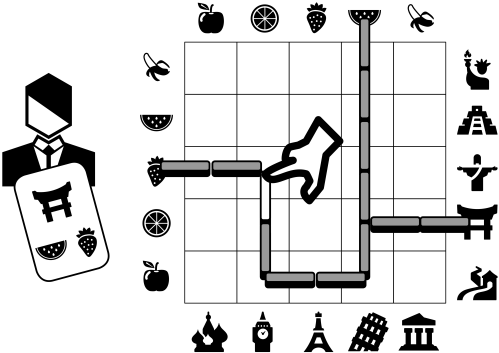
Description
Network Building is a specialized kind of set collection in which the sets collected represent ties between nodes, often represented as routes between destinations.
Discussion
Earlier in this chapter, we discussed Ticket to Ride as having a basic Rummylike set-collection mechanism that allows players to build routes in specific places based on the color and number of train cards they collected. But there’s another dimension, another kind of set that players collect in Ticket to Ride: the eponymous tickets themselves. A ticket can be satisfied by an enormous number of possible route combinations, or sets, that connect the two cities listed. The tickets represent a set of sets, or a super-set, a kind of telescoping set of set-collection mechanisms. Brass offers a similar concept in that not only are players seeking to connect certain cities but also they are seeking to ensure the availability of certain raw materials within the network created. Considering sets in this way illuminates the issue of set element exclusivity. While some games require each set element to be part of only one set (as in SET, the pattern recognition game), route-building games typically make
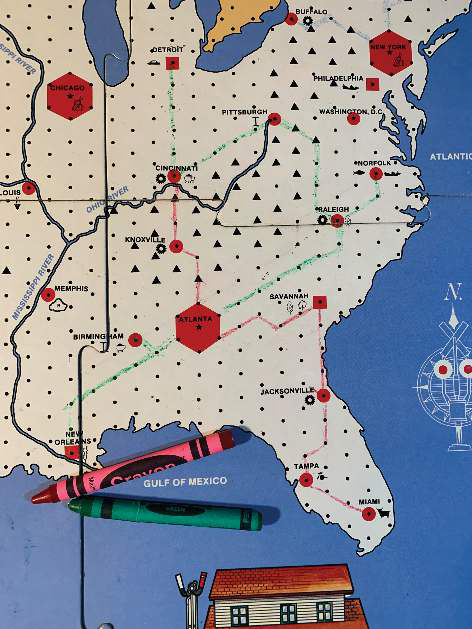
routes permanent and allow those routes to be reused as part of other sets or to be subsumed entirely into a larger set. The visual representation of the set as nodes and ties makes it really easy for players to understand why this mechanism works the way it does. Route-building games have many other elements to them beyond set collection. Blocking other players, dealing with different types of terrain, and upgrading the vehicles that run on these routes are just a few of these elements. We will look at a few of those next. Yet, underneath all of that is the core notion that by linking together a few nodes into a contiguous relationship, you create a whole that is more valuable than the sum of its parts (Illustration 12.4). There are several options available to the designer in terms of how the network is created. The three most commonly used are Point-to-Point, Tile Illustration 12.4 Routes are drawn on the board with a crayon in Empire Builder. Each segment costs a different amount depending on the terrain that is being connected.
Placement, and Existing Network. In a Point-to-Point system, the map is a regular grid of dots or connections, and players may connect any two adjacent dots. Examples of this are Empire Builder, where the connections are drawn with markers on a dry-erase surface, and Transamerica, where players place wooden sticks to connect dots, similar to roads in Catan. Point-to-Point connections can either be owned by a particular player (Empire Builder, Catan) or be neutral and usable by all (TransAmerica). In Tile Placement systems, players place (typically) square or hexagonal tiles onto a grid to form connections. Streetcar and Tsuro use square tiles, while Age of Steam and 1830 use hexagons. The requirement to form connections as tiles are placed can act as constraints on which tiles may be placed, as in Tile-Laying (SET-02), as edges need to match up. Tile Placement games allow for more complex tiles, including connections that go under or over each other, or branch off. It also allows for Upgrade systems (ECO-11), where tiles are replaced with more complex or valuable tiles. This is particularly used in rail games like 1830. The boards in Existing Network systems have the routes already printed on them. Players need to claim, construct, or activate them in some way. For example, in Ticket To Ride, all the possible rail lines are on the map but need to be claimed by players through the playing of sets of cars. In Rail Baron and Power Grid, players pay to control connections. Point-to-Point systems work well when there are a lot of possible connections players may want to make. The random cities that need to be connected in TransAmerica or the wide variety of pick-up-and-deliver locations in Empire Builder make them well suited to give players ultimate flexibility on how to build their network. However, if there are stereotypical connections that are always made, an Existing Network system may work better. In Power Grid’s original incarnation as Funkenshlag, players drew power lines on the board with markers. However, build patterns were pretty standard, so when the game was released again, the switch was made to an Existing Network system, which earned a much better reception by players. Network-Building mechanisms tend to dominate gameplay. Most games that use them do so as a centerpiece of the design. However, there are some games where the network construction is a sideshow in the main game. One example is the investigative game Android, where players may make connections between entities on a separate Conspiracy board which can give bonuses and impact victory points. Because of the tactile nature of building networks, a variety of other physical media have been used besides those mentioned. Some examples
include Twixt, which uses an ingenious peg-and-link system, String Railway, where players lay the string on the table to represent rail lines, and Paperclip Railways, which does something similar with paper clips, except that clips can be added to chains to represent additional rails being built.
Sample Games
Point-to-Point Catan (Teuber, 1995) Empire Builder (Bromley and Fawcett, 1982) Paperclip Railways (Boydell, 2011) String Railway (Hayashi, 2009) TransAmerica (Delonge, 2001) Twixt (Randolph, 1962) Tile Placement 1830 (Tresham, 1986) Age of Steam (Wallace, 2002) Android (Clark and Wilson, 2008) Streetcar (Dorra, 1995) Tsuro (McMurchie, 2004) Existing Network Brass (Wallace, 2007) Concordia (Gerdts, 2013) Hansa Teutonica (Steding, 2009) Power Grid (Friese, 2004) Rail Baron (Erickson and Erickson, 1977) Ticket to Ride (Moon, 2004)
描述
网络构建(Network Building)是一种特殊的集合收集,其中收集的集合代表节点之间的联系,通常表示为目的地之间的路线。
讨论
在本章前面,我们将《车票之旅》(Ticket to Ride)讨论为具有基本的类似拉米牌的集合收集机制,允许玩家根据收集的火车卡颜色和数量在特定位置建立路线。但在《车票之旅》中,玩家还收集了另一个维度的集合:同名车票本身。一张车票可以通过连接列出的两个城市的无数种可能的路线组合或集合来满足。车票代表一组集合,或一个超集,一种集合收集机制的嵌套集合。《Brass》提供了一个类似的概念,玩家不仅寻求连接某些城市,而且还寻求确保所创建的网络中某些原材料的可用性。以这种方式考虑集合阐明了集合元素排他性的问题。虽然有些游戏要求每个集合元素只能是一个集合的一部分(如在模式识别游戏《SET》中),但路线构建游戏通常使
路线永久化,并允许这些路线作为其他集合的一部分重复使用,或者完全归入更大的集合中。作为节点和联系的集合的视觉表示使得玩家很容易理解为什么这种机制以这种方式工作。除了集合收集之外,路线构建游戏还有许多其他元素。阻挡其他玩家、处理不同类型的地形以及升级在这些路线上运行的车辆只是这些元素中的一小部分。接下来我们将看其中的几个。然而,在这一切之下是核心概念,即通过将几个节点连接成连续的关系,你创造了一个比部分之和更有价值的整体(插图12.4)。在如何创建网络方面,设计师有几种选择。最常用的三种是点对点、板块放置和现有网络。
插图12.4 《Empire Builder》中用蜡笔在版图上绘制的路线。每个路段的成本取决于连接的地形不同。
在点对点系统中,地图是一个规则的点或连接网格,玩家可以连接任何两个相邻的点。此类的例子有《Empire Builder》,其中连接是用记号笔在干擦表面上绘制的,以及《Transamerica》,其中玩家放置木棍来连接点,类似于《卡坦岛》(Catan)中的道路。点对点连接可以由特定玩家拥有(《Empire Builder》、《卡坦岛》),也可以是中立且可供所有人使用(《TransAmerica》)。在板块放置系统中,玩家(通常)将方形或六角形板块放置在网格上以形成连接。《Streetcar》和《Tsuro》使用方形板块,而《Age of Steam》和《1830》使用六角形。在放置板块时形成连接的要求可以作为对可以放置哪些板块的限制,如在板块放置(SET-02)中,因为边缘需要匹配。板块放置游戏允许更复杂的板块,包括在彼此之下或之上通过或分支的连接。它还允许升级系统(ECO-11),其中板块被替换为更复杂或更有价值的板块。这特别用于像《1830》这样的铁路游戏。在现有网络系统的版图上已经印有路线。玩家需要以某种方式认领、建造或激活它们。例如,在《车票之旅》中,所有可能的铁路线都在地图上,但需要玩家通过打出一组车厢来认领。在《Rail Baron》和《电力公司》(Power Grid)中,玩家付费控制连接。当有很多玩家可能想要建立的连接时,点对点系统效果很好。《TransAmerica》中需要连接的随机城市或《Empire Builder》中各种各样的取货和送货地点使它们非常适合让玩家在如何构建网络方面拥有最大的灵活性。然而,如果总是建立刻板的连接,现有网络系统可能会更好。在《电力公司》作为《Funkenshlag》的最初化身中,玩家用记号笔在版图上画电线。然而,建造模式非常标准,所以当游戏再次发布时,切换到了现有网络系统,这受到了玩家的更好欢迎。网络构建机制倾向于主导游戏玩法。大多数使用它们的游戏都以此作为设计的核心。然而,有些游戏的网络建设只是主游戏的附带节目。一个例子是调查游戏《Android》,玩家可以在单独的阴谋板上的实体之间建立联系,这可以给予奖金并影响胜利点数。由于建立网络的触觉性质,除了提到的那些之外,还使用了各种其他物理媒介。一些例子
包括《Twixt》,它使用巧妙的钉子和链接系统,《String Railway》,玩家在桌子上铺设绳子来代表铁路线,以及《Paperclip Railways》,它用回形针做类似的事情,除了回形针可以添加到链条中以代表正在建造的额外铁轨。
游戏范例
Point-to-Point Catan (Teuber, 1995) - 《卡坦岛》 Empire Builder (Bromley and Fawcett, 1982) - 《Empire Builder》 Paperclip Railways (Boydell, 2011) - 《Paperclip Railways》 String Railway (Hayashi, 2009) - 《String Railway》 TransAmerica (Delonge, 2001) - 《TransAmerica》 Twixt (Randolph, 1962) - 《Twixt》 Tile Placement 1830 (Tresham, 1986) - 《1830》 Age of Steam (Wallace, 2002) - 《蒸汽时代》 Android (Clark and Wilson, 2008) - 《Android》 Streetcar (Dorra, 1995) - 《Streetcar》 Tsuro (McMurchie, 2004) - 《Tsuro》 Existing Network Brass (Wallace, 2007) - 《Brass》 Concordia (Gerdts, 2013) - 《和谐罗马》 Hansa Teutonica (Steding, 2009) - 《汉萨同盟》 Power Grid (Friese, 2004) - 《电力公司》 Rail Baron (Erickson and Erickson, 1977) - 《Rail Baron》 Ticket to Ride (Moon, 2004) - 《车票之旅》