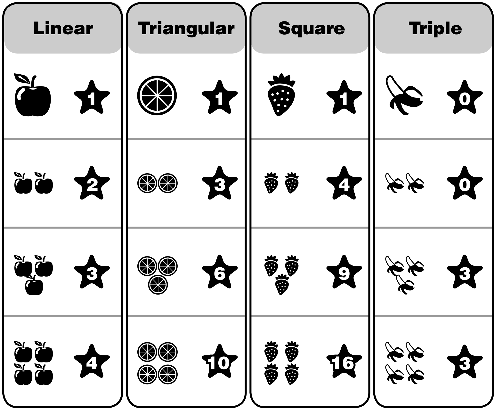
Description
Set Valuation is the logic or underlying mathematical model by which designers assign values to sets of game elements. Set Valuation can be in terms of currency, resources, or victory points.
Discussion
To paraphrase Jerry Seinfeld, it’s one thing to collect the set, but something else entirely to value the set. Many other chapters in this book, like “Economics” (Chapter 7), “Auctions” (Chapter 8), and “Card Mechanisms” (Chapter 13), discuss how resources are allocated and acquired, but in this section, we’ll discuss what those resources are actually worth. Implicit in this framing is that sets are nearly always converted into some benefit and consumed, turned in, or otherwise removed from play, even if only at game-end. Sets are not typically semi-persistent: either you complete them, and spend or score them right away, or they persist and are scored at game-end. However, some sets may be held in hand, and scored when a player chooses to do so for maximal effect. In the introduction to this chapter, we described sets as being worth more than the sum of their parts. A more precise way to say that is that sets do not
increase in value in a linear fashion. However, there are many shapes that the value curve can take, and each of these shapes will incentivize different behaviors. The simplest valuation is that set elements are worth nothing on their own, but the set, when completed, has a value. Ticket to Ride, and its traditional forebear, Rummy, value sets in this fashion. A card may fit into more than one set, but on its own, it has only potential value—and often, it may be a wasting asset too. In Ticket to Ride, routes will get claimed over time, and cards of matching colors therefore decline in their utility. In Rummy, cards left in your hand at game-end typically count against your score or contribute to your opponent’s score, depending on the specific variant. This scoring system creates something of a push-your-luck dynamic as to when to cash in a set for a reward and when to hold cards to attempt to increase the set size and payout. A less-punishing valuation provides that singleton cards have some basic value of their own. Cards may also have unequal values so that there are more valuable and less valuable cards. Sushi Go! has some cards that are worth points on their own but are worth more in a set, like the nigiri cards that have a point value that can be tripled when paired with a wasabi card. Another aspect of Set Valuation is termination. Some games define sets strictly as some number of elements, after which the set terminates. Catan defines sets in this fashion: you need one wood and one clay to build a road. No further cards fit into the set in any way, though another set of wood and clay can build another road segment. Other games offer escalating sets that terminate so they have a minimum and maximum valid size, with different payouts based on the size of the set. A similar mechanism is found In Ethnos, where bands—sets of the same creatures—are awarded points and allow markers to be placed on the board for area control (Chapter 11). Bands of six or more all score the same amount, no matter how large they get, but larger bands still gain their full on-board placement benefits. In 7 Wonders, there is no maximum set size or set score for science cards of the same type beyond the maximum number of science icons of the same type in the deck (Illustration 12.1). When sets have a maximum size and/or score, players are incentivized to diversify and collect multiple types of sets. When sets are not limited, players are wiser to specialize. However, these base dynamics can be influenced both by the specific valuation curve and the existence of orthogonal sets. 7 Wonders science scoring is a great example. In 7 Wonders, there are three types of science cards: tablets, compasses, and gears. Cards of the same type
score the number of matching cards raised to the power of two, which is a sharply accelerating scoring curve that incentivizes collecting only one kind of science. However, the orthogonal set—that is, one of each type of science—offers a counterbalance. A set of three compass cards is worth nine points (three to the power of two), but a set of one of each science type is worth a base of one point per card and a set bonus of seven, for a total of ten points—actually outscoring the geometrically increasing set of the same size. Only when the monotype set has four cards does it begin to outscore diversity sets, 16 points to 13. Players leaning into a science strategy should seek to specialize, but the most efficient scoring for three cards is a diversity set. These varying incentives create interesting decisions and behavior patterns at the table—even aside from all the other types of sets and scoring in 7 Wonders. When sets can increase in size and value, a designer can use a variety of progressions to score increasingly larger sets. We had discussed squaring, which is one common progression that accelerates sharply and is most useful either for smaller sets or for creating a shoot-the-moon or push-your-luck dynamic, where a single large set can overwhelm other scoring strategies. However, designers have overwhelmingly opted for a different sequence when trying to preserve the greater balance among options: triangular numbers. The triangular sequence, 1, 3, 6, 10, 15, 21, etc., has achieved nearly the status of a mantra or a koan among game designers. It is featured in an Illustration 12.1 Sample cards from Sushi Go! Each type of sushi is scored in a different way, as shown on the card. Egg Nigiri are worth 1 point each. Each set of two Tempura is 5 points, and the player with the most Maki Rolls scores 6.
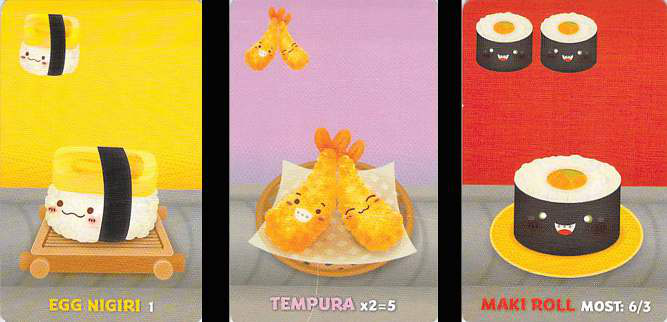
enormous number of games and proves incredibly versatile at providing escalating rewards for larger sets without overly incentivizing specialization to the exclusion of all other strategies. Triangular scoring also has a strongly intuitive property, which is that the second member of the set increases your marginal score by two points, the third increases that score by three, and so forth. If you’re playing a game with triangular scoring and you’re wondering how many additional points you’ll score by adding the nth card to your set, the answer is n. Not all scoring progressions slope up. Terminating sets are the most extreme example, but there are other possibilities too. In Cacao, players can move up a field-watering track. The track spaces are marked −10, −4, −1, 0, 2, 4, 7, 11, 16. Setting the track to start negative is mathematically uninteresting on its own. Instead, we will calculate the difference between values, which is to say, what is the actual point gain as you move from space to space. In this progression, the increase is 6, 3, 1, 2, 2, 3, 4, 5. As you can see, the first half is a declining sequence that scores well initially but yields sharply diminishing returns. The second half is a rising triangular sequence (you may notice that the 2, 4, 7, 11, 16 is our familiar 1, 3, 6, 10, 15, but with one added to each number). The marginal returns are highest at the beginning and the end of the curve, and the middle of the curve is least valuable. Players are incentivized to either water a little or a lot, but not a middling amount. This incentive is similar to the one in Animals on Board, in which players score a few points for singleton animals on their arks, and score maximum values for sets of three or more, but don’t score anything for sets of two, which must be surrendered to Noah, who evidently holds the patent on pairing animals up.
Sample Games
7 Wonders (Bauza, 2010) Animals on Board (Sentker and zur Linde, 2016) Cacao (Walker-Harding, 2015) Catan (Teuber, 1995) Ethnos (Mori, 2017) Rummy (Unknown, ∼1850) Sushi Go! (Walker-Harding, 2013) Ticket to Ride (Moon, 2004)
描述
集合估值(Set Valuation)是设计师为游戏元素集合分配价值的逻辑或底层数学模型。集合估值可以是货币、资源或胜利点数。
讨论
套用Jerry Seinfeld的话,收集集合是一回事,但估值集合完全是另一回事。本书中的许多其他章节,如“经济”(第7章)、“拍卖”(第8章)和“卡牌机制”(第13章),讨论了资源的分配和获取,但在本节中,我们将讨论这些资源实际上值多少。此框架中隐含的是,集合几乎总是转换为某种利益并被消耗、上交或以其他方式从游戏中移除,即使仅在游戏结束时也是如此。集合通常不是半持久的:要么你完成它们,并立即花费或计分,要么它们持续存在并在游戏结束时计分。然而,一些集合可能保留在手中,并在玩家选择这样做以获得最大效果时计分。在本章介绍中,我们将集合描述为价值大于部分之和。更准确的说法是,集合不
以线性方式增加价值。然而,价值曲线可以采取多种形状,每种形状都会激励不同的行为。最简单的估值是集合元素本身一文不值,但集合在完成后具有价值。《车票之旅》(Ticket to Ride)及其传统前身《拉米牌》(Rummy)以这种方式评估集合。一张卡片可能适合多个集合,但就其本身而言,它只有潜在价值——而且通常,它也可能是消耗资产。在《车票之旅》中,路线会随着时间的推移而被认领,因此匹配颜色的卡片的效用会下降。在《拉米牌》中,游戏结束时留在手中的卡牌通常会计入你的分数或贡献给对手的分数,这取决于具体变体。这种计分系统产生了一种何时兑现集合以获得奖励以及何时持有卡牌以试图增加集合规模和支出的运气博弈动态。一种不那么严厉的估值规定,单张卡牌本身具有一些基本价值。卡牌也可以具有不等的价值,因此有更有价值和更无价值的卡牌。《Sushi Go!》有些卡牌本身值分,但在集合中值更多分,就像握寿司卡牌,当与芥末卡配对时点值可以增加两倍。集合估值的另一个方面是终止。有些游戏严格定义集合为一定数量的元素,之后集合终止。 《卡坦岛》(Catan)以这种方式定义集合:你需要一块木头和一块粘土来建造一条道路。没有进一步的卡牌以任何方式适合该集合,尽管另一组木头和粘土可以建造另一段路段。其他游戏提供终止的逐步升级集合,因此它们具有最小和最大有效大小,并根据集合的大小支付不同的费用。《Ethnos》中也发现了类似的机制,其中部落(相同生物的集合)获得积分,并允许在版图上放置标记以进行区域控制(第11章)。六个或更多的部落无论变得多大,得分都相同,但更大的部落仍然获得其全部版图放置优势。在《七大奇迹》(7 Wonders)中,对于相同类型的科学卡,除了牌堆中相同类型的科学图标的最大数量之外,没有最大集合大小或集合得分(插图12.1)。当集合具有最大大小和/或得分时,玩家被激励多样化并收集多种类型的集合。当集合不受限制时,玩家更明智的做法是专业化。然而,这些基本动态可能会受到特定估值曲线和正交集合存在的影响。《七大奇迹》的科学计分就是一个很好的例子。在《七大奇迹》中,有三种类型的科学卡:石碑、罗盘和齿轮。相同类型的卡牌
得分为匹配卡牌数量的平方,这是一条急剧加速的计分曲线,激励只收集一种科学。然而,正交集合——即每种类型的科学各一个——提供了一种平衡。一组三张罗盘卡值9分(3的平方),但一组每种科学类型各一张的基本分值为每张卡1分,集合奖励为7分,总共10分——实际上超过了相同大小的几何增长集合。只有当单类型集合有四张卡时,它才开始超过多样性集合,16分对13分。倾向于科学策略的玩家应该寻求专业化,但对三张卡来说最有效的计分是多样性集合。这些不同的激励在桌面上创造了有趣的决定和行为模式——甚至撇开《七大奇迹》中的所有其他类型的集合和计分不谈。当集合的大小和价值可以增加时,设计师可以使用各种级数来为越来越大的集合计分。我们讨论过平方,这是一种急剧加速的常见级数,对于较小的集合或创建“猪羊变色”(shoot-the-moon)或运气博弈动态最有用,在这种动态中,单个大集合可以压倒其他计分策略。然而,设计师在试图保持选项之间更大的平衡时,绝大多数都选择了不同的序列:三角形数。三角形序列1, 3, 6, 10, 15, 21等,在游戏设计师中几乎达到了咒语或公案的地位。它出现在
插图12.1 《Sushi Go!》的样本卡片。每种类型的寿司计分方式不同,如卡上所示。鸡蛋握寿司每个值1分。每组两个天妇罗值5分,拥有最多加州卷的玩家得6分。
大量的游戏中,并且在为更大的集合提供不断升级的奖励方面证明极其多才多艺,而不会过度激励排斥所有其他策略的专业化。三角形计分还有一个非常直观的属性,即集合的第二个成员使你的边际得分增加2分,第三个增加3分,依此类推。如果你正在玩一个带有三角形计分的游戏,并且你想知道通过向你的集合添加第n张卡会多得多少分,答案是n。并非所有的计分级数都是向上倾斜的。终止集合是最极端的例子,但也有其他的可能性。在《Cacao》中,玩家可以在田地浇水轨道上移动。轨道空间标记为-10, -4, -1, 0, 2, 4, 7, 11, 16。设置轨道从负数开始在数学上本身并没有趣。相反,我们将计算值之间的差异,也就是说,当你在空间之间移动时实际的点数增益。在这个级数中,增加是6, 3, 1, 2, 2, 3, 4, 5。如你所见,前半部分是一个下降序列,最初得分很高,但收益急剧递减。后半部分是一个上升的三角形序列(你会注意到2, 4, 7, 11, 16是我们熟悉的1, 3, 6, 10, 15,但每个数字都加了1)。边际回报在曲线的开始和结束时最高,而曲线的中间价值最低。玩家被激励要么浇一点水,要么浇很多水,但不要浇中间量。这种激励类似于《Animals on Board》中的激励,其中玩家为方舟上的单个动物得几分,为三个或更多的集合得最高分,但为两个的集合不得分,必须交给诺亚,显然诺亚拥有配对动物的专利。
游戏范例
7 Wonders (Bauza, 2010) - 《七大奇迹》 Animals on Board (Sentker and zur Linde, 2016) - 《Animals on Board》 Cacao (Walker-Harding, 2015) - 《可可亚/Cacao》 Catan (Teuber, 1995) - 《卡坦岛》 Ethnos (Mori, 2017) - 《Ethnos》 Rummy (Unknown, ∼1850) - 《拉米牌》 Sushi Go! (Walker-Harding, 2013) - 《Sushi Go! / 回转寿司》 Ticket to Ride (Moon, 2004) - 《车票之旅》