Description
Set-collection mechanisms with spatial elements. There are other aspects to Tile-Laying games like Area-Majority scoring (ARC-02) that we won’t cover in this section.
Discussion
Tile-Laying is typically thought of as its own mechanism or family of mechanisms, and that perspective is reasonable. As we examine the patterns and relationships underlying Tile-Laying, set collection emerges as one of the foundational mechanisms of the genre, hence its inclusion in this chapter. Carcassonne’s city-completion scoring demonstrates the point: a completed city, which is a set of tiles arranged in a specific way, scores higher than the sum of the value of each tile. Tile-Laying introduces ideas of adjacency and spatial relationships to sets, either as new requirements for set validity or as buffs and nerfs to the valuation of sets. At its simplest, tile-matching of some kind defines whether a tile may be played at all. In Kingdomino, players must match at least one end of the domino played to one on the table in order to make a valid play. The actual value of the tiles is determined based on a secondary mechanism of accumulating
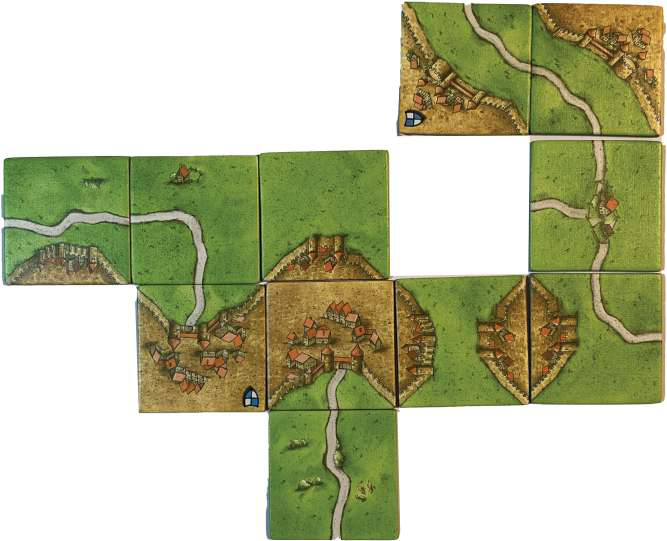
crown tiles. Latice requires that a tile matches all of its neighbors by sharing a color or an animal type. Tiles played to match multiple tiles at the same time earn a player extra turns, a scoring mechanism, since the first player to lay all their tiles wins. Each of these plays is a set-completing play (Illustration 12.2). Qwirkle requires players to place tiles such that they match either the color or shape (but not both) of the other tiles in their row or column. Players are, in essence, forming sets of either shapes or colors in a line. Völuspá has a variety of tiles, and each has its own placement and scoring mechanisms, often with set-collection features. For example, Fenris tiles are more powerful if in a line with other Fenris tiles, and no tiles may be placed adjacent to Troll tiles. Alhambra has a light touch on tile placement but incentivizes players through other means. Tile edges can either have walls or be open. Wall edges may only be placed next to walls, and open to open, otherwise players are free to place tiles as desired. However, a bonus is given to the player who has the Illustration 12.2 A sample tile layout in Carcassonne. When tiles are placed, the features on the edges must match.
longest continuous wall running around the outside edge of their tiles, which can force players going for this bonus to change their valuation of certain tiles. Otherwise, Alhambra uses a basic area-majority system. Isle of Skye: From Chieftain to King employs a large variety of possible sets that can be scored across the tiles that players collect. Some involve adjacencies, others look for region completion, while others are indifferent to spatial layouts. Some sets only score if they are the largest, a kind of Area-Majority concept (ARC-02) that is not uncommon to Tile-Laying games. The idea of sets scoring regardless of spatial relationships, what we might call a global presence mechanism, is very common. Suburbia features buildings whose powers trigger or pay off based on adjacent tiles in some cases and on tiles in a player’s city, or even in other players’ cities. Between Two Cities and Quadropolis offer similar set-scoring rules for tiles of various kinds, based on their spatial relationships to themselves or to other tile types. Another type of set, an enclosing set, can be seen in Rome: City of Marble. Sets of tiles score based on enclosing and completing a hexagon, and the specific combination of colors, the flavor of the set, determines how well it scores, with sets of a single-color scoring the best. The aforementioned Alhambra allows players to score for same-color tile sets, regardless of their adjacency.
Sample Games
Alhambra (Henn, 2003) Between Two Cities (O’Malley, Pedersen, and Rosset, 2015) Carcassonne (Wrede, 2000) Galaxy Trucker (Chvátil, 2007) Isle of Skye: From Chieftain to King (Pelikan and Pfister, 2015) Kingdomino (Cathala, 2016) Latice (Vincent, 2015) Quadropolis (Gandon, 2016) Qwirkle (Ross, 2006) Rome: City of Marble (Myers, 2015) Suburbia (Alspach, 2012) Völuspá (Caputo, 2012)
描述
具有空间元素的集合收集机制(Tile-Laying)。像区域多数计分(Area-Majority scoring,ARC-02)这样的板块放置游戏还有其他方面,我们不会在本节中介绍。
讨论
板块放置通常被认为是自己的机制或机制家族,这种观点是合理的。当我们检查板块放置背后的模式和关系时,集合收集成为该类型的基本机制之一,因此将其包含在本章中。《卡卡颂》(Carcassonne)的城市完成计分证明了这一点:一个完成的城市,即一组以特定方式排列的板块,得分高于每个板块价值的总和。板块放置将邻接和空间关系的概念引入集合,要么作为集合有效性的新要求,要么作为集合估值的增益和减益。最简单地说,某种形式的板块匹配定义了板块是否可以在该位置打出。在《多米诺王国》(Kingdomino)中,玩家必须将打出的多米诺骨牌的至少一端与桌上的一端相匹配,才能进行有效游戏。板块的实际价值取决于积累皇冠板块的次要机制。
《Latice》要求板块通过共享颜色或动物类型来匹配其所有邻居。打出同时匹配多个板块的板块可为玩家赢得额外回合,这是一种计分机制,因为最先放置所有板块的玩家获胜。这些打法中的每一次都是集合完成打法(插图12.2)。《Qwirkle》要求玩家放置板块,使它们与行或列中的其他板块匹配颜色或形状(但不能两者都匹配)。本质上,玩家正在形成形状或颜色的线条集合。《Völuspá》有各种各样的板块,每种板块都有自己的放置和计分机制,通常具有集合收集功能。例如,芬里尔(Fenris)板块如果与其他芬里尔板块排成一行会更强大,并且没有任何板块可以放置在巨魔(Troll)板块附近。《阿尔罕布拉宫》(Alhambra)对板块放置的要求较轻,但通过其他方式激励玩家。板块边缘可以有墙或开放。墙边只能放在墙旁边,开放对开放,否则玩家可以随意放置板块。然而,拥有围绕其板块外边缘的最长连续墙的玩家将获得奖金,
插图12.2 《卡卡颂》中的样本板块布局。放置板块时,边缘上的特征必须匹配。
但这可能会迫使追求此奖金的玩家改变某些板块的估值。否则,《阿尔罕布拉宫》使用基本的区域多数系统。《斯凯岛》(Isle of Skye: From Chieftain to King)采用了多种可能的集合,可以在玩家收集的板块上计分。有些涉及邻接,有些寻找区域完成,而有些则对空间布局漠不关心。有些集合只有在最大时才得分,这是板块放置游戏中并不罕见的一种区域多数概念(ARC-02)。无论空间关系如何,集合得分的这种想法,我们可以称之为全球存在机制,是非常普遍的。《Suburbia》的建筑物有些基于相邻板块触发能力或获得回报,有些是基于玩家城市中的板块,甚至其他玩家城市中的板块。《双城之间》(Between Two Cities)和《Quadropolis》为各种类型的板块提供类似的集合计分规则,基于它们与自身或其他板块类型的空间关系。另一种类型的集合,封闭集合,可见于《Rome: City of Marble》。板块集合基于包围和完成六边形得分,颜色的特定组合(集合的风味)决定了它的得分情况,单一颜色的集合得分最高。前面提到的《阿尔罕布拉宫》允许玩家为同色板块组得分,无论其是否相邻。
游戏范例
Alhambra (Henn, 2003) - 《阿尔罕布拉宫》 Between Two Cities (O’Malley, Pedersen, and Rosset, 2015) - 《双城之间》 Carcassonne (Wrede, 2000) - 《卡卡颂》 Galaxy Trucker (Chvátil, 2007) - 《银河卡车司机》 Isle of Skye: From Chieftain to King (Pelikan and Pfister, 2015) - 《斯凯岛》 Kingdomino (Cathala, 2016) - 《多米诺王国》 Latice (Vincent, 2015) - 《Latice》 Quadropolis (Gandon, 2016) - 《Quadropolis》 Qwirkle (Ross, 2006) - 《Qwirkle》 Rome: City of Marble (Myers, 2015) - 《Rome: City of Marble》 Suburbia (Alspach, 2012) - 《Suburbia》 Völuspá (Caputo, 2012) - 《Völuspá》