Description
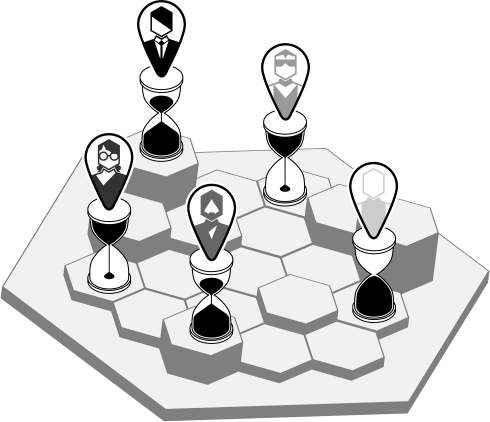
Players place owned timers on action spaces and pieces and take an action. When the timer runs out, it may be moved to another location to take that action. There are no turns; players may move their own timers any time after they have expired.
Discussion
This Action Timer mechanism is typically implemented with sand timers. Timers allow for a real-time feel (TRN-07), while mitigating their frantic nature. It allows the game to flow naturally, while giving players some structure and breathing room to plan their next actions. As such, they can be used for longer periods of time than would be desirable in a traditional Real-Time Game. Sand timers can be placed onto fixed spaces on the board to indicate what actions the players are allowed to take or onto specific pieces that move around. In Time ‘n’ Space (a remake of the classic Space Dealer), sand timers may be placed into a player’s base for research and other actions or directly onto a spaceship to allow it to move. Similarly, in War Time, the sand timers are placed directly on the units, which allows them to move or attack.
Typically, the action is taken when the timer is placed. This allows the player to place the timer, then actually do the action (take cubes, gain a research card, perform an attack, move a unit, etc.) while the sands are running. This reduces overall downtime for the players. If you wait for the timer to end before doing the action, players will typically quickly move the timer to a new action to get it going, then go back and execute the original action, which can add some confusion. In spite of this mechanism being real-time, it can have a fair amount of downtime for the players and feels sluggish at points as players watch the grains of sand, waiting to take their next action. To help mitigate this, players usually have multiple sand timers to use, to allow for action combos, and to move things along. Some games also give players timers of varying durations. In Wartime: The Battle of Valyance Vale, players have 30-, 60-, and 90-second timers, and each can be used for any unit. Deciding which to use adds an additional tactical layer and also helps give the player more to do while waiting for other timers to run out. TAMSK is an abstract game that takes a unique approach to using sand timers. The pieces are sand timers, and when they make a move the timers are flipped. A key element is that if a timer runs out of sand, it is locked into place. This gives players tactical options of how to use the timers and how much time they have to think about decisions. A piece that is moved again shortly after being moved will only have a little time remaining in the timer. There are a number of physical issues that need to be dealt with in these games. First, when players interact with each other, there can be contention about which timer finished first and so which player might be able to take an action space or launch an attack first. This can be difficult to adjudicate in the midst of the game, as timers will continue to run. Also, while a Real-Time Game can be stopped by mutual agreement of the players, this is harder with a sand timer game. The sand timers need to all be tipped over, which can take some time and also change the way the sand is distributed while they lie on their sides—to say nothing of their chances of rolling off the table! Finally, there are manufacturing variations with sand timers that can lead to a timing difference of many seconds. A 30-second timer may take as long as 40 seconds to run. Indeed, the same sand timer may run faster or slower depending on the irregularity of the grains in it and how they happen to fall. Many timers have different run times depending on which side is up. These
variations need to either simply be accepted or some type of manufacturing screening process needs to be implemented, which will add cost to production. In spite of these issues, sand timer games have a unique feel that deserves further exploration by designers. Apps and other digital-analog hybrids hold some promise here as well.
Sample Games
Space Dealer (Stapelfeldt, 2006) TAMSK (Burm, 1998) Time ‘n’ Space (Stapelfeldt, 2013) Wartime: The Battle of Valyance Vale (Guild, Lackey, Parks, and Tempkin, 2017) Wok Star (Fowers, 2010)
描述
玩家将拥有的计时器放在行动空间和棋子上并采取行动。当计时器用完时,它可以移动到另一个位置以采取该行动。没有回合;玩家可以在他们的计时器到期后的任何时间移动它们(Action Timer)。
讨论
这种行动计时器机制通常用沙漏实现。计时器允许有即时感(TRN-07),同时减轻其疯狂的性质。它允许游戏自然流动,同时给玩家一些结构和喘息的空间来计划他们的下一步行动。因此,它们的使用时间可以比传统实时游戏中理想的时间更长。沙漏可以放置在版图上的固定空间上,以指示玩家被允许采取什么行动,或放置在移动的特定棋子上。在《Time ‘n’ Space》(经典《Space Dealer》的重制版)中,沙漏可以放置在玩家基地进行研究和其他行动,或者直接放在太空飞船上以允许其移动。同样,在《War Time》中,沙漏直接放在单位上,这允许它们移动或攻击。
通常,在放置计时器时采取行动。这允许玩家放置计时器,然后在沙子流动时实际执行行动(拿取方块,获得研究卡,执行攻击,移动单位等)。这减少了玩家的总体停机时间。如果你等到计时器结束才做动作,玩家通常会迅速将计时器移动到新的动作以使其运行,然后回去执行原来的动作,这可能会增加一些混乱。尽管这种机制是实时的,但它对玩家来说可能有相当多的停机时间,并且在玩家观看沙粒,等待采取下一步行动时感觉迟钝。为了帮助缓解这种情况,玩家通常有多个沙漏可供使用,以允许行动组合,并推动事情发展。有些游戏还给玩家不同持续时间的计时器。在《Wartime: The Battle of Valyance Vale》中,玩家有30秒、60秒和90秒的计时器,每个都可以用于任何单位。决定使用哪一个增加了一个额外的战术层,也有助于给玩家更多的事情做,同时等待其他计时器用完。《TAMSK》是一款抽象游戏,它采用独特的方法使用沙漏。棋子是沙漏,当它们移动时,计时器会被翻转。一个关键要素是,如果计时器沙子用完了,它就会被锁定到位。这给了玩家如何使用计时器以及他们有多少时间思考决策的战术选择。在移动后不久再次移动的棋子在计时器中只会剩下很少的时间。在这些游戏中需要处理许多物理问题。首先,当玩家相互互动时,可能会关于哪个计时器先完成以及哪个玩家可能能够先占据行动空间或发起攻击产生争议。这在游戏过程中很难裁决,因为计时器将继续运行。此外,虽然实时游戏可以通过玩家的相互协议停止,但这对于沙漏游戏来说更难。沙漏都需要倾倒,这可能需要一些时间,并且还会改变它们侧卧时沙子的分布方式——更不用说它们滚下桌子的机会了!最后,沙漏存在制造差异,可能导致数秒的时间差异。30秒的计时器可能需要长达40秒才能运行完毕。事实上,同一个沙漏可能会因沙粒的不规则性以及它们碰巧下落的方式而运行得更快或更慢。许多计时器根据哪一面朝上而有不同的运行时间。这些
变化要么只需要被简单地接受,要么需要实施某种类型的制造筛选过程,这将增加生产成本。尽管存在这些问题,沙漏游戏具有独特的感觉,值得设计师进一步探索。应用程序和其他数字模拟混合体在这里也有一些希望。
游戏范例
Space Dealer (Stapelfeldt, 2006) - 《Space Dealer》 TAMSK (Burm, 1998) - 《时间沙漏》 Time ‘n’ Space (Stapelfeldt, 2013) - 《Time ‘n’ Space》 Wartime: The Battle of Valyance Vale (Guild, Lackey, Parks, and Tempkin, 2017) - 《Wartime: The Battle of Valyance Vale》 Wok Star (Fowers, 2010) - 《Wok Star》