Description
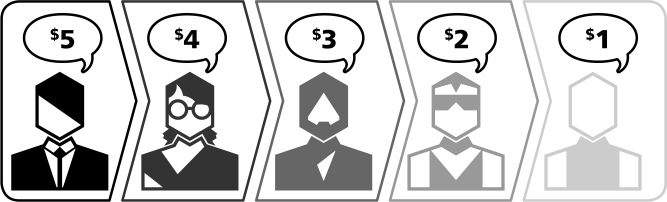
Players bid for turn order. A variety of auction mechanisms may be used (see “Auctions” in Chapter 8 for more details).
Discussion
Adding an auction for turn order, or Bid Turn Order, helps improve balance by allowing the players to decide the relative merits of different turn orders at different times and situations. However, there are several drawbacks to this method. First, it will slow the game down. Auctions in general can add a lot of time to the game and can feel tacked-on when the auction is not integrated into the core game mechanism. This is normally the case with auctioning off turn order, which is usually a prelude to the main gameplay. Age of Steam has a traditional Turn Order Until Pass auction (AUC-03). While the auction can be long, turn order in this game is very important, and the rules of the bid have additional tactical considerations, since players who drop out early get all or some of their bids back. In a tight economic game like Age of Steam, the bidding is extremely tense and important, and the experience more than makes up for the game length. In A Game of Trones, players bid for turn order via the Trone track. In addition to being the first player, the highest bidder on the Trone track also gains the ability to break any ties that occur in future auctions. Giving an extra benefit to the winner of the auction makes it more interesting to the players and raises the stakes of the bidding. Another game that uses this mechanism is El Grande, where the playing of Power Cards determines the turn order. Each player has Power Cards
numbered 1–20 and selects one to play. The selection is made based on the turn order of the prior turn. Each player may only play each Power Card once per game, and they may not play the same Power Card that another player has played earlier in the round. These rules speed the auction for turn order. In an example of elegant design, the Power Cards determine not just turn order but the number of pieces (“caballeros”) that are made available to the player for the Area Majority competition (ARC-02) featured in the game. Power cards are designed to offer better turn order and fewer caballeros or vice versa. Timing their play is a critical part of El Grande and makes the turn-order auction step more engaging. Auctions do suffer from another weakness, though. Auctions rely on players understanding the value of what they are bidding on. When bidding for resources or something tangible, it is easier for new players to judge relative worth. However, turn order is a much more nebulous concept for new players, and determining its value can be very tricky. This can lead to players over- or under-paying in the auction, which can lead to balance issues and lessened enjoyment. Terefore, if using a bid for turn order, it is recommended that designers give players guidelines for typical early game bids to help them bid appropriately. Bid Order turn systems typically require a physical element to track turn order—a track, tokens, or cards, something to indicate the sequence. Because turn order does not go “around the table,” this system can result in delays as players get confused, or need to check a secondary track, to determine whose turn it is.
Sample Games
Age of Steam (Wallace, 2002) El Grande (Kramer and Ulrich, 1995) A Game of Trones (Petersen and Wilson, 2003)
描述
玩家竞标回合顺序。可以使用各种拍卖机制(有关更多详细信息,请参阅第8章中的“拍卖”)。
讨论
增加回合顺序的拍卖,或竞标回合顺序(Bid Turn Order),通过允许玩家决定在不同时间和情况下不同回合顺序的相对优点,有助于改善平衡。然而,这种方法有几个缺点。首先,它会减慢游戏速度。拍卖通常会给游戏增加大量时间,并且当拍卖没有整合到核心游戏机制中时,可能会感觉是附加的。拍卖回合顺序通常是主要游戏的前奏,情况通常如此。《Age of Steam》有一个传统的“回合顺序直到放弃”拍卖(AUC-03)。虽然拍卖可能很长,但这款游戏中的回合顺序非常重要,而且竞标规则还有额外的战术考虑,因为早早退出的玩家会拿回全部或部分竞标。在像《Age of Steam》这样紧凑的经济游戏中,竞标极其紧张和重要,而且体验足以弥补游戏时长的增加。在《权力的游戏》(A Game of Thrones)中,玩家通过铁王座轨道竞标回合顺序。除了成为起始玩家外,铁王座轨道上的最高出价者还获得了打破未来拍卖中出现的任何平局的能力。给拍卖获胜者额外的好处使其对玩家更有趣,并提高了竞标的赌注。另一个使用这种机制的游戏是《大王》(El Grande),其中打出权力卡决定回合顺序。每个玩家都有
编号为1-20的权力卡,并选择一张打出。选择是基于前一回合的回合顺序做出的。每个玩家每场游戏只能打出每张权力卡一次,而且他们不能打出另一名玩家在回合早期打出的相同权力卡。这些规则加快了回合顺序的拍卖。在一个优雅设计的例子中,权力卡不仅决定回合顺序,还决定了提供给玩家用于游戏中特色的区域多数竞争(ARC-02)的棋子(“caballeros”)数量。权力卡旨在提供更好的回合顺序和更少的caballeros,反之亦然。把握打出它们的时机是《大王》的关键部分,并使回合顺序拍卖步骤更加引人入胜。不过,拍卖确实存在另一个弱点。拍卖依赖于玩家理解他们竞标的价值。当竞标资源或有形的东西时,新玩家更容易判断相对价值。然而,对于新玩家来说,回合顺序是一个更加模糊的概念,确定其价值可能非常棘手。这可能导致玩家在拍卖中出价过高或过低,从而导致平衡问题和乐趣减少。因此,如果使用竞标回合顺序,建议设计师给玩家典型早期游戏出价的指导方针,以帮助他们适当地竞标。竞标顺序回合系统通常需要物理元素来跟踪回合顺序——轨道、代币或卡牌,某种指示序列的东西。因为回合顺序不是“绕桌子转”,这个系统可能会导致延迟,因为玩家会感到困惑,或者需要检查次要轨道来确定轮到谁了。
游戏范例
Age of Steam (Wallace, 2002) - 《蒸汽时代》 El Grande (Kramer and Ulrich, 1995) - 《大王》 A Game of Trones (Petersen and Wilson, 2003) - 《权力的游戏》