Description
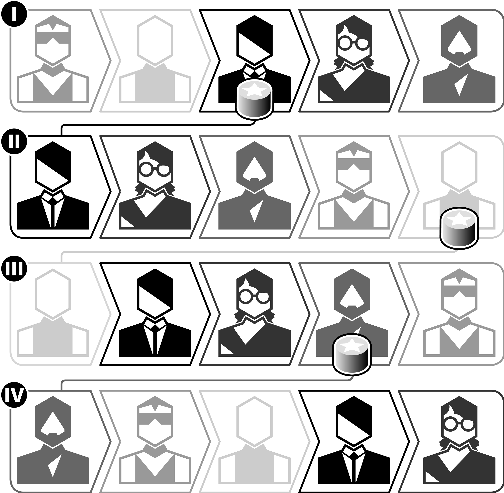
In each round, there is a First Player, and turns are taken clockwise from the first player. There is an action that may be taken to claim a place in the turn order (typically, but not always, first) for the next round, with play proceeding clockwise from the First Player. If no one takes the action, turn order remains unchanged.
Discussion
Similar to Stat Turn Order (TRN-02), Claim Turn Order Action gives more control to the players over the turn order, as they need to do something to seize control over the first player marker. Caution and finesse need to be employed by the designer when using this system, as there are a number of pitfalls. This technique is often used in Worker Placement (Chapter 9) or Action Drafting (ACT-02) games, and players will need to use one of their workers or actions to go first next time. This means that they are sacrificing their action now, effectively losing a turn, to gain that advantage. Balancing the cost can be tricky, as the value of going
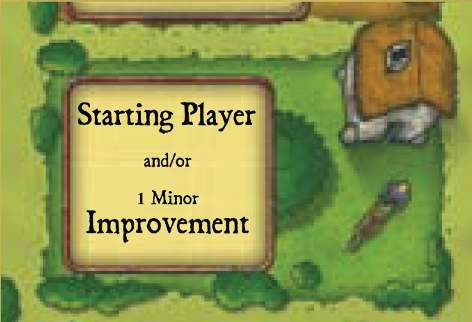
first can vary from situation to situation and player to player. The value of simply going first may not be that great, so players may avoid using an action to be the first player. In this case, the same player gets to remain the first player without losing an action. Tey simply remain the first player by default and reap the rewards at no cost. Designers can sweeten the value of claiming turn order by including other resources or abilities with it. For example, in Agricola, the player who chooses the First Player action may also play a Minor Improvement (Illustration 2.1). More importantly, the player to the left of the player who chooses to go first gets a great boon. Tey will get to play second, which, while not as good as going first, was obtained with absolutely no effort on their part. Agricola suffers quite a bit from this issue, as it is of great benefit to be to the left of the player who chose to go first and frustrating to be the player to the right, who will now go last, through no fault or action of their own. First Class: All Aboard the Orient Express deals with this issue by giving bonuses to all positions when the First Player token is chosen as an action. In a four-player game, the player who chose to go first gains two coins, the third player may take a Train Card, and the fourth player may either take or upgrade a Train Card. The player who will now be going second receives no bonus—being able to go second in the round while not giving anything up is deemed sufficient compensation. The First Class system gives the designer a lot of flexibility in balancing the different player positions. Illustration 2.1 In Agricola, a worker must be placed in this space to become First Player. When placing here you may also play a Minor Improvement.
Another pitfall to avoid is scripted play—obviously best moves by players. In earlier editions of the game Twilight Imperium, players chose an Action card on their turn to perform. One of them gave a Victory Point to the player choosing it, which was very powerful, and another let a player become First Player. Because the free Victory Point card was so strong, play almost always followed a scripted pattern. The first player to go would take the free Victory Point card, and the second player would take the card to become First Player, thus ensuring they would get the free Victory Point next turn. Turn order ended up simply moving around the table, devolving into a Progressive turn structure. However, the presentation of turn order as a choice made it seem as if the game had more flexibility than it actually did. The forcing moves for the first two players made for a much less interesting play experience. A similar issue arises in Stone Age, where expanding fields and gaining workers are invariably the first two actions chosen in each round. Sometimes, the action that determines turn order is tightly integrated into play. High Society has players bidding on objects, and the winner of an auction begins the bidding for the next auction. Trick taking games, where the winner of a trick takes the lead, are a similar example, which will be explored in more detail in Chapter 13. In both of these examples, play proceeds clockwise from the new start player. A variant of this mechanism is seen in Age of Empires III: The Age of Discovery and other games. In these, players take an action to secure their place in the turn order, but more than one player can do this. The first player to do so becomes the first player in the next round, the second player becomes second, and so on. Players who do not take this action are moved to the back of the turn order. This has similar issues to both the classic version of this mechanism and the Pass Order mechanism (TRN-06). Players must give up the opportunity for an action to improve their place in the turn order, and players that are currently early in the order have less incentive to spend an action there. Also, players that are early in the turn order have a better opportunity to keep it because they will have a first chance of using later round actions to maintain their turn position. However, it does mitigate some of the issues of the base version of this mechanism, as it puts more control into the hands of the players, albeit in an inequitable way.
Sample Games
Age of Empires III: The Age of Discovery (Drover, 2007) Agricola (Rosenberg, 2007) Bridge (Vanderbilt, 1908) First Class: All Aboard the Orient Express (Ohley, 2016) Hearts (Unknown, 1850) High Society (Knizia, 1995) Stone Age (Brunnhofer, 2008) Twilight Imperium (Petersen, 1997)
描述
在每一轮中,有一名首位玩家,回合从首位玩家开始顺时针进行。可以采取某种行动来宣称下一轮的回合顺序中的位置(通常,但不总是第一),游戏从首位玩家开始顺时针进行。如果没有人采取该行动,回合顺序保持不变(Claim Turn Order)。
讨论
类似于属性回合顺序(TRN-02),宣称回合顺序行动(Claim Turn Order Action)让玩家对回合顺序有更多的控制权,因为他们需要做些什么来夺取首位玩家标记的控制权。在使用该系统时,设计师需要谨慎和巧妙,因为存在许多陷阱。这项技术常用于工人放置(第9章)或行动轮抽(ACT-02)游戏,玩家将需要使用他们的一个工人或行动来在下次先走。这意味着他们现在牺牲了他们的行动,实际上失去了一个回合,以获得该优势。平衡成本可能很棘手,因为先走的价值
因情况而异,因玩家而异。仅仅先走的价值可能并没有那么大,所以玩家可能会避免使用行动成为首位玩家。在这种情况下,同一名玩家可以在不失去行动的情况下保持首位玩家的位置,即他们只是默认保持首位玩家,并免费获得回报。设计师可以通过包含其他资源或能力来增加宣称回合顺序的价值。例如,在《农场主》(Agricola)中,选择首位玩家行动的玩家还可以打出一张次要改进卡(插图2.1)。更重要的是,选择先走的玩家左边的玩家会得到巨大的好处。他们将获得第二顺位,这虽然不如先走好,但他们完全没有付出任何努力就获得了。《农场主》深受此问题困扰,因为在选择先走的玩家左边是有很大好处的,而在右边的玩家会感到沮丧,因为他们现在将最后走,而在他们自己没有任何过错或行动的情况下。《First Class: All Aboard the Orient Express》通过在选择首位玩家标记作为行动时向所有位置给予奖励来处理这个问题。在四人游戏中,选择先走的玩家获得两枚硬币,第三名玩家可以拿一张火车卡,第四名玩家可以拿一张或升级一张火车卡。现在将获得第二顺位的玩家没有获得奖励——能够在不放弃任何东西的情况下在这一轮中获得第二顺位被认为是足够的补偿。《First Class》系统为设计师在平衡不同玩家位置方面提供了很大的灵活性。
插图2.1 在《农场主》中,必须将一名工人放置在这个空间才能成为首位玩家。在这里放置时,你还可以打出一张次要改进卡。
另一个要避免的陷阱是脚本化游戏——即玩家明显最好的动作。在《Twilight Imperium》的早期版本中,玩家在回合中选择一张行动卡来执行。其中一张给选择它的玩家一个胜利点数,这非常强大,另一张让玩家成为首位玩家。因为免费的胜利点数卡太强了,游戏几乎总是遵循脚本化的模式。第一个走的玩家会拿走免费的胜利点数卡,第二个玩家会拿走成为首位玩家的卡,从而确保他们下回合能得到免费的胜利点数。回合顺序最终只是在桌子周围移动,退化为渐进式回合结构。然而,将回合顺序作为一种选择呈现出来,使得游戏看起来比实际具有更多的灵活性。前两名玩家的强制动作使得游戏体验不那么有趣。类似的问题出现在《石器时代》(Stone Age)中,扩张田地和获得工人总是每轮选择的前两个行动。有时,决定回合顺序的行动与其紧密集成在一起。《High Society》让玩家竞标物品,拍卖的获胜者开始下一次拍卖的竞标。吃墩游戏,赢一墩的人领出,也是类似的例子,将在第13章中详细探讨。在这两个例子中,游戏从新的起始玩家开始顺时针进行。这种机制的一个变体见于《Age of Empires III: The Age of Discovery》和其他游戏中。在这些游戏中,玩家采取行动以确保他们在回合顺序中的位置,但不仅限于一名玩家可以这样做。第一个这样做的玩家成为下一轮的第一名,第二个玩家成为第二名,依此类推。未采取此行动的玩家将被移至回合顺序的后面。这与该机制的经典版本和传递顺序机制(TRN-06)有类似的问题。玩家必须放弃采取行动的机会来改善他们在回合顺序中的位置,而目前在顺序中靠前的玩家不太有动力在那里花费行动。此外,处于回合顺序早期的玩家有更好的机会保持它,因为他们将有第一次机会使用后续轮次行动来维持他们的回合位置。然而,它确实减轻了该机制基本版本的一些问题,因为它将更多的控制权交到了玩家手中,尽管是以不公平的方式。
游戏范例
Age of Empires III: The Age of Discovery (Drover, 2007) - 《帝国时代3:探索时代》 Agricola (Rosenberg, 2007) - 《农场主》 Bridge (Vanderbilt, 1908) - 《桥牌》 First Class: All Aboard the Orient Express (Ohley, 2016) - 《First Class: All Aboard the Orient Express》 Hearts (Unknown, 1850) - 《红心大战》 High Society (Knizia, 1995) - 《上流社会》 Stone Age (Brunnhofer, 2008) - 《石器时代》 Twilight Imperium (Petersen, 1997) - 《帝国的曙光》