Description
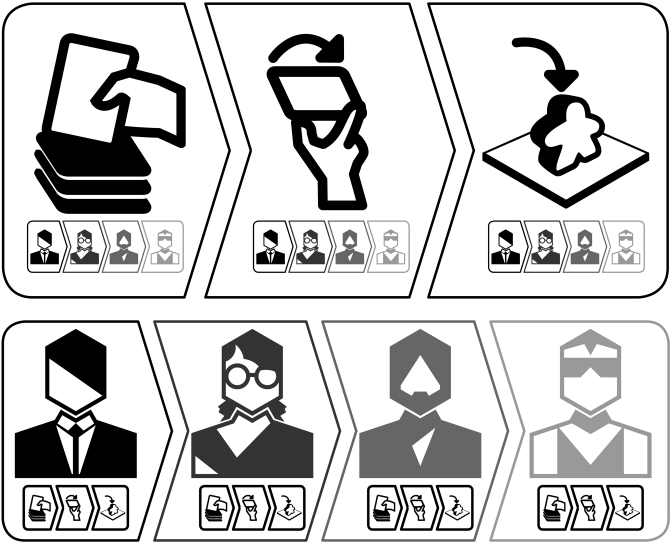
This describes two different meta-turn structures. In an Interleaved Phase structure (a), all players perform the first phase, then all perform the second phase, etc. In a Sequential Phase structure (b), each player performs all phases before moving on to the next player, who then performs all phases, etc.
Discussion
Interleaved structures in general are preferred in modern design, as they reduce downtime between player actions. War games in the 1970s and 1980s were notorious for their “I Go, You Go” structures, where one player would take a turn that could last for a very long time, with the other player wandering off to do some other activity. In the 1980s and 1990s, this started to shift, with designers moving to Interleaved turn structures to keep players
more engaged throughout. However, there are plenty of games that stick to a Sequential turn structure for a variety of reasons. The Russian Campaign, a simulation of the German invasion of Russia during World War II, uses a strictly Sequential turn structure. Each player performs all of these steps before the turn passes to the next player: • Receive Reinforcements and Replacements • Move All Units • Combat • Breakthrough Movement • Breakthrough Combat The Sequential structure of The Russian Campaign is integral to the strategy and experience of the game. Allowing one player to move and attack twice before the opponent gets to respond gives the game epic swings and devastating breakthroughs and does a particularly good job of capturing the early and late phases of the war, which featured large-scale encirclements and desperate breakouts. In contrast, Power Grid uses an Interleaved turn structure. There are three main Phases in each Round: • Buy Power Plants • Buy Raw Materials • Build Power Lines In turn, all players perform Buy Power Plants, then in turn all players perform Buy Raw Materials, etc. There is little time between a player taking their next action. Any turn structure can be used inside the meta-structures of Sequential and Interleaved. For example, Power Grid uses a Stat Order structure (TRN-02). These structures are not mutually exclusive: some parts of a game may be interleaved and some may be sequential, and different Turn Order structures may be used for each. For example, Simultaneous Turn structure is frequently appropriate during upkeep or planning phases but the movement is usually sequential. As always, these different mechanisms are tools, and each has its place and circumstance.
Sample Games
Sequential The Russian Campaign (Edwards, 1974) Trough the Ages: A Story of Civilization (Chvátil, 2006) Interleaved Orleans (Stockhausen, 2014) Power Grid (Friese, 2004)
描述
这描述了两种不同的元回合结构。在交错阶段结构(Interleaved Phase structure)(a)中,所有玩家执行第一阶段,然后所有玩家执行第二阶段,依此类推。在顺序阶段结构(Sequential Phase structure)(b)中,每个玩家在移动到下一个玩家之前执行所有阶段,然后下一个玩家执行所有阶段,依此类推。
讨论
一般来说,现代设计首选交错结构,因为它们减少了玩家行动之间的停机时间。20世纪70年代和80年代的战争游戏因其“我走,你走”结构而臭名昭著,其中一名玩家的回合可能会持续很长时间,而另一名玩家则游荡去做其他活动。在80年代和90年代,这种情况开始转变,设计师转向交错回合结构以保持玩家
至始至终更加投入。然而,有许多游戏出于各种原因坚持顺序回合结构。《The Russian Campaign》是二战期间德国入侵俄罗斯的模拟,采用了严格的顺序回合结构。在回合传递给下一名玩家之前,每位玩家执行所有这些步骤: • 接收增援和补充 • 移动所有单位 • 战斗 • 突破移动 • 突破战斗 《The Russian Campaign》的顺序结构是游戏策略和体验不可或缺的一部分。允许一名玩家在对手做出反应之前移动和攻击两次,给游戏带来了史诗般的波动和毁灭性的突破,并且特别好地捕捉了战争的早期和晚期阶段,其特点是大规模包围和绝望的突围。相比之下,《电力公司》(Power Grid)使用交错回合结构。每轮有三个主要阶段: • 购买发电厂 • 购买原材料 • 建造输电线路 依次,所有玩家执行购买发电厂,然后依次所有玩家执行购买原材料,依此类推。玩家采取下一次行动之间的时间很少。任何回合结构都可以在顺序和交错的元结构中使用。例如,《电力公司》使用属性顺序结构(TRN-02)。这些结构并不相互排斥:游戏的某些部分可以是交错的,某些部分可以是顺序的,并且每个部分都可以使用不同的回合顺序结构。例如,同时回合结构通常适用于维护或规划阶段,但移动通常是顺序的。正如以往,这些不同的机制是工具,每一种都有其位置和情况。
游戏范例
顺序 The Russian Campaign (Edwards, 1974) - 《俄罗斯战役》 Trough the Ages: A Story of Civilization (Chvátil, 2006) - 《历史巨轮》
交错 Orleans (Stockhausen, 2014) - 《奥尔良》 Power Grid (Friese, 2004) - 《电力公司》