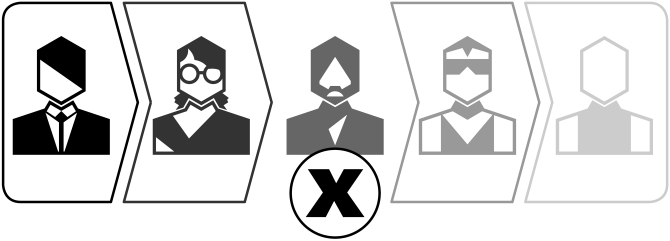
Description
This is a meta-mechanism that can be applied to a variety of turn structures. A player who “Loses a Turn” must skip their next opportunity for a turn.
Discussion
Losing a Turn was common in Roll and Move games of the nineteenth and twentieth centuries (MOV-02). In the current game-design philosophy, it is considered an anti-pattern to be avoided. It was frequently used as a possible outcome of landing on a particular space or drawing a card—actions which were, themselves, random and not the result of a player’s choice. Losing a Turn keeps the player from enjoying and participating in the game and can be very frustrating if one player is disproportionately affected. Mostly though, it frustrates the intent of the player as a person seeking to engage in an activity. Players want to play a game, and losing your turn means not playing a game. Like the ads on the radio that interrupt the music, if it happens too often, players will “change stations” and play something else (Illustration 2.3). There are other mechanisms where players are allowed to take a turn but may end up not doing anything, which can be equally an issue, that is functionally (and psychologically) and generally equivalent to Lose a Turn. An example may be having to win a Roll and Move game by “exact count,” such as Trouble or Snakes & Ladders. In these games, players may only win by advancing to the final space by getting exactly what they need and can result in many turns of fruitlessly rolling a die or spinning a spinner. While
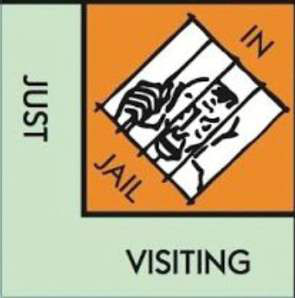
the players still get a turn, and there is some excitement in seeing if the player will win, it still can become frustrating if it lasts many turns. Similarly, games like Sorry! require certain values to leave “Home” and, in essence, start the game. Again, this can result in many consecutive turns of inactivity, which leads to frustration and boredom. In Monopoly, players can be sent to Jail, where they will need to roll doubles to escape. Monopoly has some remediation to this “Lose a Turn” effect, as players may choose to pay to get out of Jail and will be let out after a maximum of three lost turns elapse. In later stages of the game, players may prefer (and hope) to remain in Jail to avoid the possibility of paying high rents for landing on properties with hotels. There are other effects that are similar to losing a turn. In a Worker Placement game (Chapter 9), losing a worker for a round is equivalent to losing a turn. In an Action Retrieval system (ACT-03), the turn that the Actions are retrieved can feel like a lost turn to players. In a shedding card game where cards are shed one per turn (like UNO), having to draw cards is similar to “Losing a Turn” in terms of tempo, although it does not impinge on the player’s participation in the game. Similarly, when some players gain extra turns, this is equivalent to the others losing a turn. However, due to psychological framing effects, these more modern takes do not feel as bad. Tus, giving extra turns to other players or removing resources can be a better solution for including “Lose a Turn” effects. If the reason that a turn is lost is in control of the player, then this anti-pattern is remediated. If players choose to take a risky course or over-spend Illustration 2.3 The Jail space in Monopoly may cause players to lose up to three turns. Initially, this can be harmful to a player’s position, but in the late stages of the game, it can be a respite from possibly landing on others’ properties.
a resource that leaves them unable to take a turn, that can be an effective design, as turn loss results from player action and is not perceived as unfair by players. As an example, in the Passed Action Token game, Camelot (TRN14), players who play too slowly may miss a turn if the other Action Token catches up to them. Instead of making a game slow and frustrating, this adds excitement, as players can see the Action Token getting closer and can speed up their play to avoid losing a turn.
Sample Games
Camelot (Jolly, 2005) Monopoly (Darrow and Magie, 1933) Snakes & Ladders (Unknown, ∼200 bce) Sorry! (Haskell, Jr. and Storey, 1929) Trouble (Kohner, Kohner, and Kroll, 1965) UNO (Robbins, 1971)
描述
这是一种可以应用于各种回合结构的元机制。“失去回合”(Lose a Turn)的玩家必须跳过他们下一次回合的机会。
讨论
“失去回合”在19世纪和20世纪的掷骰移动游戏(MOV-02)中很常见。在当前的游戏设计哲学中,它被认为是一种应避免的反模式。它经常作为落在特定空间或抽牌的可能结果而被使用——这些行动本身是随机的,并非玩家选择的结果。“失去回合”使玩家无法享受和参与游戏,如果一名玩家受到的影响不成比例,可能会非常令人沮丧。但主要的是,它挫败了玩家作为一个寻求参与活动的人的意图。玩家想玩游戏,而失去你的回合意味着没玩游戏。就像收音机里打断音乐的广告一样,如果发生得太频繁,玩家就会“换台”去玩别的东西(插图2.3)。还有其他机制允许玩家进行回合但最终可能什么都不做,这同样是一个问题,在功能上(和心理上)通常等同于“失去回合”。一个例子是在掷骰移动游戏中必须通过“精确点数”获胜,例如《Trouble》或《蛇梯棋》(Snakes & Ladders)。在这些游戏中,玩家只能通过获得完全需要的点数推进到最后空间来获胜,这可能导致许多回合徒劳地掷骰子或旋转转盘。虽然
玩家仍然获得回合,并且看到玩家是否获胜会有一些兴奋,但如果持续许多回合,它仍然可能变得令人沮丧。同样,像《Sorry!》这样的游戏需要某些值才能离开“家”,实际上是开始游戏。同样,这可能导致连续许多回的不活动,从而导致沮丧和无聊。在《大富翁》(Monopoly)中,玩家可能会被送进监狱,在那里他们需要掷出双倍才能逃脱。《大富翁》对此“失去回合”效应有一些补救措施,因为玩家可以选择付费出狱,并将在最多三个失去的回合过去后被放出。在游戏的后期阶段,玩家可能更愿意(并希望)留在监狱里,以避免落在拥有酒店的房产上支付高额租金的可能性。还有其他类似于失去回合的效应。在工人放置游戏(第9章)中,失去一轮的工人等同于失去一个回合。在行动检索系统(ACT-03)中,检索行动的回合对玩家来说感觉像是失去了一个回合。在每回合打出一张牌的脱手纸牌游戏(如《UNO》)中,不得不抽牌在节奏上类似于“失去回合”,尽管它并不妨碍玩家参与游戏。同样,当一些玩家获得额外回合时,这等同于其他人失去回合。然而,由于心理框架效应,这些更现代的做法感觉没那么糟糕。因此,给其他玩家额外回合或移除资源可能是包含“失去回合”效应的更好解决方案。如果失去回合的原因在玩家的控制之中,那么这种反模式就得到了补救。如果玩家选择采取冒险路线或超支
插图2.3 《大富翁》中的监狱空间可能会导致玩家失去最多三个回合。最初,这对玩家的位置可能是有害的,但在游戏后期,这可以是避免落在他人房产上的喘息机会。
导致他们无法进行回合的资源,那可能是一个有效的设计,因为回合损失是由玩家行动造成的,并且不会被玩家视为不公平。例如,在传递行动代币游戏《Camelot》(TRN14)中,如果是另一个行动代币追上他们,玩得太慢的玩家可能会错过一个回合。这并没有让游戏变得缓慢和令人沮丧,反而增加了兴奋感,因为玩家可以看到行动代币越来越近,并可以加快他们的游戏速度以避免失去回合。
游戏范例
Camelot (Jolly, 2005) - 《Camelot》 Monopoly (Darrow and Magie, 1933) - 《大富翁》 Snakes & Ladders (Unknown, ∼200 bce) - 《蛇梯棋》 Sorry! (Haskell, Jr. and Storey, 1929) - 《Sorry!》 Trouble (Kohner, Kohner, and Kroll, 1965) - 《Trouble》 UNO (Robbins, 1971) - 《UNO》