Description
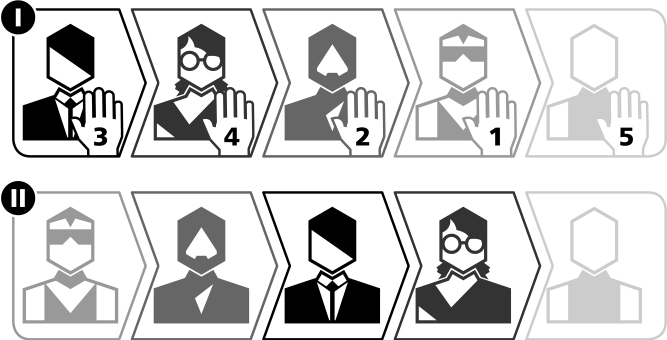
On their turn, players may either take an action or pass. The first player who passes becomes the new first player for the next round. The second player who passes becomes the second player for the next round, and so on. Reversing pass order and turn order is also possible when going later in turn order is more advantageous.
Discussion
Pass Order attempts to address the issues created by more static turn-order mechanisms, or those which order all players based on the actions of a single player. With Pass Order, players are presented with a choice: take additional actions this turn or be earlier in the turn order for the entire next round. Players have to estimate whether continuing to take actions in the current round is worth more than having an earlier choice on actions in the following round. A good place for this mechanism is in a game that features some type of drafting (CAR-06). In Caylus, players place workers on buildings (“Worker Placement,” Chapter 9) to receive certain benefits. Each building can be occupied by only one player each round, so players are drafting from a limited pool of possible actions. Going earlier in turn order ensures players can
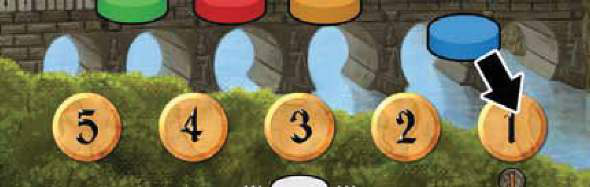
select the buildings they desire most. But taking additional actions later in the turn order can yield additional benefits (Illustration 2.2). Games in which players are very likely to take an equal number of actions in a round are a poor fit for this mechanism. For example, if players only have three actions in a turn, most likely they will all be passing after the same number of turns. If players take six or more actions in a round, the cost of losing later actions in the round is much reduced. An important consideration with Action/Passing is the fate of the last player who has not passed. This is an issue that affects any game in which players end their round by choosing to pass. For example, in The Networks, players receive more money or victory points for passing early, rather than turn-order position. Nevertheless, because The Networks is a Rochester draft (see “CAR-06, Drafting” in Chapter 13), there are relatively few limits on the ability of the last player still active to sweep up whatever cards remain on the ability of the last player to gain too much advantage by requiring expending a limited pool of workers to activate the remaining buildings. Caylus addresses this issue in a different way, by making it increasingly expensive to place workers as more players pass. Finally, in Sentient, players who pass first go last, which actually provides them with the advantage of sweeping the board. Designers using this structure should be careful to align the turn-order reward (first or last) with the game. The mechanism works best when turnorder preference is strong, when players act many times over the course of a single round, and when there is some hard limit on the total number of actions a player can take. Rewards other than turn-order advantage can be employed as an alternative or in addition. Illustration 2.2 The pass track from Caylus, as illustrated in the instruction manual. The first player to pass places their disk in the rightmost slot, showing they will go first next turn. As players pass, they place their disks in each successive position.
Two final notes of caution. First, designers must provide some physical affordances for tracking who has passed and in what order. Ideally, these are combined so that when a player passes, they move some indicator to show that they have passed and when they will play in a future turn. Second, designers should also pay attention to the amount of downtime experienced by the first player to pass.
Sample Games
Caylus (Attia, 2005) The Networks (Hova, 2016) Sentient (Kevern, 2017)
描述
在他们的回合中,玩家可以采取行动或放弃(Pass)。第一个放弃的玩家成为下一轮的新首位玩家。第二个放弃的玩家成为下一轮的第二位玩家,依此类推。当在回合顺序中较晚行动更有利时,也可以反转放弃顺序和回合顺序。
讨论
放弃顺序(Pass Order)试图解决由更静态的回合顺序机制或那些基于单个玩家的行动对所有玩家进行排序的机制所产生的问题。通过放弃顺序,玩家面临一个选择:在本回合采取额外的行动,还是在整个下一轮的回合顺序中排在前面。玩家必须估计在当前轮继续采取行动是否比在下一轮拥有更早的行动选择权更有价值。这个机制的一个好地方是具有某种类型轮抽(CAR-06)的游戏。在《Caylus》中,玩家将工人放置在建筑物上(“工人放置”,第9章)以获得某些好处。每栋建筑物每轮只能被一名玩家占据,因此玩家是从有限的可能行动池中进行轮抽。在回合顺序中更早行动确保玩家可以
选择他们最想要的建筑物。但在回合顺序较晚时采取额外行动可以产生额外的好处(插图2.2)。玩家很可能在一轮中采取相同数量行动的游戏不适合这种机制。例如,如果玩家在一个回合中只有三个行动,很可能他们会在相同数量的回合后全部放弃。如果玩家在一轮中采取六个或更多行动,失去轮次后期行动的成本就会大大降低。行动/放弃的一个重要考虑因素是最后一名未放弃玩家的命运。这是一个影响任何玩家通过选择放弃来结束其回合的游戏的问题。例如,在《The Networks》中,玩家因提早放弃而获得更多的金钱或胜利点数,而不是回合顺序位置。尽管如此,因为《The Networks》是罗切斯特轮抽(参见第13章中的“CAR-06,轮抽”),对于最后一名仍然活跃的玩家横扫剩余卡牌的能力几乎没有限制,以通过要求消耗有限的工人池来激活剩余建筑物来获得太多优势。《Caylus》以不同的方式解决这个问题,即随着更多玩家放弃,放置工人的成本越来越高。最后,在《Sentient》中,先放弃的玩家最后走,这实际上为他们提供了横扫版面的优势。使用这种结构的设计师应小心将回合顺序奖励(第一或最后)与游戏保持一致。当回合顺序偏好强烈,当玩家在一轮过程中多次行动,以及当玩家可以采取的总行动数量有某种硬性限制时,该机制效果最好。可以采用除回合顺序优势之外的奖励作为替代或补充。
插图2.2 《Caylus》说明书中的放弃轨道。第一个放弃的玩家将他们的圆盘放在最右边的插槽中,表明他们下回合将先走。随着玩家放弃,他们将圆盘放在每个连续的位置。
最后两个注意事项。首先,设计师必须提供一些物理功能来跟踪谁放弃了以及以什么顺序放弃。理想情况下,这些是结合在一起的,这样当玩家放弃时,他们移动一些指示器来表明他们已经放弃以及他们将在未来的回合中何时行动。其次,设计师还应注意第一个放弃的玩家所经历的停机时间。
游戏范例
Caylus (Attia, 2005) - 《凯吕斯》 The Networks (Hova, 2016) - 《电视网》 Sentient (Kevern, 2017) - 《Sentient》