Description
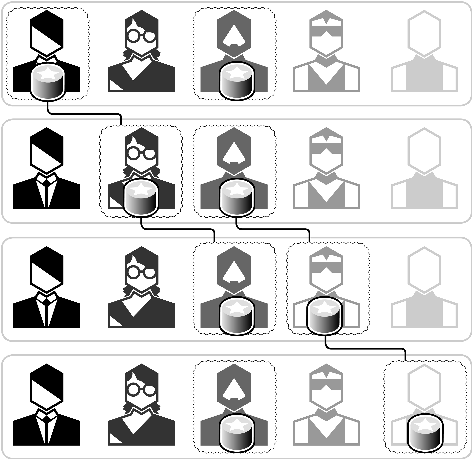
Players possess one or more Action Tokens. Tose who have an Action Token may take a turn, and then they pass the token clockwise, allowing the next player to perform an action. Actions are performed in real-time; there is no pausing and structure within the turn. Typically, to prevent stalling and to keep the game moving, in games with multiple Action Tokens, if both tokens are held by the same player, they suffer a penalty.
Discussion
This mechanism is a cross between a real-time-based and a turn-based game. Similar to the Action Timer mechanism (TRN-12), it allows players to play at their own pace, and asynchronously, but still offers some structure. However, with the Action Timer mechanism, players are basically independent of one other and can operate simultaneously. Here, players are linked more closely, in that one player’s turn can only start when the previous player finishes their turn. This helps solve the dilemma of players breaking rules (either
inadvertently or deliberately) that are present in other real-time mechanisms. The inactive players can watch what the active players are doing and interrupt if necessary. This allows for more complex mechanisms within the game itself than is possible in traditional real-time games. Generally, this mechanism requires that multiple Action Tokens are passed around the circle at the same time. The exception is if the round itself is timed in some fashion and having possession of the Action Token causes a player to lose. Hot Potato and Catch Phrase! are examples of this, where the player holding the item when time runs out loses (see Hot Potato, RES-23). When using multiple Action Tokens, a key design consideration is what happens if multiple tokens end up with the same player. In Camelot, if another token would be passed to a player who already has one, it instead skips that player and goes to the person to his or her left. This is equivalent to losing a turn, as other players will get to act a second time before the affected player does. While we recommend against players losing a turn and classify it as an anti-pattern (TRN-16), in this case, the opportunity to avoid losing a turn lies with the player and is not luck-based or the result of targeting by other players. Terefore, it is an understandable and satisfying solution to use in this case. It forces players to move at a reasonable pace, at least comparable in speed to the other players. While this solution encourages faster play, it does not mean that the faster players will always win. If a reasonably thought-out single move will beat a hasty double move, then playing as fast as possible will not be the dominant strategy. Players will need to balance optimal plays with “good enough” plays. An alternative system to penalizing players for collecting a second Action Token is seen in Diner. In Diner, all players start with an Action Token and may continue to act simultaneously with others so long as they have at least one action token. After each action, players pass one action token to the left. Several Action Token can pile up in front of the same player, and they simply sit there until the player completes a move and passes a token to the next player. There is no “lapping” as there is in Camelot. This can lead to slower and more conservative play, but in Diner, players are incentivized to play quickly in order to draft the best cards in a central tableau. Because players play simultaneously, playing slowly to accumulate several tokens will allow other players to grab more desirable cards. It is also possible to use Passed Action Tokens as an overlay or subset of another structure. Space Cadets uses a real-time turn structure, but in certain
situations, an Action Token (a small deck of cards in this case) is passed around to allow players to perform a special action beyond what they can normally do. Eclipse, in a variant mode that can accommodate as many as nine players, uses two Action Tokens. The only distinction between the tokens is that one provides priority over the other for acquiring new technologies. The system is surprisingly effective at speeding along what would otherwise be an unplayable behemoth of a game.
Sample Games
Camelot (Jolly, 2005) Catch Phrase! (Uncredited, 1994) Diner (O’Malley, 2014) Eclipse (rule variant) (Tahkokallio, 2011) Hot Potato (Unknown, 1800’s) Space Cadets (Engelstein, Engelstein, and Engelstein, 2012)
描述
玩家拥有一个或多个行动代币(Action Tokens)。拥有行动代币的人可以采用一个回合,然后顺时针传递代币,允许下一个玩家执行一个动作。动作是实时执行的;回合内没有暂停和结构。通常,为了防止拖延并保持游戏进行,在有多个行动代币的游戏中,如果同一个玩家持有两个代币,他们将受到惩罚。
讨论
这种机制是基于实时的和基于回合的游戏之间的交叉。类似于行动计时器机制(TRN-12),它允许玩家按自己的节奏异步游戏,但仍提供一些结构。然而,使用行动计时器机制,玩家基本上彼此独立,可以同时操作。在这里,玩家联系更紧密,因为一个玩家的回合只能在前一个玩家完成他们的回合时开始。这有助于解决玩家在其他实时机制中存在的违反规则(无论是
无意还是有意)的困境。非活跃玩家可以观察活跃玩家正在做什么,并在必要时进行打断。这允许游戏本身具有比传统实时游戏更复杂的机制。通常,这种机制要求多个行动代币同时在圆圈周围传递。例外情况是,如果回合本身以某种方式计时,并且拥有行动代币会导致玩家输掉。《击鼓传花》(Hot Potato)和《Catch Phrase!》就是这方面的例子,当时间用完时持有物品的玩家会输(见击鼓传花,RES-23)。当使用多个行动代币时,一个关键的设计考虑是如果同一个玩家最终拥有多个代币会发生什么。在《Camelot》中,如果另一个代币将传递给已经拥有一个代币的玩家,它反而会跳过该玩家并传给其左边的人。这等同于失去一个回合,因为其他玩家将在受影响的玩家行动之前获得第二次行动机会。虽然我们建议反对玩家失去回合,并将其归类为反模式(TRN-16),但在这种情况下,避免失去回合的机会在于玩家,而不是基于运气或被其他玩家针对的结果。因此,在这种情况下使用它是可以理解和满意的解决方案。它迫使玩家以合理的速度移动,至少在速度上与其他玩家相当。虽然此解决方案鼓励更快的游戏,但这并不意味着更快的玩家总是会赢。如果一个经过深思熟虑的单一动作可以击败匆忙的双重动作,那么尽可能快地玩将不会是主导策略。玩家需要在最佳玩法和“足够好”的玩法之间取得平衡。在《Diner》中可以看到惩罚收集第二个行动代币的另一种系统。在《Diner》中,所有玩家都以一个行动代币开始,只要他们拥有至少一个行动代币,就可以继续与其他人同时行动。每次行动后,玩家将一个行动代币向左传递。几个行动代币可以堆积在同一个玩家面前,它们只是坐在那里,直到玩家完成移动并将代币传递给下一个玩家。没有《Camelot》中的“套圈”。这可能导致更慢、更保守的游戏,但在《Diner》中,玩家被激励快速行动,以便在中央画面中轮抽最好的卡牌。因为玩家同时游戏,慢慢玩积攒几个代币会让其他玩家抢走更想要的卡牌。也可以将传递行动代币作为另一个结构的覆盖或子集使用。《Space Cadets》使用实时回合结构,但在某些
情况下,行动代币(在这种情况下是一小副牌)被传递,以允许玩家执行超出他们通常能做的特殊行动。《Eclipse》在一个可以容纳多达九名玩家的变体模式中使用了两个行动代币。代币之间的唯一区别是,一个在获取其新技术方面提供优先权。该系统在加速原本无法玩的庞大游戏方面极其有效。
游戏范例
Camelot (Jolly, 2005) - 《Camelot》 Catch Phrase! (Uncredited, 1994) - 《Catch Phrase!》 Diner (O’Malley, 2014) - 《Diner》 Eclipse (rule variant) (Tahkokallio, 2011) - 《星蚀》(规则变体) Hot Potato (Unknown, 1800’s) - 《击鼓传花》 Space Cadets (Engelstein, Engelstein, and Engelstein, 2012) - 《太空学员》