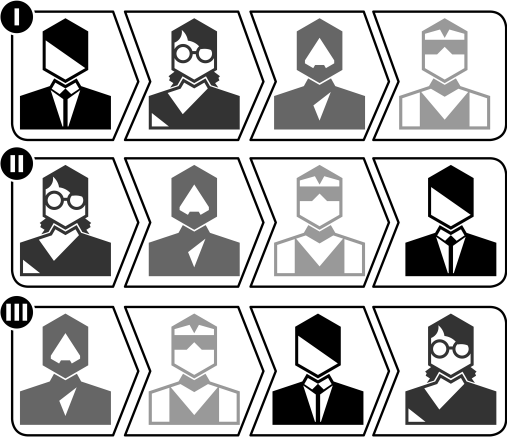
Description
One player has the First Player token. At the end of the round, the token passes to the player to the left who becomes the new First Player for that round. During the round, players take turns clockwise around the table.
Discussion
There are several advantages to the Progressive Turn Order system over the Fixed Turn Order (TRN-01) structure. First, it naturally rotates the first player marker through the players in a predictable way. This enables planning on the part of the players, and it introduces a timing element. If you are going second, you know that you will be going first in the next round and can plan accordingly. Similarly, being first in a round is immediately followed by being last in the next round. This gives a nice rhythm to the game, as over a series of rounds you move closer and closer to going first and then slip to last place. It’s a gradual build-up, followed by a sharp drop. The above assumes, of course, that going first is the best position, and going last the worst. In some games, the opposite is true, like Texas Hold’Em
Poker. In this game, the first position is typically considered the worst, while the last, “the button,” is the best, as seeing what other players do before you make your decision gives you more information to work with. Terefore, in Texas Hold’Em Poker, once the player is in the best position, the button, they gradually move closer and closer to the worst position, the small blind. Ten the player jumps from being in the worst position to the best. (One might view the small blind as receiving some turn-order compensation for having the worst position, in that they must only stake half as much money as the big blind, which is the player following them in turn order.) Progressive games can leave a large gap between player turns. For example, in a five-player game, when a player moves first, the next round he or she will move fifth. That means that it will be nine turns until the player gets to go again (eight opponent turns). Depending on the game, this can lead to serious downtime. For this reason, Progressive is most effective in games with short turns or where players take actions during other player turns. The latter is done in Puerto Rico, where the other players get to perform a less powerful version of the action selected by the main player (ACT-08). Typically, games that use Progressive Turn structure are played to the end of the round in which the end-game condition is triggered. Terefore, the issue with players having an unequal number of turns does not arise as it does in Fixed Turn Order games. Sometimes, a mechanism is included to ensure that each player has the same number of opportunities to go first (often by setting the number of rounds equal to the number of players or a multiple of that number). A less-used variant on Progressive Turn structure is Regressive, where the First Player token passes counter-clockwise, while turns are taken clockwise. Much of the discussion in Progressive applies here, in terms of psychology and gaps between turns. However, there is one important difference: in a Regressive structure, the player who goes last in one round will go first in the next. Players having two turns in a row can be extremely powerful, particularly when a player knows it is happening and can plan accordingly. The game needs to be designed and structured to either take advantage of that or blunt it in some fashion. For example, in Dead of Winter, a semi-cooperative potential hidden traitor game (STR-05), the hidden traitors would do well to reveal themselves to be the traitors in the round in which they go last, as they will have two successive turns in which to wreak havoc. Regressive is unintuitive to players, because so many games go clockwise. Having a turn which moves clockwise, but a token which moves counter-clockwise, is an additional cognitive burden that should only be imposed for some specific design reason.
Sample Games
Progressive The Little Prince: Make Me a Planet (Bauza and Cathala, 2013) Puerto Rico (Seyfarth, 2002) Quadropolis (Gandon, 2016) Terraforming Mars (Fryxelius, 2016) Texas Hold’Em (Unknown) Regressive Dead of Winter: A Crossroads Game (Gilmour and Vega, 2014) Kepler (Bariot and Montiage, 2012) Viticulture (Stegmaier and Stone, 2013) Walk the Plank! (Steely and Tinney, 2013)
描述
一名玩家拥有首位玩家标记。在回合结束时,标记传递给左边的玩家,该玩家成为该轮的新首位玩家。在回合期间,玩家按顺时针方向轮流进行(Progressive Turn Order)。
讨论
渐进式回合顺序(Progressive Turn Order)系统相对于固定回合顺序(TRN-01)结构有几个优点。首先,它自然地以可预测的方式在玩家之间轮换第一玩家标记。这使得玩家能够进行规划,并引入了时机元素。如果你是第二个走,你知道下一轮你将第一个走,并可以据此计划。同样,在一轮中第一个走之后,紧接着在下一轮中最后走。这给游戏带来了很好的节奏,因为在一系列回合中,你越来越接近第一个走,然后滑落到最后一名。这是一个逐渐积累,然后急剧下降的过程。当然,以上假设先走是最佳位置,后走是最差的。在某些游戏中,情况正好相反,如德州扑克
(Texas Hold’Em Poker)。在这个游戏中,第一个位置通常被认为是最差的,而最后一个,“庄家”(the button),是最好的,因为在做出决定之前看到其他玩家做什么会给你更多的信息来处理。因此,在德州扑克中,一旦玩家处于最佳位置,即庄家,他们就会逐渐越来越接近最差位置,即小盲注。然后玩家从最差位置跳到最好位置。(人们可能认为小盲注因拥有最差位置而获得一些回合顺序补偿,因为他们只需下注大盲注的一半,大盲注是回合顺序中跟随他们的玩家。)渐进式游戏可能会在玩家回合之间留下很大的空白。例如,在五人游戏中,当一名玩家第一个移动时,下一轮他或她将第五个移动。这意味着直到玩家再次行动还需要九个回合(八个对手回合)。根据游戏的不同,这可能导致严重的停机时间。因此,渐进式在回合短的游戏或玩家在其他玩家回合采取行动的游戏中最有效。后者在《波多黎各》(Puerto Rico)中完成,其他玩家可以执行主要玩家选择的行动的较弱版本(ACT-08)。通常,使用渐进式回合结构的游戏一直玩到触发游戏结束条件的回合结束。因此,玩家回合数不均等的问题不会像固定回合顺序游戏那样出现。有时,包含一种机制以确保每个玩家有相同数量的机会先走(通常通过将轮数设置为等于玩家人数或该人数的倍数)。渐进式回合结构的一个较少使用的变体是回归式(Regressive),其中首位玩家标记逆时针传递,而回合顺时针进行。关于渐进式的大部分讨论也适用于此,包括心理学和回合之间的差距。然而,有一个重要的区别:在回归式结构中,在一轮中最后走的玩家将在下一轮中先走。连续两个回合对玩家来说可能极其强大,特别是当玩家知道这正在发生并可以据此计划时。游戏的设计和结构要么需要利用这一点,要么以某种方式削弱它。例如,在半合作潜在隐藏叛徒游戏《Dead of Winter》(STR-05)中,隐藏叛徒最好在他们最后走的回合中暴露自己是叛徒,因为他们将有两个连续的回合来大肆破坏。回归式玩家来说是不直观的,因为许多游戏都是顺时针进行的。拥有顺时针移动的回合,但逆时针移动的标记,是一种额外的认知负担,只有出于某种特定的设计原因才应强加。
游戏范例
渐进式 The Little Prince: Make Me a Planet (Bauza and Cathala, 2013) - 《小王子:给我一个星球》 Puerto Rico (Seyfarth, 2002) - 《波多黎各》 Quadropolis (Gandon, 2016) - 《Quadropolis》 Terraforming Mars (Fryxelius, 2016) - 《殖民火星》 Texas Hold’Em (Unknown) - 《德州扑克》
回归式 Dead of Winter: A Crossroads Game (Gilmour and Vega, 2014) - 《死亡寒冬》 Kepler (Bariot and Montiage, 2012) - 《Kepler》 Viticulture (Stegmaier and Stone, 2013) - 《葡萄园》 Walk the Plank! (Steely and Tinney, 2013) - 《Walk the Plank!》