Description
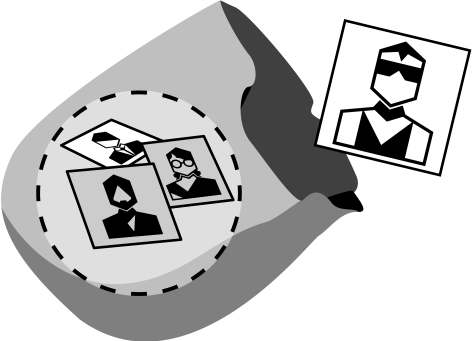
Representatives of play pieces or players are randomized and ones is drawn at a time. That player or play piece takes its turn, and then a new random draw is made.
Discussion
Random Turn Order can introduce a lot of excitement and tension to a game, as players anxiously await which token will be revealed next. However, it also reduces the ability of the players to plan effectively, which makes it most effective in lighter games. Games are more tactical, as players need to react to the situation as it develops, because they can’t predict when their turn will come. There are ways to increase the ability for strategic planning when using a Random Turn Order. Pillars of the Earth is a Worker Placement game (Chapter 9), where workers are pulled from a bag. As with most Worker Placement games, going early is an advantage, as more and better options are available. When a player’s piece is pulled, if that player wishes to place it, they need to pay a cost. This cost starts high and gradually drops throughout the turn. If a player does not want to (or cannot) pay the cost, the worker is placed to the side and is used to select an action at the very end of the turn. This presents players with an interesting strategic option of trying to judge
the value of going early. The higher price of going early counteracts the luck of being drawn early. In Warrior Knights, actions are represented by cards. Each player selects two cards from their personal deck that they wish to use that turn. The selections from all the players are shuffled together and then they are drawn one at a time and the player whose card is chosen performs the corresponding action. The inability to create a perfect plan has made this a popular mechanism in war games. Rather than one player moving all pieces, and then the next player moving all of theirs, a random draw for who gets to activate next helps simulate battlefield uncertainty, while also reducing downtime for the players. Firepower implements this type of chit-pull system. Random Turn Order also gives the war game designer flexibility in modeling superior and inferior units. For example, in the game A Victory Lost: Crisis in Ukraine 1942–1943, Activation Chits for units are placed into a cup. However, veteran units receive multiple chits, while new recruits may receive only one, modeling in a natural way the increased effectiveness of the veterans. This is a kind of Deck Building system (CAR-05). Another technique is to include a wild card or category tokens, which give the player a choice of which unit to activate when they are pulled, as long as they correspond to the matching category. This also increases tactical flexibility and reduces the luck factor. Battle Masters is an example of a game that uses this approach.
Sample Games
Battle Masters (Baker, 1992) Pillars of the Earth (Rieneck and Stadler, 2006) A Victory Lost: Crisis in Ukraine 1942–1943 (Nakamura, 2006) Warrior Knights (Carver, Clequin, Faidutti, and Konieczka, 2006)
描述
游戏棋子或玩家的代表物被随机化,一次抽取一个。该玩家或游戏棋子进行其回合,然后进行新的随机抽取。
讨论
随机回合顺序(Random Turn Order)可以为游戏引入很多兴奋和紧张感,因为玩家焦急地等待下一个显示的是哪个代币。然而,这也降低了玩家有效计划的能力,这使得它在较轻的游戏中最为有效。游戏更具战术性,玩家需要随着局势的发展做出反应,因为他们无法预测何时轮到他们。在使用随机回合顺序时,有一些方法可以提高战略规划的能力。《Pillars of the Earth》是一款工人放置游戏(第9章),其中工人是从袋子里抽出来的。与大多数工人放置游戏一样,早走是一种优势,因为有更多更好的选择可用。当玩家的棋子被抽出时,如果该玩家希望放置它,他们需要支付成本。这个成本开始很高,并在整个回合中逐渐下降。如果玩家不想(或不能)支付成本,工人将被放在一边,并在回合结束时用于选择行动。这给玩家提供了一个有趣的战略选择,即试图判断
早走的价值。早走的较高价格抵消了被早早抽到的运气。在《Warrior Knights》中,行动由卡牌表示。每个玩家从他们的个人牌组中选择两张他们希望在该回合使用的卡牌。所有玩家的选择混合在一起,然后一次抽一张,卡牌被选中的玩家执行相应的行动。无法制定完美计划使得这成为战争游戏中流行的机制。这就不是一个玩家移动所有棋子,然后下一个玩家移动他们所有的棋子,而是随机抽取谁下一个激活,这有助于模拟战场的不确定性,同时也减少了玩家的停机时间。《Firepower》实施了这种类型的抽签系统。随机回合顺序还赋予战争游戏设计师在模拟优势和劣势单位时的灵活性。例如,在游戏《A Victory Lost: Crisis in Ukraine 1942–1943》中,单位的激活标记被放入杯子中。然而,老兵单位获得多个标记,而新兵可能只获得一个,以自然的方式模拟老兵增加的效率。这是一种牌库构建系统(CAR-05)。另一种技术是包括万能卡或类别代币,当它们被抽出时,只要它们对应于匹配的类别,就给玩家选择激活哪个单位的权利。这也增加了战术灵活性并降低了运气因素。《Battle Masters》是使用这种方法的游戏的一个例子。
游戏范例
Battle Masters (Baker, 1992) - 《Battle Masters》 Pillars of the Earth (Rieneck and Stadler, 2006) - 《Pillars of the Earth》 A Victory Lost: Crisis in Ukraine 1942–1943 (Nakamura, 2006) - 《A Victory Lost: Crisis in Ukraine 1942–1943》 Warrior Knights (Carver, Clequin, Faidutti, and Konieczka, 2006) - 《Warrior Knights》