Description
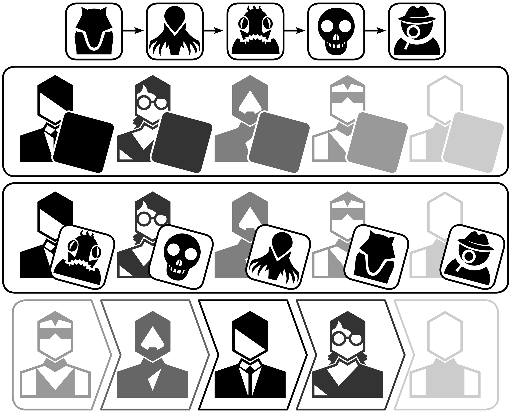
Players secretly and simultaneously select an action, role, or priority. Ten they are revealed, and the actions/roles revealed determine the order in which players act.
Discussion
Role Order is a subset of Simultaneous Action Selection (TRN-09). There are several ways to implement this mechanism. Citadels, for example, has players draft roles (like Tief or Assassin). There is one card for each role in a deck. Some of the roles are removed without any of the players knowing their identity. The first player then looks at the remaining roles, chooses one, and passes the remaining cards to the left. After each player has selected a role, the first player calls out the roles from first to last, according to their number. Tief, for example, is number two. If a player has that role, he or she reveals it and takes that action. Race for the Galaxy has a different approach. Each player simultaneously selects which of the roles (like Explore or Settle) they wish to play. Ten all players reveal their choice. The roles are resolved in a defined order (e.g., Explore is always first). For each role that is chosen by at least one player,
all players get to perform it, but the player(s) who chose it get to take a more powerful version of the action. More on this in the Follow mechanism (ACT-08). If no one selects a role, it is skipped, so if players really want a specific role to occur, they can select it, or gamble that, based on the situation, other players are likely to select it, affording them the opportunity to choose something else. This introduces an element of Yomi (UNC-01), as players attempt to outguess each other. In both of these games, players are not guaranteed that certain roles will occur. This is typical of implementations of this mechanism as a result of the hidden role selection—if all the roles were in play, players could readily deduce which roles were taken before them. Using Role Order allows Citadels to introduce an interesting twist. The player who chooses the Assassin role names another role that will have to lose a turn. Note that it is the role that is targeted, not the player. Players losing their turn is an anti-pattern (TRN-16) that usually results in negative feelings because it frustrates the player’s desire to play the game at all. However, in Citadels, the role is targeted, not a specific player. While the Assassin players may have an idea of who may be more likely to choose a role, they are not sure. Additionally, the role the Assassin names may not even have been selected that turn, rendering the ability moot. Role Order allows the designers to control the order in which operations occur, while giving players a choice about which of those will happen. It also introduces a well-defined turn order that doesn’t suffer from needing to have a mechanism to shift the first player. It happens naturally.
Sample Games
Citadels (Faidutti, 2000) Race for the Galaxy (Lehmann, 2007)
描述
玩家秘密并同时选择行动、角色或优先级。然后揭示它们,揭示的行动/角色决定玩家行动的顺序。
讨论
角色顺序(Role Order)是同时行动选择(TRN-09)的一个子集。有几种方法可以实施这一机制。《富饶之城》(Citadels)让玩家轮抽角色(如小偷或刺客)。牌堆中每个角色有一张卡。有些角色在没有任何玩家知道其身份的情况下被移除。然后第一个玩家查看剩余的角色,选择一个,并将剩余的卡片传给左边。每个玩家选择角色后,第一个玩家根据角色的编号从第一到最后叫出角色。例如,小偷是二号。如果玩家拥有该角色,他或她揭示它并采取该行动。《银河竞逐》(Race for the Galaxy)有不同的方法。每个玩家同时选择他们希望扮演的角色(如探索或定居)。然后所有玩家揭示他们的选择。角色按定义的顺序解决(例如,探索总是第一)。对于至少有一个玩家选择的每个角色,
所有玩家都可以执行它,但选择它的玩家可以采取更强大的行动版本。更多关于这一点在跟随机制(ACT-08)中。如果没有人选择角色,它就会被跳过,所以如果玩家真的希望发生特定角色,他们可以选择它,或者赌一把,根据情况,其他玩家可能会选择它,从而让他们有机会选择其他东西。这引入了Yomi元素(UNC-01),因为玩家试图互相猜测。在这两款游戏中,都不保证会出现某些角色。这是由于隐藏角色选择导致该机制实施的典型情况——如果所有角色都在场,玩家很容易推断出在他们之前采取了哪些角色。使用角色顺序允许《富饶之城》引入一个有趣的转折。选择刺客角色的玩家指定另一个将不得不失去回合的角色。请注意,目标是角色,而不是玩家。玩家失去回合并非是一种反模式(TRN-16),通常会导致负面情绪,因为它挫败了玩家玩游戏的愿望。然而,在《富饶之城》中,目标是角色,而不是特定玩家。虽然刺客玩家可能知道谁更有可能选择角色,但他们并不确定。此外,刺客指定的角色甚至可能在那一轮没有被选中,使得该能力毫无意义。角色顺序允许设计师控制操作发生的顺序,同时让玩家选择其中哪些会发生。它还引入了一个明确定义的回合顺序,不需要有机制来改变第一玩家。它是自然发生的。
游戏范例
Citadels (Faidutti, 2000) - 《富饶之城》 Race for the Galaxy (Lehmann, 2007) - 《银河竞逐》