Description
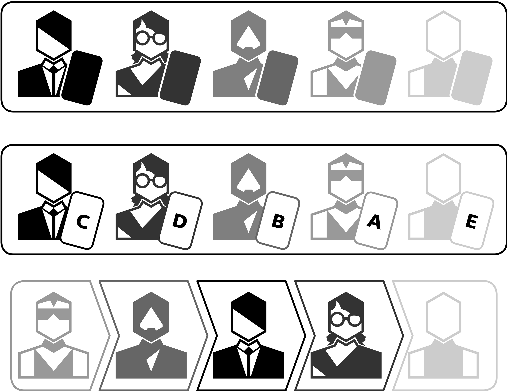
Players plan their turn simultaneously and secretly. Ten, they reveal their plans at the same time.
Discussion
A Simultaneous Action Selection Game has players selecting actions at the same time, but actions are generally resolved in turn order. The Action Selection mechanism will usually include a subsystem for determining the order by which the action resolution phase will be played. For example, in Libertalia, players choose a role card from their hand and play it face down. Ten, all cards are revealed simultaneously, and the lowest-numbered card revealed is resolved first. Each player in Libertalia has the same role cards in their hands, so duplicate plays occur frequently. To resolve these ties, each card also shows a unique priority number. Robo Rally, a classic in the genre, uses a similar priority number mechanism to sequence the players once cards are revealed.
Priority numbers are not necessarily required for Simultaneous Action Selection. Race for the Galaxy has players simultaneously select which roles they would like to execute, but then the roles are always performed in a specific order. See the Role Order mechanism for more details (TRN-10). Typically, cards are used to implement this mechanism, although other components, such as tiles or dice, can also be used. In Incan Gold, each turn, players simultaneously decide whether they are going to remain in the cave or return to camp. In the original version (called Diamant) players indicated this choice by either secretly holding their wooden adventurer figure in their hand or having an empty fist. Later versions replaced this mechanism by placing a “Stay” or “Go” card face down. In the A Game of Trones board game, actions are planned using order tokens that are placed face down and then revealed by flipping them all face up. This mechanism gives players the opportunity to try to anticipate what their opponents will do and to plan accordingly. The general term for mechanisms which have players trying to guess what their opponents will do is called “Yomi,” a Japanese word. We discuss Yomi in more detail in UNC-01. Simultaneous Action Selection can also speed up games and reduce downtime, as players are acting simultaneously. However, if the planning is extensive, as in Diplomacy and A Game of Trones, it can give room for Negotiation (ECO-18) and increased strategy, which adds length.
Sample Games
Diplomacy (Calhamer, 1959) A Game of Trones (Petersen and Wilson, 2003) Incan Gold (Faidutti and Moon, 2005) Libertalia (Mori, 2012) Robo Rally (Garfield, 1994)
描述
玩家同时并秘密地计划他们的回合。然后,他们同时揭示他们的计划。
讨论
同时行动选择(Simultaneous Action Selection)游戏让玩家同时选择行动,但行动通常按回合顺序解决。行动选择机制通常包括确定行动解决阶段进行顺序的子系统。例如,在《Libertalia》中,玩家从手牌中选择一张角色卡并面朝下打出。然后,同时揭示所有卡牌,并首先解决揭示的编号最小的卡牌。在《Libertalia》中,每位玩家手中有相同的角色卡,因此经常出现重复打出。为了解决这些平局,每张卡还显示唯一的优先级编号。《Robo Rally/机器人拉力赛》是该类型的经典之作,一旦揭示卡牌,就使用类似的优先级编号机制对玩家进行排序。
优先级编号对于同时行动选择并非必不可少。《银河竞逐》(Race for the Galaxy)让玩家同时选择他们想要执行的角色,但然后角色总是按特定顺序执行。有关更多详细信息,请参阅角色顺序机制(TRN-10)。通常,使用卡牌来实现此机制,尽管也可以使用其他组件,如板块或骰子。在《印加宝藏》(Incan Gold)中,每回合,玩家同时决定是留在洞穴中还是返回营地。在原始版本(称为《Diamant》)中,玩家通在手中秘密持有木制冒险家人物或空拳来表示这种选择。后续版本通过面朝下放置“留下”或“离开”卡来替换此机制。在《权力的游戏》(A Game of Thrones)棋盘游戏中,使用面朝下放置的命令代币来计划行动,然后通过将它们全部面朝上翻转来揭示。这种机制给玩家机会试图预测对手会做什么并据此计划。让玩家试图猜测对手会做什么的机制的统称叫“Yomi”,这是一个日语单词。我们在UNC-01中更详细地讨论Yomi。同时行动选择还可以加快游戏速度并减少停机时间,因为玩家同时行动。然而,如果计划很广泛,如在《外交》(Diplomacy)和《权力的游戏》中,它可以为谈判(ECO-18)和增加策略提供空间,从而增加时长。
游戏范例
Diplomacy (Calhamer, 1959) - 《外交》 A Game of Trones (Petersen and Wilson, 2003) - 《权力的游戏》 Incan Gold (Faidutti and Moon, 2005) - 《印加宝藏》 Libertalia (Mori, 2012) - 《Libertalia》 Robo Rally (Garfield, 1994) - 《机器人拉力赛》