Description
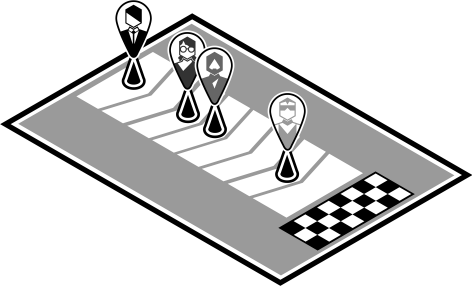
There is a linear “Time Track” with many spaces. Each player has a marker on the track, which indicates where they are “in time.” Markers farther on the track are further forward in time. The player with the marker lowest on the track (furthest “back in time”) takes the next action. Each action has a cost in time, and the player’s marker is advanced a number of spaces according to that cost. Ten, the next lowest marker on the track takes an action. It is possible that the same player takes multiple turns in a row.
Discussion
Time Tracks have a number of inherent advantages: • Clarity: It is obvious who goes next, even though turn order jumps around a lot. • Player Control: Players have some choice over who goes next, allowing for additional tactical play. • Balance: The designer can include powerful actions but can give them a long time duration to compensate. However, there are, of course, downsides to this technique. It can lead to players being out of the action for some time if they have taken long-duration options. Admittedly, they have chosen to do this, but an option available to players should not result in them having a less enjoyable experience.
To prevent this situation, designers typically do not include very longduration activities. However, this compression of durations into a narrower range works against the benefits and promise of this system, as players usually are quite close together on the Time Track. The Dragon & Flagon, for example, has actions that range from one to four Time. Most of the actions in Tebes are in a similar range, although players can opt to dig for artifacts for up to 12 Time, which will give their opponents the opportunity to perform many actions before their turn comes around again. Because of this tight-duration grouping, players frequently will share a space on the Time Track. These ties are usually resolved by having the player on top of the stack (the last piece to arrive there) move first. However, this “Last-in-First-out,” or LIFO, system will give players guaranteed double moves in some situations. Depending on the game, this may not be an issue and may even be desirable. But for some, it may be too powerful and some mediation needs to happen. In The Dragon and Flagon, for example, Turn Order is randomly determined when multiple players share the same space. Another alternative is to only allow one piece per space on the Time Track, forcing players who would otherwise occupy a space to move one or more spaces further forward until they find an empty space. This can add an extra layer of decision-making, as the actual cost of certain actions may vary based on the positioning of the opponent. When a game offers only a limited amount of time or creates triggers based on specific spaces on the track, the particulars of how ties are handled and whether players skip spaces become especially important. Glen More and Kraftwagen use a Time Track combined with an Action Selection mechanism. Each space on the Time Track has an associated action. When players move to the space, they execute the action. The player furthest back on the track moves first, and two players may not occupy the same space. Players have the choice of moving far forward to guarantee a needed action but potentially giving their opponents multiple turns.
Sample Games
AuZtralia (Wallace, 2018) The Dragon & Flagon (Engelstein, Engelstein, and Engelstein, 2016) Glen More (Cramer, 2010) High Rise (Hova, 2019) Tebes (Prinz, 2007) Tokaido (Bauza, 2012)
描述
有一个带有许多格子的线性“时间轨道”(Time Track)。每个玩家在轨道上都有一个标记,指示他们在“时间”中的位置。轨道上较远的标记在时间上更靠前。轨道上标记最低(最“回到过去”)的玩家采取下一个行动。每个行动都有时间成本,玩家的标记根据该成本前进若干格。然后,轨道上下一个最低的标记采取行动。同一个玩家可能会连续进行多个回合。
讨论
时间轨道具有许多固有的优点: • 清晰度:即使回合顺序经常跳动,谁下一个走也是显而易见的。 • 玩家控制:玩家对谁下一个走有一定的选择权,允许进行额外的战术游戏。 • 平衡:设计师可以包括强大的行动,但可以给它们很长的时间持续时间作为补偿。然而,这种技术当然也有缺点。如果玩家选择了持续时间长的选项,可能会导致他们在一段时间内无法行动。诚然,他们选择了这样做,但提供给玩家的选项不应导致其实验不愉快。
为了防止这种情况,设计师通常不包括持续时间很长的活动。然而,将持续时间压缩到更窄的范围不利于该系统的优点和承诺,因为玩家通常在时间轨道上非常接近。例如,《The Dragon & Flagon》的行动范围从1到4时间。《Tebes》中的大多数行动都在类似的范围内,尽管玩家可以选择挖掘文物长达12时间,这将给对手在他们再次轮到之前执行许多行动的机会。由于这种紧密的持续时间分组,玩家经常会共享时间轨道上的一个空间。这些平局通常通过让堆叠顶部的玩家(最后到达那里的棋子)先动来解决。然而,这种“后进先出”或LIFO系统会在某些情况下给玩家保证的双重移动。根据游戏的不同,这可能不是问题,甚至可能是可取的。但对于某些游戏来说,这可能太强大了,需要进行一些调解。例如,在《The Dragon & Flagon》中,当多个玩家共享同一空间时,回合顺序是随机确定的。另一种选择是只允许时间轨道上的每个空间有一个棋子,迫使原本占据空间的玩家向前移动一个或多个空间,直到找到空位。这可以增加额外的决策层,因为某些行动的实际成本可能会根据对手的位置而变化。当游戏只提供有限的时间或基于轨道上的特定空间创建触发器时,如何处理平局以及玩家是否跳过空间的细节变得尤为重要。《Glen More》和《Kraftwagen》使用结合行动选择机制的时间轨道。时间轨道上的每个空间都有一个关联的行动。当玩家移动到该空间时,他们执行该行动。轨道上最靠后的玩家先走,且两个玩家不能占据同一空间。玩家可以选择向前移动很远以保证所需的行动,但可能会给对手多个回合。
游戏范例
AuZtralia (Wallace, 2018) - 《澳洲天劫》 The Dragon & Flagon (Engelstein, Engelstein, and Engelstein, 2016) - 《龙与名为弗拉贡的酒馆》 Glen More (Cramer, 2010) - 《Glen More》 High Rise (Hova, 2019) - 《High Rise》 Tebes (Prinz, 2007) - 《底比斯》 Tokaido (Bauza, 2012) - 《东海道》