Description
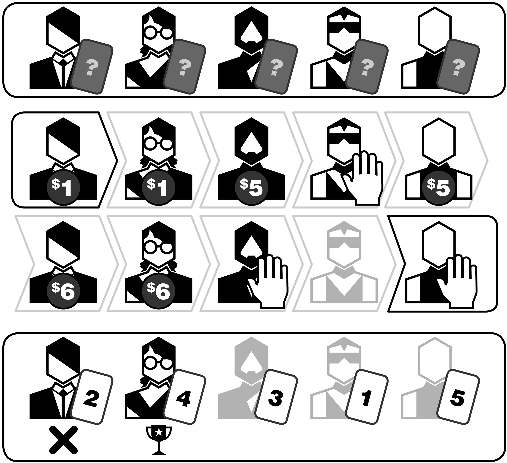
Players commit a stake of currency or resources to purchase a chance of winning everyone’s stake, based on some random outcome like being dealt a superior set of cards or rolling a higher number. Players typically have partial information about the overall game state and may “bluff” by representing through their in-game actions that they hold a stronger position than they do. Conversely, players may “fold” or quit the contest and limit their losses to whatever they had already staked.
Discussion
Some of the oldest games in human memory are betting games, often involving dice, and rather than trying to recapitulate every type of betting game and mechanism, we’ll restrict ourselves to how the mechanism is used in the modern board-gaming context. Nevertheless, a field trip to your local casino is highly recommended for extended study of these topics.
One common group of games that feature betting is trick-taking games, like Tichu, where players place a “bet” by predicting the number of tricks they will take. The role of betting in these designs is to allow players to self-balance the outcomes of a random card deal. Players will bet more aggressively with a stronger hand. Racing games like Camel Up offer wagering to allow players to wager for the same reason. One might pedantically note that the game doesn’t actually simulate or model camel racing as much as it models wagering on camel races. Nevertheless, this is a very popular way for designers to make games about racing, while sidestepping many of the challenges of modeling an actual race. The games above have wagering, without any real bluffing elements. Conversely, there are games like Coup which feature bluffing but not any wagering. In Coup, players hold role cards that enable certain actions. These cards are held in hand, as secret information, and a player can declare that they possess any card and take any connected action. As long as no player challenges, the action occurs, but if a challenge is issued, the active player must show the card they claimed and force the challenger to discard a role card, or the player must discard one of their own role cards if they do not hold the role card they claimed. Players who discard their last role cards are eliminated from the game. This dynamic is present in many social deduction games, which we discuss in a dedicated section (see “UNC-04” in this chapter). Other games that are only about bluffing include Skull and Roses, Liar’s Dice, Cockroach Poker, and the classic game Cheat (which our saltier readers may know by its more bovine name). What these games share in common is that they have no currency to wager and that when a player makes a challenge, uncertainty exists only based upon player actions. A key design element for including bluffing is not only hidden information, of course, but also some form of information transmission. In poker, the information is in the form of betting patterns, and the community cards visible on the table. In Coup, the character a player chooses gives them special abilities. The actions a player may perform based on the role give context to the choice and the possibility of the bluff. It is better if the hidden information doesn’t change too frequently, to give a history to the choices a player makes. If the hidden information constantly changes, it reduces the opportunities for players to try to see through a bluff, leaving players with a random guessing game. Bluffing is common in the party game space, but Wits & Wagers introduced betting into the trivia genre. Players answer numbers-based questions and arrange their numerical answers on a betting line in order from lowest
to highest. Players may then make two bets on which answer is closest to the actual answer printed on the card. By cleverly allowing players to make two wagers, the game expands from being only about how much confidence players have in their own knowledge to a richer set of choices. Players must consider whether their wagers are revealing too much to their opponents, while also looking to how other players bet to try and suss out likely answers based on those betting patterns. If you’re playing with a doctor, for example, you might follow their bets on biology and medical topics—until they catch on to your strategy and lay a trap for you! One of the most interesting places to find bluffing and wagering is in modern resolution mechanisms for combat, some of which are discussed in Chapter 4. In various games, players put forward some combination of known strength, and some hidden amount of strength, and simultaneously reveal and then resolve abilities to determine a winner. The hidden strength may be represented by a number on a die, as in Tiny Epic Kingdoms, a leader card, as in Dune, or a battle card, as in Kemet. Combat is entirely deterministic, and all possible combat modifications are also known, such that in many combats, players know which player will win if they spend their maximal strength. The game is in out-thinking or out-guessing your opponent as to how much strength he or she will spend. These combat systems are what we might call all-pay, in that the committed resources are discarded. This is a key distinction between auctions and wagers more generally: in auctions only the winner pays, but in a wager, the losers pay. The ability to read and out-guess your opponents, to know their minds, is described by the Japanese word “Yomi.” Yomi is especially prominent in games with a simultaneous reveal mechanism like 1v1 fighting games. However, role-selection games (ACT-02) like Race for the Galaxy have this flavor too: assessing which roles your opponents will select, and thus, which you should select is the Yomi experience. In The Mind, that same notion is pushed to the limit, but in a co-op game. In The Mind, players must, without communicating, somehow play hands of cards in ascending numerical order. There are no turns, and not all cards are dealt from the deck, so players must simply play based on their instincts and their ability to sense what their partners might hold.
Sample Games
Camel Up (Bogen, 2014) Cheat (Unknown) Cockroach Poker (Zeimet, 2004) Coup (Tahta, 2012) Dune (Eberle, Kittredge, and Olatka, 1979) Kemet (Bariot and Montiage, 2012) Liar’s Dice (Unknown, ∼1800) Manila (Delonge, 2005) The Mind (Warsch, 2018) Race for the Galaxy (Lehmann, 2007) Skull and Roses (Marly, 2011) Tichu (Hostettler, 1991) Tiny Epic Kingdoms (Almes, 2014) Wits & Wagers (Crapuchettes, 2003)
描述
玩家投入一定数量的货币或资源作为赌注,以购买赢取所有人赌注的机会,这是基于某种随机结果,如发到一副更好的牌或掷出更高的点数。玩家通常拥有关于整体游戏状态的部分信息,并可能通过他们的游戏内行动来“虚张声势”(bluff),表现出他们持有比实际更强的地位。反之,玩家可能会“弃牌”(fold)或退出比赛,并将损失限制在他们已经下注的任何东西上。
讨论
人类记忆中最古老的一些游戏是博彩游戏,通常涉及骰子,而不是试图概括每种类型的博彩游戏和机制,我们将限制自己在现代棋盘游戏背景下如何使用该机制。尽管如此,还是强烈建议去当地赌场实地考察,以深入研究这些话题。
常见的以博彩为特色的游戏组之一是吃墩游戏,如《Tichu/地主》,玩家通过预测他们将吃多少墩来进行“下注”。博彩在这些设计中的作用是允许玩家自我平衡随机发牌的结果。拿到强牌的玩家会更积极地下注。像《Camel Up》这样的竞速游戏提供下注,也是出于同样的原因允许玩家下注。有人可能会吹毛求疵地指出,该游戏实际上并没有模拟或建模骆驼赛跑,而是模拟了对骆驼赛跑的下注。尽管如此,这对于设计师来说是一种非常流行的方式,可以制作关于赛跑的游戏,同时避开了建模实际赛跑的许多挑战。上面的游戏有赌注,但没有任何真正的虚张声势元素。相反,有些游戏像《政变》(Coup)具有虚张声势,但没有任何赌注。在《政变》中,玩家持有能执行某些行动的角色卡。这些卡在手中持有,作为秘密信息,玩家可以声明他们拥有任何卡并采取任何相关行动。只要没有玩家质疑,行动就会发生,但如果有人提出质疑,活跃玩家必须出示他们声称的卡,并迫使质疑者弃掉一张角色卡,或者如果活跃玩家没有持有他们声称的角色卡,他们必须弃掉自己的一张角色卡。弃掉最后一张角色卡的玩家将从游戏中淘汰。这种动态存在于许多社交推理游戏中,我们将在专门的部分(参见本章中的“UNC-04”)进行讨论。其他只关于虚张声势的游戏包括《骷髅与玫瑰》(Skull and Roses)、《大话骰》(Liar’s Dice)、《德国蟑螂》(Cockroach Poker)和经典游戏《Cheat》(我们更粗俗的读者可能知道它更像牛的名字 Bullshit)。这些游戏的共同点是它们没有可下注的货币,并且当玩家提出质疑时,不确定性仅基于玩家行动而存在。包含虚张声势的关键设计元素当然不仅是隐藏信息,还有某种形式的信息传输。在扑克中,信息是以博彩模式和桌面上可见的公共牌的形式存在的。在《政变》中,玩家选择的角色赋予他们特殊能力。玩家根据角色可以执行的行动为选择和虚张声势的可能性提供了背景。如果隐藏信息不经常变化,那就更好了,这样可以给玩家做出的选择留下历史记录。如果隐藏信息不断变化,它就会减少玩家看穿虚张声势的机会,让玩家只能玩随机猜测游戏。虚张声势在聚会游戏领域很常见,但《Wits & Wagers》将博彩引入了问答类游戏。玩家回答基于数字的问题,并将他们的数字答案按从最低到
最高的顺序排列在赌注线上。然后玩家可以在哪个答案最接近卡上印的实际答案上进行两次下注。通过巧妙地允许玩家进行两次下注,游戏从仅仅关于玩家对自己知识有多少信心扩展到了更丰富的选择集。玩家必须考虑他们的赌注是否向对手透露太多,同时也观察其他玩家如何下注,试图根据这些下注模式推断出可能的答案。例如,如果你和医生一起玩,你可能会跟随他们在生物学和医学话题上的下注——直到他们发现你的策略并为你设下陷阱!寻找虚张声势和赌注的最有趣的地方之一是在现代战斗解决机制中,其中一些将在第4章中讨论。在各种游戏中,玩家提出某种已知力量和某种隐藏力量的组合,同时揭示并解决能力以确定赢家。隐藏的力量可以由骰子上的数字表示,如在《Tiny Epic Kingdoms》中,领袖卡,如在《沙丘》(Dune)中,或战斗卡,如在《Kemet》中。战斗完全是确定性的,所有可能的战斗修改也是已知的,因此在许多战斗中,玩家知道如果他们花费最大力量,哪个玩家会赢。游戏在于智胜或猜透对手会花费多少力量。这些战斗系统就是我们可能称之为“全付”的系统,因为承诺的资源会被丢弃。这是拍卖与一般赌注之间的关键区别:在拍卖中只有赢家付费,但在赌注中,输家也付费。阅读和猜透对手,了解他们想法的能力,在日语中用“Yomi”一词来描述。Yomi在具有同时揭示机制的游戏(如1v1格斗游戏)中尤为突出。然而,像《银河竞逐》(Race for the Galaxy)这样的角色选择游戏(ACT-02)也有这种味道:评估对手将选择哪些角色,从而你应该选择哪些,这就是Yomi体验。在《The Mind》中,同样的概念被推向了极限,但在合作游戏中。在《The Mind》中,玩家必须在不交流的情况下,以某种方式按升序打出手牌。没有回合,也不是所有的牌都从牌堆中发出的,所以玩家只能根据直觉和感知伙伴可能持有某种牌的能力来玩。
游戏范例
Camel Up (Bogen, 2014) - 《骆驼大赛》 Cheat (Unknown) - 《吹牛》 Cockroach Poker (Zeimet, 2004) - 《德国蟑螂》 Coup (Tahta, 2012) - 《政变》 Dune (Eberle, Kittredge, and Olatka, 1979) - 《沙丘》 Kemet (Bariot and Montiage, 2012) - 《Kemet》 Liar’s Dice (Unknown, ∼1800) - 《大话骰》 Manila (Delonge, 2005) - 《马尼拉》 The Mind (Warsch, 2018) - 《心灵同步》 Race for the Galaxy (Lehmann, 2007) - 《银河竞逐》 Skull and Roses (Marly, 2011) - 《骷髅与玫瑰》 Tichu (Hostettler, 1991) - 《地主/Tichu》 Tiny Epic Kingdoms (Almes, 2014) - 《小小史诗王国》 Wits & Wagers (Crapuchettes, 2003) - 《Wits & Wagers》