Description
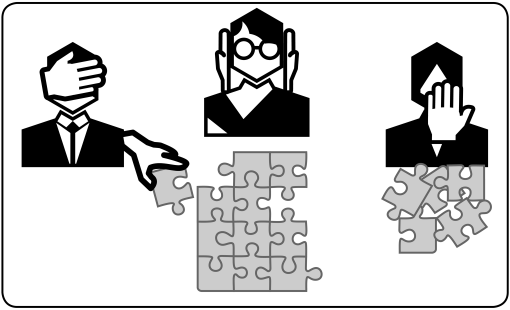
Games may limit players from communicating with one another openly. These restrictions can be absolute as they relate to certain specific pieces of information, or they may restrict certain types of communication, such as speaking.
Discussion
Communication limits are most common in cooperative games, but they exist in other kinds of games as well. Many games limit players from revealing privately held cards. In Cosmic Encounter, players may openly discuss which cards they intend to play, but the actual cards cannot be shown in order to preserve the possibility of a double cross. In traitor games, identity cards are an obvious example of communication limits. In cooperative games or games with intra-team cooperation, communication limits operate to make the game more difficult. Party games like Charades, Pictionary, and Show & Tile all ask players to communicate non-verbally, with pantomime, drawing, or building with tangrams, respectively. These games are all games of inductive reasoning (UNC-13), where the clues provided suggest an answer. Hanabi is particularly notable in that the more players come to the game with agreed-upon principles and conventions for how to play, the more the game shifts from being about inductive reasoning to deductive reasoning. Games with deduction mechanisms, in which
players gain information by asking specific types of questions—like Clue or hidden movement games like Specter Ops—are another example of communication limits as a mechanism to manage uncertainty, preserving enough of it for interesting play. Team3 is a three-player cooperative game where the team is attempting to recreate a blueprint showing how blocks are to be arranged. Each player has a different restriction on information or communication. One player can see the blueprint but cannot speak, only gesture. The second player can watch the first player and describe to the third player, who has their eyes closed, how the blocks should be arranged. Only the third player may touch the blocks. This combination of different communication restrictions leads to varied and entertaining gameplay. Returning to Hanabi, players are restricted not only in the type of information they are allowed to provide or the modality by which it may be pro-vided but also by the frequency with which they may communicate. Players have a limited number of clues, and if no clues are available, players may not communicate at all. Mysterium takes a similar approach, except that communication is only limited between certain player roles. The ghost and the mediums may only swap information through cards, but the mediums may freely converse with one another. In Witness, players may only communicate their information once, which leaves players unable to confirm what they’ve heard or to clarify anything they might have missed. In the absence of specific rules of what information can be shared, playgroups are left to manage themselves. In The Game, the rules indicate that players may not share the specific values of cards in their hands but may say “don’t play on that pile” or “don’t make a large jump on this pile.” In practice, this can often lead to results very similar to players playing with open hands, especially when players at the table have different ideas about what should and should not be allowed. This dynamic is on full display in The Mind, where the rules bar all communication, yet the gameplay is all about reading the slightest and most subconscious of cues. Once again, each group will have very different mores and norms by which they play.
Sample Games
Charades (Unknown, early 19th c.) Cosmic Encounter (Eberle, Kittredge, Norton, and Olatka, 1977) Crazy Karts (Perret, 2016) The Game (Benndorf, 2015) Hanabi (Bauza, 2010) The Mind (Warsch, 2018) Mysterium (Nevskiy and Sidorenko, 2015) Pictionary (Angel, 1985) Show & Tile (Loomis and Shalev, 2018) Specter Ops (Matsuuchi, 2015) Team3 (Cutler and Fantastic, 2019) Witness (Bodin, 2014)
描述
游戏可能会限制玩家公开放地相互交流。这些限制可以是绝对的,因为它们涉及某些特定信息,或者它们可能会限制某些类型的交流,例如说话。
讨论
通信限制(Communication Limits)在合作游戏中最常见,但也存在于其他类型的游戏中。许多游戏限制玩家揭示私人持有的卡片。在《Cosmic Encounter》中,玩家可以公开讨论他们打算打哪张牌,但为了保留背叛的可能性,不能显示实际的卡牌。在叛徒游戏中,身份卡是通信限制的一个明显例子。在合作游戏或具有团队内部合作的游戏中,通信限制的作用是使游戏更加困难。像《猜谜游戏》(Charades)、《Pictionary》和《Show & Tile》这样的聚会游戏都要求玩家进行非语言交流,分别是哑剧、绘画或用七巧板拼搭。这些游戏都是归纳推理游戏(UNC-13),提供的线索暗示答案。《花火》(Hanabi)特别值得注意的是,玩家带着商定的原则和惯例来玩游戏越多,游戏就越从关于归纳推理转变为演绎推理。具有演绎机制的游戏,其
玩家通过询问特定类型的问题来获取信息——像《Clue》或像《Specter Ops》这样的隐藏移动游戏——是通信限制作为管理不确定性机制的另一个例子,保留了足够的不确定性以进行有趣的游戏。《Team3》是一个三人合作游戏,团队试图重建展示如何排列积木的蓝图。每个玩家在信息或通信方面都有不同的限制。一个玩家可以看到蓝图但不能说话,只能做手势。第二个玩家可以看第一个玩家并向闭着眼睛的第三个玩家描述应该如何排列积木。只有第三个玩家可以触摸积木。这种不同通信限制的结合导致了多样化和有趣的玩法。回到《花火》,玩家不仅在被允许提供的信息类型或提供信息的方式上受到限制,而且在他们可以交流的频率上也受到限制。玩家拥有有限数量的线索,如果没有可用的线索,玩家根本无法交流。《Mysterium》采取了类似的方法,只是通信仅限于特定玩家角色之间。鬼魂和灵媒只能通过卡牌交换信息,但灵媒可以自由地相互交谈。在《Witness》中,玩家只能交流他们的信息一次,这使得玩家无法确认他们听到了什么或澄清他们可能错过的任何事情。在没有关于可以共享什么信息的具体规则的情况下,游戏组只能自行管理。在《The Game》中,规则表明玩家不能分享手牌的具体数值,但可以说“不要在那一堆上打牌”或“不要在那一堆上大跳跃”。在实践中,这通常会导致与玩家摊牌玩非常相似的结果,特别是当桌上的玩家对应该允许什么和不应该允许什么有不同的想法时。这种动态在《The Mind》中得到了充分展示,规则禁止所有交流,但这游戏玩法完全是关于阅读最细微和最潜意识的提示。再一次,每个小组都会有非常不同的习俗和规范来进行游戏。
游戏范例
Charades (Unknown, early 19th c.) - 《猜谜游戏》 Cosmic Encounter (Eberle, Kittredge, Norton, and Olatka, 1977) - 《星际遭遇战》 Crazy Karts (Perret, 2016) - 《Crazy Karts》 The Game (Benndorf, 2015) - 《The Game》 Hanabi (Bauza, 2010) - 《花火》 The Mind (Warsch, 2018) - 《心灵同步》 Mysterium (Nevskiy and Sidorenko, 2015) - 《诡秘庄园》 Pictionary (Angel, 1985) - 《Pictionary》 Show & Tile (Loomis and Shalev, 2018) - 《Show & Tile》 Specter Ops (Matsuuchi, 2015) - 《Specter Ops》 Team3 (Cutler and Fantastic, 2019) - 《Team3》 Witness (Bodin, 2014) - 《Witness》