Description
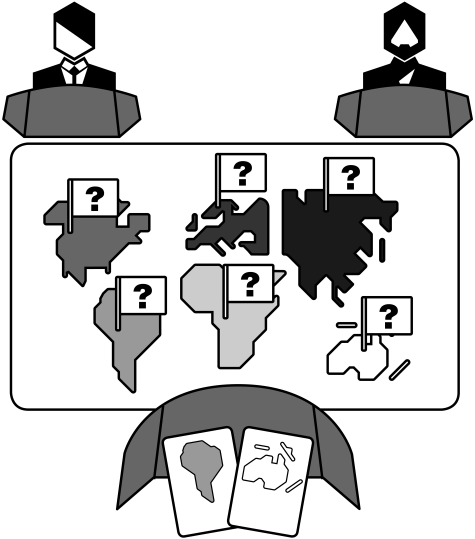
Players have hidden influence on locations or characters, which they reveal to perform actions.
Discussion
In a game of this kind, play is divided up between assigning influence and either declaring or spending that influence to trigger the effects of the character or location in question. In Mythology, players secretly assign control points to heroes (or monsters, events, etc.) in one phase. In a later phase in the round, any player may attempt to activate these heroes by announcing that they are taking control. If nobody challenges that control, the action succeeds. If another player challenges, the players engage in an auction-like process of declaring an amount of control points that they had previously assigned. Players may choose to reveal none, some, or all of the control points
they have assigned in an effort to take control of the hero, and the player who reveals the most influence is awarded control. In Kremlin, players influence politicians in the Soviet party, each of whom can trigger certain actions based on their altitude in the party hierarchy. Players write down the influence they assign to politicians on a secret log sheet and then reveal some or all of the claimed influence to control these politicians. Revealed politicians are targets for exile, or, in some versions of the game, execution by the KGB, so players must balance the risks and rewards of revealing control. This mechanism can also be used as part of a traditional public influence system. In Colossal Arena, players bet on battling creatures. The player who has placed the highest value of bets on a creature may use its special ability. However, at the start of the game, each player may place a secret bet on a single creature. Timing when to reveal your secret bet to seize control of a creature is a key tactic in the game. This kind of revealed influence is an uncommon mechanism, perhaps because it requires a log sheet or some other form of tracking, which can be cumbersome. It is also fragile to player deception that is hard to discover. But, used judiciously or with proper physical techniques, it can be compelling. This is perhaps an area that will be explored more in digital hybrid games.
Sample Games
Colossal Arena (Knizia, 1997) Conspiracy (Solomon, 1973) Kremlin (Hostettler, 1986) Mythology (Peek, 1980) Nothing Personal (Avery and Vasel, 2013)
描述
玩家对地点或角色有隐藏的影响力,他们揭示这些影响力来执行行动。
讨论
在这类游戏中,游戏分为分配影响力和声明或花费该影响力以触发相关角色或地点的效果。在《Mythology》中,玩家在一个阶段秘密地将控制点分配给英雄(或怪物、事件等)。在回合的后续阶段,任何玩家都可以通过宣布他们正在接管控制权来尝试激活这些英雄。如果没有人质疑该控制权,则行动成功。如果有其他玩家提出质疑,玩家将参与类似拍卖的过程,声明他们之前分配的控制点数量。玩家可以选择揭示无、部分或全部的控制点
他们分配的影响力试图控制英雄,揭示影响力最大的玩家将获得控制权。在《Kremlin》中,玩家影响苏联党内的政治家,每个人都可以根据他们在党内层级中的高度触发某些行动。玩家在秘密记录表上写下他们分配给政治家的影响力,然后揭示部分或全部声称的影响力以控制这些政治家。被揭示的政治家是流放的目标,或者在游戏的某些版本中,是被克格勃处决的目标,因此玩家必须平衡揭示控制权的风险和回报。此机制也可以作为传统公共影响力系统的一部分使用。在《Colossal Arena》中,玩家对战斗生物进行下注。对某个生物下注最高价值的玩家可以使用其特殊能力。然而,在游戏开始时,每个玩家可以对单个生物进行秘密下注。掌握何时揭示你的秘密赌注以夺取生物的控制权是游戏中的关键战术。这种揭示的影响力是一种不常见的机制,可能是因为它需要记录表或其他形式的跟踪,这可能很麻烦。它也很容易受到难以发现的玩家欺骗的影响。但是,如果明智地使用或使用适当的物理技术,它可以令人信服。这也许是数字混合游戏中将更多探索的领域。
游戏范例
Colossal Arena (Knizia, 1997) - 《Colossal Arena》 Conspiracy (Solomon, 1973) - 《Conspiracy》 Kremlin (Hostettler, 1986) - 《克里姆林宫》 Mythology (Peek, 1980) - 《Mythology》 Nothing Personal (Avery and Vasel, 2013) - 《Nothing Personal》