Description
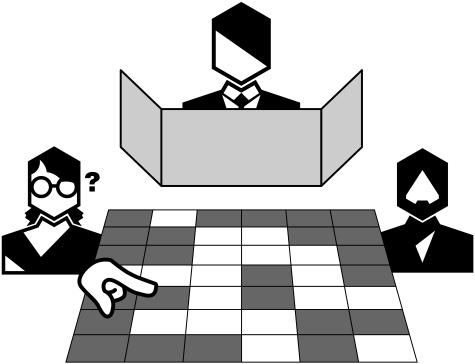
Aspects of the game state are hidden from all but one or a few players.
Discussion
Information can be known to one or more players but not to all players. This includes information we’ve covered elsewhere, like Hidden Roles (UNC-04), or private hands of cards. However, in this context, we refer less to those sets of information which are permanent elements of a player’s role in a game, like their hand of cards. Instead, we’re considering things like the strength of the monsters that all players can battle for victory points in Champions of Midgard. The types of information that may be hidden in this manner typically fall into a few categories: secret player abilities, secret goals, the strength of enemies, and the location of specific items or resources. Players might spend actions or resources to gain this knowledge, or not. Another type of information of this sort is specific knowledge of another player’s hand based on deduction. If you hold the Princess in Love Letter, you can be certain that nobody else does, but no other player can be certain about whether the Princess is in your hand, any other player’s hand, or the draw deck. Designers employ a variety of mechanisms and components to manage hiding and revealing this kind of information. Cards are especially common, as in
Clue, where players respond to an accusation by showing a disproving card only to the accusing player. Other options include face-down cards, player screens, tokens with common backs but different fronts, and figures with information on the bottom of their bases. More exotically, in Pikoko, a competitive tricktaking game, players hold their hands facing out, so each player can see every card in hand, except those held in their own hand. Careers begins with players selecting their own victory conditions as a mixture of Fame, Happiness, and Money, and recording it on their personal play sheet. These techniques can help add new layers of strategy for advanced players. Once players understand what the range of the hidden information is, they can try to deduce what it is from players who know it. This also offers an opportunity for bluffing. For example, paying attention to what elements players include in a guess in Clue may give astute players knowledge of what cards other players have been shown. But knowing that players may be looking out for that may cause advanced players to continue to include elements in their guesses that they think will lead their opponents to draw erroneous conclusions.
Sample Games
Careers (Brown, 1955) Champions of Midgard (Steiness, 2015) Clue (Pratt, 1949) Kingsburg (Chiarvesio and Iennaco, 2007) Love Letter (Kanai, 2012) Pikoko (Porter, 2018)
描述
游戏状态的某些方面只对一个或少数玩家是已知的,对其他玩家隐藏(Hidden Information)。
讨论
信息可以被一个或多个玩家知道,但不能被所有玩家知道。这包括我们在别处涵盖的信息,如隐藏角色(UNC-04)或私人手牌。然而,在这种情况下,我们较少指那些作为游戏玩家角色永久元素的几组信息,比如他们的手牌。相反,我们考虑的是像在《Champions of Midgard》中所有玩家都可以为胜利点数而战的怪物的强度之类的东西。这种可能被隐藏的信息类型通常分为几类:秘密玩家能力、秘密目标、敌人的强度以及特定物品或资源的位置。玩家可能会花费行动或资源来获得这种知识,或者不。另一种此类信息是基于演绎对另一名玩家手牌的具体了解。如果你在《Love Letter》中持有公主,你可以确定其他人没有,但没有其他玩家可以确定公主是在你手中、任何其他玩家手中还是在牌堆中。设计师采用各种机制和组件来管理隐藏和揭示此类信息。卡牌特别常见,如在
《Clue》中,玩家通过只向指控玩家出示反驳卡来回应指控。其他选项包括面朝下的卡牌、玩家屏幕、背面相同但正面不同的代币,以及底座底部有信息的人物。更奇特的是,在竞争性吃墩游戏《Pikoko》中,玩家将手牌面朝外持有,因此每个玩家都可以看到手中的每张牌,除了自己手中的牌。《Careers》开始时,玩家选择自己的胜利条件,混合名声、幸福和金钱,并将其记录在个人游戏表上。这些技术可以帮助为高级玩家增加新的策略层。一旦玩家了解隐藏信息的范围,他们就可以尝试从知道它的玩家那里推断出它是什么。这也提供了虚张声势的机会。例如,注意玩家在《Clue》的猜测中包含哪些元素,可能会给精明的玩家关于其他玩家展示了什么牌的知识。但是,知道玩家可能会注意这一点可能会导致高级玩家继续在猜测中包含他们认为会导致对手得出错误结论的元素。
游戏范例
Careers (Brown, 1955) - 《Careers》 Champions of Midgard (Steiness, 2015) - 《Champions of Midgard》 Clue (Pratt, 1949) - 《妙探寻凶/Clue》 Kingsburg (Chiarvesio and Iennaco, 2007) - 《Kingsburg》 Love Letter (Kanai, 2012) - 《情书》 Pikoko (Porter, 2018) - 《Pikoko》