Description
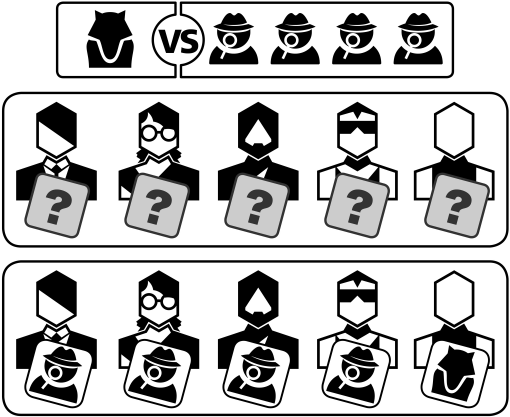
One or more players are assigned differing roles that are not publicly revealed at the start of the game.
Discussion
While uncertainty lurks in many games, in Hidden Roles games, uncertainty is at the very heart of the gameplay. We can broadly talk about three types of Hidden Roles games: social deduction games, traitor games, and competing roles games. We touched on this topic earlier in the chapter about game structure (see Chapter 1). Social deduction games are team games in which the object of gameplay is to deduce the team allegiances of the players, as in the classic open-source game Mafia (which, ten years after its invention, was recast as Werewolf ). It’s worth noting that in these games, usually, only one team faces uncertainty. The werewolves know who all the villagers are, and as such, the werewolves are playing a role-playing game whose win condition is to successfully deceive the villagers for long enough to devour them. The villagers are playing a deduction game where the evidence is mostly in the social interactions
at the table rather than the almost non-existent mechanical interactions. In this section, we’ll generically refer to the “villagers” to represent the team, typically positioned as the thematic protagonists, that has less knowledge of the game state, and “werewolves” to describe their opponents, who know the identities of most or all players. Shadow Hunters, Two Rooms and a Boom, and BANG! are exceptions to this general rule. In these games, the players do not know the identities of any of the other players (except for the Sheriff in BANG!, who is known to all). This gives these games a different feel, as there is less paranoia, as all players are on an equal footing, and an early part of the game is players trying to determine who is on their team without tipping their hand. Traitor games, as distinct from social deduction games, have some other win condition for the “villager” side besides revealing the traitors. In Battlestar Galactica: The Board Game, players try to reach Korhol (or some other destination), and the game operates as a cooperative game (see “STR-02” in Chapter 1). However, a traitor may lurk among the players, secretly sabotaging them. In traitor games, the traitor, upon discovery or self-revelation, often shifts into a different role with a new win condition, new actions, and different player powers. Traitor games need to use hidden resolution systems so that players can cause trouble while maintaining anonymity. In Battlestar, players play cards face-down during the crisis phase, trying to sum up to a value of cards of a certain color. Because the cards are played face-down, the traitor can sabotage the crisis resolution effort without revealing himself or herself; although, through deduction, the other players may start to uncover their identity. Dark Moon has players roll dice behind a screen. Each player must select one die to use to resolve the action. Traitors may use their worst rolls so as not to benefit the team, but showing a bad roll does not guarantee a traitor, as a loyal player may just have a bad roll and have no good dice to choose from. In our final category, competing roles games, players are not on fixed teams and have hidden identities, but revealing those identities is not directly tied to winning or losing. Ravenous River and Coup are examples of competing roles games. In Ravenous River, each player is secretly assigned one of seven animal identities. Animals eat one other type of animal and are in turn eaten by one other type. Players use cards to manipulate the positions of any animals, not just their animal, seeking to end the round in the same region as their prey and not their predator. Deducing the identities of the other players can help in executing a strategy but isn’t worth any points toward victory.
The uncertainty in all of these types of games is not the operational uncertainty of attempting an outcome without knowing whether it will succeed, but it still is a kind of output randomness that injects noise between a player’s intention and the results of his or her action. In Mascarade, player roles can move around from player to player, such that a player may not know what role he or she has at any given time, which creates a lot of uncertainty. Like in Coup, players can claim the actions associated with any role, but unlike in Coup, roles can get shuffled and players may not look at their own role cards freely; they must spend their turn doing so. An important source of uncertainty in social deduction games in particular is in the unstructured conversation during which players discuss potential targets and coordinate for the upcoming resolution phase, typically a vote. The conversation phase offers players the opportunities to lie, obfuscate, bluff, posture, or hide in a shroud of silence. Experientially, this phase is crucial, and whether players enjoy this genre of the game rests largely on how much they enjoy this part of the game. Some games attempt to enforce some structure in the discussion phase, by creating mechanisms with in-game consequences that players must grapple with. In Salem 1692, players play action cards on one another that impact status and abilities, including accusation cards that operate in place of the voting phase of other social deduction games. In Shadow Hunters, players give cards with yes/no questions to other players, which they must answer. In Ravenous River, as mentioned above, a player may have the opportunity to manipulate the positions of a few animals, including animals other than themselves. These actions, and their potential point-scoring consequences, provide evidence of the player’s secret identity. This is related to hidden endgame goals (VIC-06). We’ve touched briefly on Werewolf in its most basic form. However, its most popular commercial iterations, such as Ultimate Werewolf and The Resistance: Avalon, feature a dizzying array of additional roles, each of which changes the dimensions and possibilities of gameplay. Some roles offer players additional private information about other players and their roles or team identities. Others can protect players from being eliminated, which injects performative uncertainty into the elimination action. Some roles provide an elimination power, which can be helpful to the “villager” side but might actually cloud the situation and make it more difficult to assess who the “werewolves” are because players don’t know which team eliminated which players. There’s much more to be said about the various types of roles possible in these kinds of games, which is beyond the scope of this work. However, one
role is critical to consider: the role of the moderator. In many social deduction games, the need to hide substantial aspects of the game state from a shifting set of audiences makes these games inherently fragile and subject to inadvertent revealing of information or even tolerance for some mild cheating. Because these games also have unstructured conversation phases, driving the game toward a conclusion can sometimes be difficult. That’s why many of these games call for a moderator who does not play the game, at least in the sense that the moderator can neither win nor lose, but simply administrates the game, and especially enforces time limits, whether formal and agreed upon or informal and socially accepted. Since the moderator is the only person who knows the complete game state, playing as the moderator can be quite appealing to players who enjoy spectating and people-watching. The moderator role can also be performed with theatricality and has an element of role-playing that sits in its own layer of game-engagement that is separate from the core game engine. And of course, like any refereeing role, the moderator can have both unintentional and intentional impacts on the course of the game through their manipulation of soft power, like when to call a discussion to a close and insist on a vote. Perhaps for these reasons, the moderator role has been eliminated in many modern designs. In One Night Ultimate Werewolf, a prerecorded voice, run by an app, takes players through the paces of each round, such that a moderator is not required. In Dracula’s Feast, both the moderator and the idea of player elimination are removed, and players have asymmetric win conditions, some of which are not tied to discovering other players but to being accused of inhabiting certain roles. These differences put the game firmly into the competing roles category rather than the social deduction category. In order to get around the problem of sharing information secretly, players each have a “Yes” and “No” card that they can show to the one player asking them a question. These games can often have multiple players winning by fulfilling different conditions. Two Rooms and a Boom is particularly instructive in this area. Voting-based player elimination is very common in social deduction games, and that mechanism can create negative social consequences. From the perspective of a cultural critic, these games are intended to recreate uncomfortable social and political realities like mob justice, betrayal, and schoolyard cliques. Some games lean into these dynamics, like Secret Hitler, which not only requires that players step into a magic circle where they may have to self-identify as a Nazi, or as Hitler himself, but must also participate
in a morally gray universe in which even non-Fascists might pass Fascist policies. Designers need to take care that players understand the nature of the magic circle that they’re stepping into, and what might be expected of them in their suspension of real-world rules during play.
Sample Games
BANG! (Sciarra, 2002) Battlestar Galactica: The Board Game (Konieczka, 2008) Coup (Tahta, 2012) Dark Moon (Derrick, 2011) Dracula’s Feast (Hayward, 2017) Mascarade (Faidutti, 2013) One Night Ultimate Werewolf (Alspach and Okui, 2014) Ravenous River (Shalev, 2016) The Resistance: Avalon (Eskrisge, 2012) Salem 1692 (Hancock, 2015) Secret Hitler (Boxleiter, Maranges, and Temkin, 2016) Shadow Hunters (Ikeda, 2005) Two Rooms and a Boom (Gerding and McCoy, 2013) Ultimate Werewolf (Alspach, 2010) Werewolf (Davidoff and Plotkin, 1986)
描述
一名或多名玩家被分配了不同的角色(Hidden Roles),这些角色在游戏开始时不会公开揭示。
讨论
虽然不确定性潜伏在许多游戏中,但在隐藏角色游戏中,不确定性是核心玩法。我们可以大致讨论三种类型的隐藏角色游戏:社交推理游戏、叛徒游戏和竞争角色游戏。我们在本章前面关于游戏结构的部分中谈到过这个话题(参见第1章)。社交推理游戏是团队游戏,其中的游戏目标是推断玩家的团队效忠,如经典的开源游戏《Mafia》(在其发明十年后被重铸为《狼人杀》/Werewolf)。值得注意的是,在这些游戏中,通常只有一方团队面临不确定性。狼人知道所有村民是谁,因此,狼人实际上是在玩角色扮演游戏,其胜利条件是成功欺骗村民足够长的时间来吞噬他们。村民则是在玩演绎推理游戏,其中的证据主要是在社交互动中,
而不是几乎不存在的机制互动。在本节中,我们将统称“村民”来代表对游戏状态知识较少的团队,通常被定位为主题主角,用“狼人”来描述他们的对手,后者知道大多数或所有玩家的身份。《Shadow Hunters》、《Two Rooms and a Boom》和《BANG!》是这个一般规则的例外。在这些游戏中,玩家不知道任何其他玩家的身份(除了在《BANG!》中警长是所有人都知道的)。这给这些游戏带来了不同的感觉,因为偏执感较少,所有玩家处于平等的地位,游戏的早期部分是玩家试图确定谁在他们的团队中,而不暴露自己。与社交推理游戏不同,叛徒游戏对于“村民”方除了揭示叛徒之外还有其他胜利条件。在《Battlestar Galactica: The Board Game》中,玩家试图到达Korhol(或其他目的地),游戏作为合作游戏运行(参见第1章中的“STR-02”)。然而,叛徒可能潜伏在玩家中间,暗中破坏他们。在叛徒游戏中,叛徒在被发现或自我揭示后,通常会转变为具有新胜利条件、新行动和不同玩家能力的不同角色。叛徒游戏需要使用隐藏解决系统,以便玩家可以在保持匿名的情况下制造麻烦。在《Battlestar》中,玩家在危机阶段面朝下打出卡牌,试图总结出某种颜色卡牌的值。因为卡牌是面朝下打出的,叛徒可以在不暴露自己的情况下破坏危机解决工作;尽管通过演绎,其他玩家可能会开始发现他们的身份。《Dark Moon》让玩家在屏幕后面掷骰子。每个玩家必须选择一个骰子来解决行动。叛徒可能会使用他们最差的掷骰结果以免让团队受益,但展示糟糕的掷骰结果并不能保证是叛徒,因为忠诚的玩家也可能只是运气不好,没有好的骰子可供选择。在我们的最后一类竞争角色游戏中,玩家不在固定团队中并且拥有隐藏身份,但揭示这些身份与输赢没有直接联系。《Ravenous River》和《Coup》是竞争角色游戏的例子。在《Ravenous River》中,每个玩家被秘密分配了七种动物身份之一。动物吃一种其他类型的动物,反过来又被另一种类型的动物吃。玩家使用卡牌来操纵任何动物的位置,而不仅仅是他们的动物,试图在回合结束时与其猎物在同一区域,而不是与其捕食者在同一区域。推断其他玩家的身份可以帮助执行策略,但这对于胜利没有任何点数价值。
所有这些类型游戏中的不确定性不是尝试结果而不知道是否会成功的操作不确定性,但它仍然是一种输出随机性,在玩家意图与其行动结果之间注入噪音。在《Mascarade》中,玩家角色可以在玩家之间移动,使得玩家可能不知道自己在任何给定时间拥有什么角色,这产生了很大的不确定性。像在《Coup》中一样,玩家可以声称与任何角色相关的行动,但与《Coup》不同的是,角色会被洗混,玩家不能随意查看自己的角色卡;他们必须花费回合这样做。特别是在社交推理游戏中,不确定性的一个重要来源是无结构的对话,在此期间玩家讨论潜在目标并为即将到来的解决阶段(通常是投票)进行协调。对话阶段为玩家提供了撒谎、混淆视听、虚张声势、装腔作势或隐藏在沉默中的机会。从经验上讲,这个阶段至关重要,玩家是否喜欢这种类型的游戏很大程度上取决于他们有多喜欢这部分游戏。有些游戏试图在讨论阶段强制执行某种结构,通过创建具有游戏内后果的机制让玩家必须应对。在《Salem 1692》中,玩家对彼此打出影响状态和能力的行动卡,包括代替其他社交推理游戏投票阶段的指控卡。在《Shadow Hunters》中,玩家给其他玩家带有是/否问题的卡片,他们必须回答。如上所述,在《Ravenous River》中,玩家可能有机会操纵几只动物的位置,包括除自己以外的动物。这些行动及其潜在的得分后果提供了玩家秘密身份的证据。这与隐藏的终局目标(VIC-06)有关。我们简要介绍了最基本形式的《狼人杀》。然而,其最受欢迎的商业迭代,如《Ultimate Werewolf》和《The Resistance: Avalon》,具有令人眼花缭乱的额外角色,每个角色都会改变游戏的维度和可能性。有些角色为玩家提供有关其他玩家及其角色或团队身份的额外私人信息。其他角色可以保护玩家免于被淘汰,这给淘汰行动注入了表演性的不确定性。有些角色提供淘汰能力,这对“村民”方可能有帮助,但实际上可能会混淆局势,使评估谁是“狼人”变得更加困难,因为玩家不知道哪个团队淘汰了哪些玩家。关于这类游戏中可能的各种角色类型还有很多要说的,但这超出了本作品的范围。然而,有一个
角色至关重要:主持人的角色。在许多社交推理游戏中,需要向不断变化的受众隐藏游戏状态的大部分方面,这使得这些游戏本质上很脆弱,容易无意中泄露信息,甚至容忍一些轻微的作弊。因为这些游戏也有无结构的对话阶段,推动游戏走向结局有时可能很困难。这就是为什么其中许多游戏需要一名不玩游戏的主持人,至少在这个意义上,主持人既不能赢也不能输,而只是管理游戏,特别是执行时间限制,无论是正式商定的还是非正式的社会公认的。由于主持人是唯一知道完整游戏状态的人,作为主持人玩对于喜欢旁观和观察人的玩家来说可能非常有吸引力。主持人角色还可以带有戏剧性,并且具有角色扮演的元素,这位于独立于核心游戏引擎的游戏参与层中。当然,像任何裁判角色一样,主持人可以通过操纵软实力(如何时结束讨论并坚持投票)对游戏进程产生无意和有意的既有影响。也许出于这些原因,许多现代设计中已经取消了主持人角色。在《One Night Ultimate Werewolf》中,由应用程序运行的预先录制的声音带领玩家完成每一轮的步骤,因此不需要主持人。在《Dracula’s Feast》, 主持人和玩家淘汰的概念都被移除了,玩家拥有不对称的胜利条件,其中一些与发现其他玩家无关,而是与被指控拥有某些角色有关。这些差异使游戏坚定地属于竞争角色类别,而不是社交推理类别。为了解决秘密分享信息的问题,每位玩家都有一张“是”和“否”卡,他们可以向问他们问题的一名玩家出示。这些游戏通常可以让多个玩家通过满足不同条件获胜。《Two Rooms and a Boom》在这方面特别具有指导意义。基于投票的玩家淘汰在社交推理游戏中非常常见,这种机制可能会产生负面的社会后果。从文化评论家的角度来看,这些游戏旨在重现令人不安的社会和政治现实,如暴民正义、背叛和校园派系。有些游戏倾向于这些动态,如《Secret Hitler》,它不仅要求玩家步入一个魔法圈,在那里他们可能不得不自我认同为纳粹,或者希特勒本人,而且还必须参与
在一个道德灰色的宇宙中,甚至非法西斯分子也可能通过法西斯政策。设计师需要注意让玩家理解他们正在步入的魔法圈的性质,以及在游戏中暂停现实世界规则时对他们的期望。
游戏范例
BANG! (Sciarra, 2002) - 《砰!/BANG!》 Battlestar Galactica: The Board Game (Konieczka, 2008) - 《太空堡垒卡拉狄加》 Coup (Tahta, 2012) - 《政变》 Dark Moon (Derrick, 2011) - 《Dark Moon》 Dracula’s Feast (Hayward, 2017) - 《Dracula’s Feast》 Mascarade (Faidutti, 2013) - 《假面舞会》 One Night Ultimate Werewolf (Alspach and Okui, 2014) - 《一夜终极狼人》 Ravenous River (Shalev, 2016) - 《Ravenous River》 The Resistance: Avalon (Eskrisge, 2012) - 《抵抗组织:阿瓦隆》 Salem 1692 (Hancock, 2015) - 《塞勒姆1692》 Secret Hitler (Boxleiter, Maranges, and Temkin, 2016) - 《Secret Hitler》 Shadow Hunters (Ikeda, 2005) - 《暗影猎人》 Two Rooms and a Boom (Gerding and McCoy, 2013) - 《Two Rooms and a Boom》 Ultimate Werewolf (Alspach, 2010) - 《终极狼人》 Werewolf (Davidoff and Plotkin, 1986) - 《狼人杀》