9♠ 4♠ 10♠ 5♠ 7♠ 2♠ 3♠ ♠♠ …
Description
Players attempt to determine the rules governing a situation. Typically, a game master creates a hidden rule. Players then create a pattern or play a game element and are told by the game master whether that matches the rule.
Discussion
Induction is a similar mechanism to Deduction but with distinct differences. The textbook definition of the concepts of “deductive” versus “inductive” reasoning is that deductive starts with facts (or theories) to draw a conclusion. Inductive reasoning starts with observations and then tries to come up with an explanation that ties together those observations. There is a lot of overlap between these approaches, which leads to confusion in their everyday usage. “Induction” as a game mechanism is best understood through an example. Eleusis is played with a standard set of playing cards. The dealer secretly comes up with a rule and lays out a starter card on the table. The other players in turn then play a card and are told whether it fits the rule and can be added to the line of cards on the table (beginning with the starter card) or not. If the card does not fit the rule, it is played next to the main line so players can have a history of both what did and did not work.
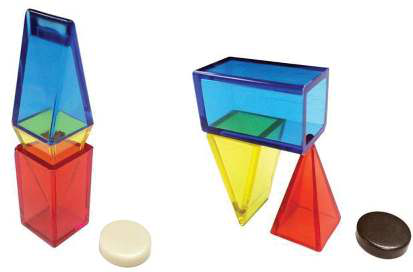
Examples of simple rules in Eleusis include black and red cards have to alternate, or the value of the card cannot be more than three away from the last card. A more complex rule might be that cards must alternate red and black, but that face cards can only be played after cards that are a perfect square (1, 4, 9). If a player thinks they know the rule, they can declare that they are “the prophet.” Tey take over the roles of declaring whether any card played is right or wrong. So long as they are correct, they continue in this role. If the dealer says they are incorrect, they are no longer the prophet and are penalized. Scoring rules for Eleusis are fairly complex, as they want to reward the dealer for coming up with a complex rule but not so complex that no one figures it out. This is reminiscent of Targeted Clues (RES-17), where a player wants some, but not all, of the other players to guess something. Zendo is another classic example of an induction game. It is based on Eleusis but uses pyramidal blocks of various shapes and colors. The “Master” devises a secret rule. Players then construct a “Koan” from the stackable pyramid pieces on the table and the master marks with a white stone if it meets the rule, or a black stone if it doesn’t (Illustration 6.3). For purposes of games, the distinguishing characteristics of induction games are: • Open-ended rule • Players make guesses. Tey are only told if they fit or don’t fit the rule. Illustration 6.3 Two sample guesses, or “Koans,” in Zendo. The first meets the rule, and the second does not, as indicated by the stone color. The rule might be that there is a yellow piece, but it does not touch the table. Photo by W. Eric Martin.
This seems similar to deduction games like Clue. There, players make guesses and are told whether they are right or wrong. But the difference comes from the open-ended nature of the possible answer to the puzzle. In Clue, players know that the solution contains exactly one Suspect, Room, and Weapon. In Eleusis, there is no bounded list of possibilities. Another distinction between induction and deduction games is that in deduction games you are almost always given some information when making a failed guess—being shown a card disproving the accusation in Clue, for example. In Induction, you are merely told “right” or “wrong” and need to come up with your own “experiment” to try to figure out why you were right or wrong, so you can limit the possible rule space. The crux of induction games is the creation of the rule. First-time players are often stymied for ideas on rules, and players also tend to dramatically underestimate the complexity of their rules. There is a small sweet spot of a satisfying rule that players are gradually able to zero in on versus an obscure rule that only leads to a long, frustrating play experience. To help with this, some games come with “starter rules” or some other way to generate rules. However, this undercuts the strength of Induction, as once players know what the possible rules are, it reverts to a deduction game. The public domain game Mao is a metagame activity, where experienced players, who know the rules, play with novices, who do not. When a card is played, the novices are told whether it is a legal play or not. At the end of the game, the winner secretly adds a new rule for the next game. The secret rules usually go beyond the expected mechanisms of a card game. Tey may be tied to what players are wearing, what they might say, which hands they use, or anything else. The knowledge imbalance between the novices and the experienced players encourages the development of a ruleset based on injokes and private group dynamics. A commercial version of Mao, called Quao (pronounced “cow”), jumpstarts this organic rules-growth, by including a small deck of starter rules. One player selects some of these, at random, to start each game. Reviews of the game have noted that if these rule cards have all been seen and begin to be reused, the game loses much of its charm. A vast potential playspace is an important component of Induction games. In addition to how rules are created, the designer also needs to consider how guesses are made. Tey can be bounded, as in Eleusis, where a player must play a card from their hand as a guess, or unbounded, as in Zendo,
where players can arrange their pyramids as they see fit. This makes Zendo more challenging than Eleusis. Unbounded guesses do not automatically translate to complexity, however. The classic guessing game 20 Questions is also a form of Induction. One player thinks of (typically) a noun, and the other players need to ask yes or no questions to determine what that player is thinking of. The flexibility of language helps the players narrow things down the category fairly quickly (e.g., Is it an animal? Is it larger than a toaster?). Another example of a game with bounded guesses is Visitor in Blackwood Grove. One player is an alien who crashes into a forest and creates a forcefield around the ship. The alien player creates a rule about what objects may pass through the forcefield (e.g., objects containing metal will pass). The “kid” player is working to get objects to the alien player before the government agents figure out the rule. The use of object cards cleverly opens up a large body of “world” knowledge to possible rules that do not exist in Eleusis or Zendo. Visitor also shows that Induction games can be thematic, unlike almost all Induction games published to date.
Sample Games
20 Questions (Unknown) Eleusis (Abbott, 1956) Mao (Unknown) Quao (Rivaldi and Rivaldi, 2007) Visitor in Blackwood Grove (Flanagan and Seidman, 2018) Zendo (Heath and Looney, 2001)
9♠ 4♠ 10♠ 5♠ 7♠ 2♠ 3♠ ♠♠ …
描述
玩家试图确定控制局势的规则(Induction)。通常,游戏管理员创建一个隐藏规则。然后玩家创建一个模式或打出一个游戏元素,并由游戏管理员告知该元素是否符合规则。
讨论
归纳与演绎是类似的机制,但有明显的区别。“演绎”与“归纳”推理概念的教科书定义是,演绎从事实(或理论)开始得出结论。归纳推理从观察开始,然后试图提出一个将这些观察联系起来的解释。这些方法之间有很多重叠,导致在日常使用中容易混淆。作为一个游戏机制,“归纳”最好通过一个例子来理解。《Eleusis》是用一副标准的扑克牌玩的。庄家秘密想出一个规则,并在桌子上放一张起始牌。其他玩家轮流打出一张牌,并被告知它是否符合规则,是否可以添加到桌子上的牌列中(从起始牌开始)。如果这张牌不符合规则,它将被放在主线旁边,以便玩家可以拥有关于什么有效什么无效的历史记录。
《Eleusis》中简单规则的例子包括黑牌和红牌必须交替,或者牌的值不能与上一张牌相差超过三。更复杂的规则可能是牌必须红黑交替,但人头牌只能在完全平方数(1, 4, 9)的牌之后打出。如果玩家认为他们知道规则,他们可以宣布他们是“先知”。他们接管宣布任何打出的牌是对还是错的角色。只要他们是正确的,他们就继续担任这个角色。如果庄家说他们不正确,他们就不再是先知并受到惩罚。《Eleusis》的得分规则相当复杂,因为它们想要奖励想出复杂规则的庄家,但不能太复杂以至于没人能弄清楚。这让人想起定向线索(RES-17),其中玩家希望一部分人(但不是所有人)猜出某事。《Zendo》是归纳游戏的另一个经典例子。它基于《Eleusis》,但使用各种形状和颜色的金字塔块。“大师”设计一个秘密规则。然后玩家用桌上可堆叠的金字塔块构建一个“公案”(Koan),如果它符合规则,大师就用白石标记,如果不符合,就用黑石标记(插图6.3)。出于游戏目的,归纳游戏的区别特征是: • 开放式规则 • 玩家进行猜测。他们只被告知是否符合规则。
插图6.3 《Zendo》中的两个猜测样本,或“公案”。如石头颜色所示,第一个符合规则,第二个不符合。规则可能是有一个黄色的棋子,但它不接触桌面。摄影:W. Eric Martin。
这看起来类似于《Clue》这样的演绎游戏。在那里,玩家进行猜测并被告知是对还是错。但区别来自谜题可能答案的开放性质。在《Clue》中,玩家知道解决方案恰好包含一个嫌疑人、一个房间和一个武器。在《Eleusis》中,没有可能性的有界列表。归纳和演绎游戏之间的另一个区别是,在演绎游戏中,当你做出失败的猜测时,你几乎总是得到一些信息——例如在《Clue》中被展示一张反驳指控的卡片。在归纳中,你只被告知“对”或“错”,需要想出你自己的“实验”来试图弄清楚为什么你是对的或错的,这样你就可以限制可能的规则空间。归纳游戏的关键是规则的创建。初次玩家经常对规则的想法感到束手无策,而且玩家也倾向于大大低估他们规则的复杂性。在玩家逐渐能够锁定的令人满意的规则与只导致漫长、令人沮丧的游戏体验的晦涩规则之间,有一个很小的最佳击球点。为了帮助解决这个问题,一些游戏附带了“入门规则”或其他生成规则的方法。然而,这削弱了归纳的强度,因为一旦玩家知道可能的规则是什么,它就回复到演绎游戏。公共领域游戏《Mao》是一个元游戏活动,知道规则的有经验的玩家与不知道规则的新手一起玩。当打出一张牌时,新手被告知这是否是一个合法的打法。在游戏结束时,获胜者秘密地为下一场游戏添加一条新规则。秘密规则通常超出纸牌游戏的预期机制。它们可能与玩家穿什么、他们可能说什么、他们用哪只手或任何其他事情有关。新手和有经验玩家之间的知识不平衡鼓励了基于内部笑话和私人群体动态的规则集的发展。《Mao》的商业版本,称为《Quao》(发音为“cow”),通过包含一小副入门规则来启动这种有机规则增长。一名玩家随机选择其中一些来开始每场游戏。游戏的评论指出,如果这些规则卡都被看过并开始重复使用,游戏就会失去很多魅力。巨大的潜在游玩空间是归纳游戏的一个重要组成部分。除了如何创建规则外,设计师还需要考虑如何进行猜测。它们可以是有界的,如在《Eleusis》中,玩家必须从手中打出一张牌作为猜测,或者是无界的,如在《Zendo》中,
玩家可以按他们认为合适的方式排列他们的金字塔。这使得《Zendo》比《Eleusis》更具挑战性。然而,无界猜测并不自动转化为复杂性。经典的猜测游戏《20 Questions》也是一种归纳形式。一个玩家想(通常)一个名词,其他玩家需要问是或否的问题来确定那个玩家在想什么。语言的灵活性有助于玩家相当快地缩小类别范围(例如,它是一种动物吗?它比烤面包机大吗?)。有界猜测游戏的另一个例子是《Visitor in Blackwood Grove》。一个玩家是坠入森林并在飞船周围制造力场的外星人。外星人玩家创建一个关于什么物体可以通过力场的规则(例如,含有金属的物体将通过)。“孩子”玩家正在努力在外星人被政府特工弄清楚规则之前将物体送给外星人。物体卡的使用巧妙地打开了通往可能规则的大量“世界”知识,这是《Eleusis》或《Zendo》中不存在的。《Visitor》还表明,归纳游戏可以是具有主题的,这与迄今为止出版的几乎所有归纳游戏都不同。
游戏范例
20 Questions (Unknown) - 《20 Questions》 Eleusis (Abbott, 1956) - 《Eleusis》 Mao (Unknown) - 《Mao》 Quao (Rivaldi and Rivaldi, 2007) - 《Quao》 Visitor in Blackwood Grove (Flanagan and Seidman, 2018) - 《Visitor in Blackwood Grove》 Zendo (Heath and Looney, 2001) - 《Zendo》