Description
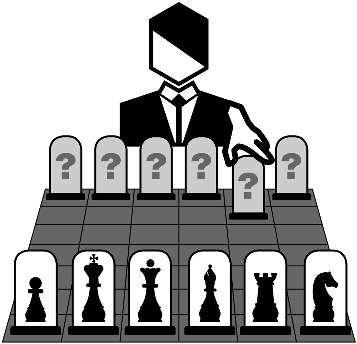
Hidden, trackable information whose tracking gives players an advantage.
Discussion
Memory can be a game mechanism or a capability a player draws upon when engaging with one or more mechanisms. It’s an important design ingredient, a lever whose setting will have a substantial impact on a game’s weight, intended audience, and general reception. Our discussion will focus on games where memory is at the center of the game design, rather than where memory is an ancillary skill that the game tests. Memory games can be seen on a spectrum. At one end, are games like the classic game Memory and the modern game The Magic Labyrinth, in which the only skill the core game mechanism tests is whether players can remember things. In Memory, it’s the specific location of various items in the face-down grid of tiles. In The Magic Labyrinth, players need to remember the correct path through the maze, because the walls of the maze are invisible, and the game uses magnets on the underside of the board to define that path. Memoarrr! borrows a bit from both of these games, with cards that feature two elements that must be remembered, and then arranged spatially.
Further down this spectrum are games where memory is crucial to the core gameplay in patent and obvious ways. Stratego and Lord of the Rings: The Confrontation features player pieces on standees or blocks. These pieces have unit information on only one side, such that players can’t see the identities of opposing pieces before they encounter them. In an encounter, players reveal the pieces, then flip them back, leaving the players to use their memories to track the location and identity of the revealed pieces. These games have fairly small and stripped-down rulesets that put the spotlight squarely on memory, but block-style war games like Sekigahara: The Unification of Japan use this same mechanism to add fog of war—the uncertainty of the disposition of enemy forces that is typical in war. This type of memory mechanism, sometimes called “Hidden Trackable Information” (HTI), for short, challenges players to remember information that was once revealed to them. We’ve discussed positional examples so far, but those examples are perhaps the least polarizing. In Small World, players must announce how many coins (i.e., victory points or VPs) they have collected at the end of their turn but not their total. It would be trivial to track this information with a paper and pencil, but in the context of a fast-moving game of territory control, it’s easy for players to lose track of who is ahead. This is intentional on the part of the game designer! Small World is the successor to Vinci, a Roman-themed game that is mechanically almost identical. One key change between the two games was making the victory points hidden, trackable information. This helped to prevent dynamics which plagued Vinci: bash-the-leader behavior and the extent to which players optimized their play on the last turn. This change, along with cute art and a lighthearted feeling, turned Small World into an evergreen success in the casual games space. Another example of HTI is found in El Grande. In addition to placing cubes onto the board, players may choose to place them into the Castillo, a tall tower. Players cannot look in the Castillo; they need to remember how many cubes are there. At the end of the round, each player secretly selects a province in which to place his or her Castillo cubes. Remembering how many cubes of each player are in the tower can be challenging—even remembering how many of your own are in there can be difficult for players. But this lends a fun, swingy punctuation to what otherwise is a very calculable game. HTI can be especially controversial when it exists in more complex games, but it is nonetheless common in 18xx games and other heavy economic or auction games (see Chapter 7 “Economics” and Chapter 8 “Auctions”,
respectively), where a player or corporate cash holdings are hidden. To some extent, this thematically reflects the ways in which corporations are secretive about their finances. Mechanically, pricing an auction or predicting an opponent’s actions is much simpler when the total money in the system is known and is even easier when the allocation of that money is known. Memory and HTI sharply reduce accessibility and inclusion. To help players who have trouble remembering, many games provide tracking components, like Clue’s guessing pad. Other games provide some aid to memory, like Hunt for the Ring, where the Nazgul players have a handful of tokens with different markings that they can use as they wish. In Hanabi, the rules explicitly encourage players to find a limit on communications that maximized the fun for the group. This leaves open an enormous range of possibilities, from playing Hanabi as a strict memory game where each individual must keep track of his or her own hand, to one with almost no memory component since players are free to remind one another what each of them has been clued to in his or her own hands previously. Even under such rules, however, players must remember when they were clued about the state of their hands, and which new cards they have drawn since then. Many games rely heavily on memory, even though they’re not explicitly memory games, and players with better memory (or card-counting systems) will have a substantial advantage. Trick-taking games and classic card games in general fall into this category, since players who can remember which cards have already been played can make better decisions about what to play next, and the relative values of cards still in their hands. Another common dynamic is games in which remembering the types of sets your opponent is collecting allows you to interfere with them effectively, as in Animals on Board. In these games, cards or tiles collected by players are hidden away after collection. These are important design considerations, but they relate to memory as a player skill rather than as a game mechanism. Admittedly, the line between these two is fuzzy, but we will wrap our discussion of memory mechanisms here.
Sample Games
Animals on Board (Sentker and zur Linde, 2016) Clue (Pratt, 1949) El Grande (Kramer and Ulrich, 1995) Hanabi (Bauza, 2010) Hunt for the Ring (Maggi, Mari, and Nepitello, 2017) Lord of the Rings: The Confrontation (Knizia, 2002) The Magic Labyrinth (Baumann, 2009) Memoarrr! (Bortolini, 2017) Memory (Unknown, 1959) Sekigahara: The Unification of Japan (Clakins, 2011) Small World (Keyaerts, 2009) Stratego (Mogendorff, 1946) Vinci (Keyaerts, 1999)
描述
跟踪会给玩家带来优势的隐藏、可跟踪信息(Memory)。
讨论
记忆可以是一种游戏机制,或者是玩家在参与一种或多种机制时所利用的能力。这是一个重要的设计要素,其设置将对游戏的权重、目标受众和总体接受度产生重大影响。我们的讨论将集中在记忆处于游戏设计中心的游戏,而不是记忆作为游戏测试的辅助技能的游戏。记忆游戏可以看作是一个谱系。在一端,是像经典游戏《Memory》和现代游戏《The Magic Labyrinth》这样的游戏,其中核心游戏机制测试的唯一技能是玩家是否能记住东西。在《Memory》中,是面朝下板块网格中各种物品的具体位置。在《The Magic Labyrinth》中,玩家需要记住迷宫的正确路径,因为迷宫的墙壁是不可见的,游戏利用棋盘底面的磁铁来定义该路径。《Memoarrr!》借鉴了这两种游戏的内容,其卡牌具有两个必须记住的元素,然后在空间上排列。
在这个谱系的更下方是那些记忆对核心玩法至关重要的游戏,其方式是显而易见的。《Stratego》和《魔戒对决》(Lord of the Rings: The Confrontation)的特点是玩家棋子放在立架或方块上。这些棋子只有一面有单位信息,这样玩家在遇到对方棋子之前看不到对方的身份。在遭遇中,玩家揭示棋子,然后翻回去,让玩家利用记忆来跟踪已揭示棋子的位置和身份。这些游戏有相当小且精简的规则集,将焦点直接放在记忆上,但像《Sekigahara: The Unification of Japan》这样的方块式战争游戏使用同样的机制来增加战争迷雾——战争中典型的敌军部署的不确定性。这种类型的记忆机制,有时简称为“隐藏可跟踪信息”(Hidden Trackable Information, HTI),挑战玩家记住曾经向他们揭示的信息。到目前为止,我们已经讨论了位置示例,但这些示例也许是最不具两极分化的。在《小小世界》(Small World)中,玩家必须宣布他们在回合结束时收集了多少硬币(即胜利点数或VP),但不是他们的总数。用纸笔记录这些信息是微不足道的,但在领土控制的快速移动游戏背景下,玩家很容易忘记谁领先。这正是游戏设计师的意图!《小小世界》是《Vinci》的继任者,后者是一款罗马主题的游戏,机制上几乎相同。两款游戏之间的一个关键变化是让胜利点数成为隐藏的、可跟踪的信息。这有助于防止困扰《Vinci》的动态:痛打领头羊行为以及玩家在最后一回合优化其游戏的程度。这一变化,加上可爱的艺术和轻松的感觉,使《小小世界》成为休闲游戏领域的长青树。HTI的另一个例子见于《大王》(El Grande)。除了将方块放在板上外,玩家还可以选择将它们放入卡斯蒂略(Castillo),一座高塔。玩家不能看卡斯蒂略里面;他们需要记住那里有多少方块。在回合结束时,每个玩家秘密选择一个省份来放置他或她的卡斯蒂略方块。记住每个玩家在塔里有多少方块可能具有挑战性——即使记住你自己有多少方块对玩家来说也很困难。但这给原本非常可计算的游戏增添了一种有趣、摇摆不定的标点。当HTI存在于更复杂的游戏中时,它可能特别具有争议性,但这在18xx游戏和其他重度经济或拍卖游戏中很常见(参见第7章“经济”和第8章“拍卖”,
分别),其中玩家或公司的现金持有是隐藏的。在某种程度上,这在主题上反映了公司对其财务状况保密的方式。在机制上,当系统中的总资金已知时,对拍卖定价或预测对手的行动要简单得多,而当该资金的分配已知时甚至更容易。记忆和HTI急剧降低了可访问性和包容性。为了帮助难以记忆的玩家,许多游戏提供跟踪组件,如《Clue》的猜测垫。其他游戏提供一些记忆辅助,如《Hunt for the Ring》,其中戒灵玩家有一把带有不同标记的代币,他们可以随意使用。在《花火》中,规则明确鼓励玩家找到一种能最大化群体乐趣的沟通限制。这留下了巨大的可能性范围,从作为严格的记忆游戏玩《花火》,每个人必须跟踪自己的手牌,到几乎没有记忆组件,因为玩家可以自由地提醒彼此之前对他们自己手中的牌有什么线索。然而,即使在这样的规则下,玩家也必须记住他们何时获得了关于手牌状态的线索,以及自那时以来他们抽了哪些新牌。许多游戏严重依赖记忆,即使它们没有明确是记忆游戏,记忆力更好(或有记牌系统)的玩家将拥有巨大优势。吃墩游戏和一般的经典纸牌游戏属于此类,因为能记住已经打出哪些牌的玩家可以更好地决定接下来打什么,以及仍然在手中的牌的相对价值。另一个常见的动态是记住对手正在收集的套牌类型允许你有效地干扰他们,如在《Animals on Board》中。在这些游戏中,玩家收集的卡牌或板块在收集后被隐藏起来。这些都是重要的设计考虑因素,但它们与记忆作为一种玩家技能有关,而不是作为一种游戏机制。诚然,这两者之间的界限是模糊的,但我们将在此结束对记忆机制的讨论。
游戏范例
Animals on Board (Sentker and zur Linde, 2016) - 《Animals on Board》 Clue (Pratt, 1949) - 《妙探寻凶/Clue》 El Grande (Kramer and Ulrich, 1995) - 《大王》 Hanabi (Bauza, 2010) - 《花火》 Hunt for the Ring (Maggi, Mari, and Nepitello, 2017) - 《Hunt for the Ring》 Lord of the Rings: The Confrontation (Knizia, 2002) - 《魔戒对决》 The Magic Labyrinth (Baumann, 2009) - 《The Magic Labyrinth》 Memoarrr! (Bortolini, 2017) - 《Memoarrr!》 Memory (Unknown, 1959) - 《Memory》 Sekigahara: The Unification of Japan (Clakins, 2011) - 《关原之战》 Small World (Keyaerts, 2009) - 《小小世界》 Stratego (Mogendorff, 1946) - 《海陆空三军战棋/暗棋》 Vinci (Keyaerts, 1999) - 《Vinci》