Description
A mechanism which allows players to influence the probabilities of certain outcomes but not directly determine them.
Discussion
Probability Management is intrinsic to all dice and card games. At its most direct, players can gain dice modifier tokens that allow them to add or sub-tract from the value of a die, as in Kingsburg or Sagrada. More obliquely, in Backgammon, players can move their blots (the name given to the checkers) into positions that minimize the probabilities of good rolls for their opponents and maximize those probabilities themselves. Betting games allow players to assign stakes to probabilistic events like dice rolls or card deals. However, the type of Probability Management we’ll cover here is exemplified by deck-building games. In a deck-building game, such as the progenitor of the genre, Dominion, players draw a hand of cards from a private deck each turn and play those cards to acquire other, more powerful cards, usually from a central market. Players try to acquire more powerful cards, and cards that synergize together. By keeping the deck tuned so that draws consistently surface those cards, players seek to increase the average output of their deck, in whatever terms—currency at the start of a game, and victory point later is a typical framework. We’ll discuss DeckBuilding in depth in its own section (CAR-05) (Illustration 6.1).
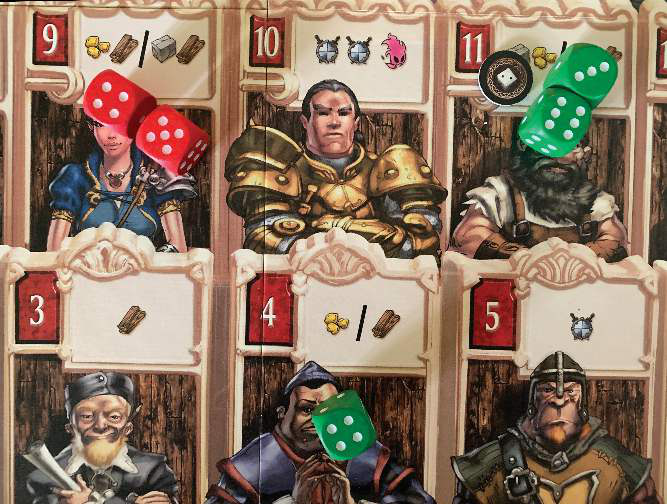
Some games offer probability manipulation at rarified skill levels. In Twilight Struggle, some cards leave the game after being played for their events. High-level players are careful not to trigger cards showing their own events, and to trigger, in as safe a manner as possible, their opponent’s events. Over time, the weight of the deck shifts and forces the opponent into many difficult hand-management situations where they must trigger highly damaging events. In Alhambra, players can draw currency into their hands, either by taking a single card, or any number of cards adding up to no more than five. Players gain a bonus action when purchasing tiles with exact change, and a great deal of the skill in this game lies in managing a hand that can match many values. Failure to realize this aspect of gameplay results in a substantial loss of player agency. Illustration 6.1 In Kingsbridge, players can earn +2 tokens, which allow them to modify future dice rolls. Here, a +2 token is used to place the 6/3 dice into the “11” space, where normally they would have to go in the “9” space.
Sample Games
Alhambra (Henn, 2003) Backgammon (Unknown, 3000 BCE) Dominion (Vaccarino, 2008) Kingsburg (Chiarvesio and Iennaco, 2007) Orleans (Stockhausen, 2014) Puzzle Strike (Sirlin, 2010) Sagrada (Andrews, 2017) Twilight Struggle (Gupta and Matthews, 2005)
描述
一种允许玩家影响某些结果的概率(Probability Management)但不直接确定它们的机制。
讨论
概率管理是所有骰子和纸牌游戏固有的。最直接的是,玩家可以获得骰子修正代币,允许他们增加或减少骰子的值,如在《Kingsburg》或《Sagrada》中。更间接的是,在《双陆棋》(Backgammon)中,玩家可以将他们的棋子(blots)移动到使对手掷出好骰子的概率最小化并使自己掷出好骰子的概率最大化的位置。博彩游戏允许玩家对骰子滚动或发牌等概率事件进行下注。然而,我们将在这里涵盖的概率管理类型以牌库构建游戏为例。在牌库构建游戏中,如流派的鼻祖《皇舆争霸》(Dominion),玩家每回合从私人牌组中抽取一手牌,并打出这些牌来获得其他更强大的牌,通常是从中央市场获得。玩家试图获得更强大的牌,以及能够协同作用的牌。通过调整牌组使得抽取持续浮现那些牌,玩家寻求增加他们牌组的平均产出,无论以何种术语——游戏开始时的货币,以及随后的胜利点数是一个典型的框架。我们将在专门的部分(CAR-05)深入讨论牌库构建(插图6.1)。
有些游戏在稀有技能水平上提供概率操纵。在《冷战热斗》(Twilight Struggle)中,有些牌在作为事件打出后会离开游戏。高水平玩家小心不要触发显示自己事件的牌,并尽可能安全地触发对手的事件。随着时间的推移,牌组的权重发生变化,迫使对手陷入许多困难的手牌管理情况,他们必须触发高度破坏性的事件。在《阿尔罕布拉宫》(Alhambra)中,玩家可以将货币抽入手牌,要么拿一张牌,要么拿总和不超过五的任意数量的牌。玩家在使用零钱购买板块时获得奖励行动,这款游戏的大量技巧在于管理一手可以匹配许多值的牌。未能意识到这方面的游戏玩法会导致玩家代理权的实质性损失。
插图6.1 在《Kingsbridge》中,玩家可以获得+2代币,这允许他们修改未来的骰子滚动。在这里,一个+2代币被用来将6/3骰子放入“11”空间,而通常它们必须进入“9”空间。
游戏范例
Alhambra (Henn, 2003) - 《阿尔罕布拉宫》 Backgammon (Unknown, 3000 BCE) - 《双陆棋》 Dominion (Vaccarino, 2008) - 《皇舆争霸》 Kingsburg (Chiarvesio and Iennaco, 2007) - 《Kingsburg》 Orleans (Stockhausen, 2014) - 《奥尔良》 Puzzle Strike (Sirlin, 2010) - 《Puzzle Strike》 Sagrada (Andrews, 2017) - 《彩色玻璃窗/Sagrada》 Twilight Struggle (Gupta and Matthews, 2005) - 《冷战热斗》