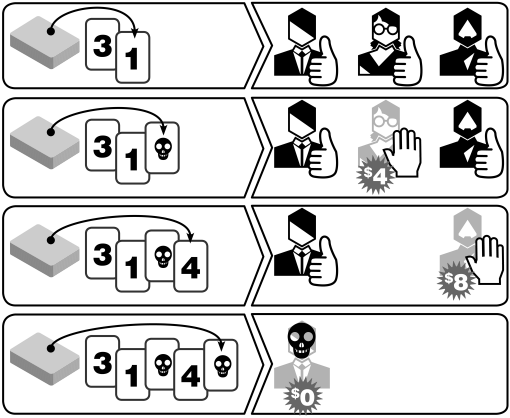
Description
Players must decide between settling for existing gains and risking them all for further rewards. Push-Your-Luck is also known as press-your-luck.
Discussion
A good example of a game whose central mechanism is Push-Your-Luck is Sid Sackson’s Can’t Stop. In Can’t Stop, the active player rolls 4 dice and advances up to 2 pawns in tracks numbered from 2 to 12, based on matching the sum of any 2 dice to the numbers on the tracks. The player may choose at any point to stop rolling, and lock in their progress along the tracks, or reroll to attempt to advance again. However, if after rolling, the player cannot match the sum of the dice to any of the three active tracks the player is advancing on, the player “busts,” and all progress from that turn is lost. PushYour-Luck is a type of wager in which players have less control over the ante or the stakes than in most casino games. An important dynamic in push-your-luck games is how changes to the stakes can alter player behavior. In Can’t Stop, when a player reaches the top of any numbered track, the track is closed, and nobody else can score it. The
first player to reach the top of three tracks is the winner. Players may be more timid at the start, but when one player is close to reaching the top of a track, competitors also racing up that track usually become much more aggressive and risk-tolerant, as they attempt to close the track themselves. This is doubly so when a player is close to winning the game, and the other players try to win it all themselves in one epic turn. When there’s nothing to lose, why not press-your-luck? Some of the behaviors and emotions that Sackson evokes in Can’t Stop stems from behavior that echoes the sunk-cost fallacy, in which investing additional resources into some goal is based not on the chances for succeeding, or the expected return on the investment, but on an emotional connection to what has already been invested in the past. In addition, Sackson is also depending on the difficulty in computing probabilities in Can’t Stop. Avid gamers, whether raised on Backgammon or Catan, are adept at calculating probabilities featuring 2d6, but calculating the probabilities of successfully rolling at least one of two or three different numbers on 4d6 is the kind of thing that few players can do in their heads. This obfuscation is critical since games in which expected values can always be calculated exactly can feel stale and boring. Can’t Stop is unforgiving. A single miss, a single roll of the dice that fails to advance a runner on a track, leads to a bust. In Yahtzee, players roll five dice and may choose to keep any number and reroll the rest before being forced to score the results. However, players are limited to a total of three rolls. In Favor of the Pharaoh, there is an additional restriction that players must keep, or lock, at least one die result before rerolling the remaining dice. In Tiny Epic Galaxies, players may spend a specific resource to purchase additional rerolls. Alternatively, instead of focusing on the die roll, Push-Your-Luck can be implemented in the chase for rewards. In Roll Trough the Ages: The Iron Age, players race to build monuments, but the first player to complete the monument will get a larger reward than all subsequent players. Players must choose between participating in the race for monument completion and devoting their resources to a different pursuit. Similarly, in Incan Gold (also known by its original name, Diamant, which remains its European title), players simultaneously choose whether to explore more deeply into a temple in hopes of turning up more gems on the next turn of a card from the expedition deck or to leave. At first, there is no risk attached to staying in, but after the first of a type of hazard card is revealed, the danger is that a matching hazard will be revealed and all gems discovered will be lost. Players who leave early get to retain all their gems gained so far, while players who remain will be splitting
new treasure with fewer players, making staying in the cave more rewarding as well as riskier. Formula De ties a player’s movement to gears represented by dice. Higher gears allow players to roll dice with more sides, up to a D30 for top gear—but curves offer a speed limit past which cars take damage. Take too much damage and you’re out of the race! Dice are a common means of implementing a press-your-luck mechanism, but they are far from the only one, as per the aforementioned Incan Gold. In Oh My Goods!, cards representing resources are played face-up into a market row until two cards showing a half-sun icon are revealed. Players must assign their workers after seeing one market row revealed, and can assign workers to tasks that require more goods to be completed than are currently showing in the market row. A second market row is then revealed, which may provide sufficient resources for players to complete their work … or not! Notably, the game allows players to assign workers to work in a way that will yield the maximum reward, which requires all resources are available, or to work for a lesser reward, in which case, a resource can be missing. This allows players to choose the stakes and probabilities of their wager while retaining the “bust” outcome that characterizes these games. Press-your-luck can be the central mechanism in a game, but it appears just as frequently as a part of a larger game. In Ra, players draw tiles from a bag to create an auction lot. Prior to each draw, the active player may call an auction, but auctions are more often triggered when a Ra tile is drawn out of the bag. There are multiple dimensions of luck-pressing baked into play: tiles are worth different amounts to players based on a set-collection mechanism (see Chapter 12 “Set Collection”), some tiles will impact players negatively, while other tiles are highly desirable to all players. Drawing another tile instead of calling the auction can radically change the overall value of the lots, and change them differently for each player. Toward the end of the round, when only one player remains, that player continues drawing tiles until he or she wishes to stop and purchase the lot. However, if a Ra tile is drawn at this point, the round ends immediately and the player loses his or her opportunity to buy. It is not uncommon to hear chants of “Ra! Ra! Ra!” during this phase of a game, demonstrating how meaningful the stakes feel in this masterpiece. Ra’s Push-Your-Luck mechanism permeates the whole game, yet it is clearly in service to the auction-and-set-collection core. In many games, the Push-Your-Luck element is a layer of flair rather than a core of the experience. In Mystic Vale, a kind of deck-building game (see “CAR-05” in Chapter 13) players flop cards to establish their mana pool for the turn, until three
spoils symbols are showing on the cards. Players may choose to risk flopping an additional card to expand their mana pool, but if another spoils symbol shows, the player busts and loses his or her turn. This mechanism is entirely optional and additive, and players can play and win without ever engaging in it, but it can be wisely leveraged to accelerate a deck’s construction too. Push-Your-Luck as a mechanism is straightforward to understand, even if the risks can be difficult to calculate, and it easily creates drama, tension, and excitement. It should be considered an essential part of every designer’s toolkit.
Sample Games
Backgammon (Unknown, 3000 BCE) Can’t Stop (Sackson, 1980) Favor of the Pharaoh (Lehmann, 2015) Formula De (Lavauer and Randall, 1991) Incan Gold (Faidutti and Moon, 2005) Mystic Vale (Clair, 2016) Oh My Goods! (Pfister, 2015) Ra (Knizia, 1999) Roll Trough the Ages: The Iron Age (Lehmann, 2014) Tiny Epic Galaxies (Almes, 2015) Yahtzee (Lowe, 1956)
描述
玩家必须在满足于现有收益和冒失去所有的风险以获得更多奖励之间做出决定。运气博弈(Push-Your-Luck)也被称为press-your-luck。
讨论
以运气博弈为核心机制的游戏的一个好例子是Sid Sackson的《Can’t Stop》。在《Can’t Stop》中,积极玩家掷4个骰子,并根据任意2个骰子的总和与轨道上的数字相匹配,在2到12编号的轨道上推进最多2个棋子。玩家可以在任何时候选择停止掷骰子,并锁定他们在轨道上的进度,或者重新掷骰子以尝试再次推进。然而,如果在掷骰子后,玩家无法匹配骰子的总和与玩家正在推进的任何三个活跃轨道,则玩家“爆掉”,并且那一回合的所有进度都将丢失。运气博弈是一种赌注,其中玩家对抗赌注的控制权比大多数赌场游戏少。运气博弈游戏中的一个重要动态是赌注的变化如何改变玩家行为。在《Can’t Stop》中,当一名玩家到达任何编号轨道的顶部时,该轨道关闭,其他人无法得分。
第一个到达三条轨道顶部的玩家是赢家。玩家一开始可能会比较胆小,但当一名玩家接近到达轨道顶部时,同样在该轨道上竞争的对手通常会变得更加激进和能容忍风险,因为他们试图自己关闭轨道。当一名玩家接近赢得游戏时,这一点更是加倍,其他玩家试图在一个史诗般的回合中自己赢得一切。当没有什么可失去的时候,为什么不运气博弈呢?Sackson在《Can’t Stop》中唤起的一些行为和情感源于与沉没成本谬误相呼应的行为,即向某个目标投入额外资源不是基于成功的机会火投资的预期回报,而是基于对过去已经投入的东西的情感联系。此外,Sackson还依赖于《Can’t Stop》中计算概率的难度。狂热的玩家,无论是在《双陆棋》还是《卡坦岛》上长大的,都擅长计算2d6的概率,但计算成功掷出4d6上两三个不同数字中至少一个的概率是很少有玩家能在脑海中做到的。这种混淆至关重要,因为期望值总是可以精确计算的游戏可能会让人感到陈旧和无聊。 《Can’t Stop》是无情的。一次失误,一次未能推进轨道上跑步者的骰子,就会导致爆掉。在《Yahtzee》中,玩家掷五个骰子,可以选择保留任意数量并重掷其余骰子,然后再被迫对结果进行计分。然而,玩家总共只能掷三次。在《Favor of the Pharaoh》中,有一个额外的限制,即玩家必须保留或锁定至少一个骰子结果,然后重掷剩余的骰子。在《Tiny Epic Galaxies》中,玩家可以花费特定资源购买额外的重掷。或者,运气博弈可以实施在对奖励的追逐中,而不是专注于骰子滚动。在《Roll Through the Ages: The Iron Age》中,玩家竞相建造纪念碑,但第一个完成纪念碑的玩家将获得比所有后续玩家更大的奖励。玩家必须在参与纪念碑完成竞赛和将资源投入不同追求之间做出选择。同样,在《印加宝藏》(Incan Gold)(也以其原名《Diamant》而闻名,这也是其欧洲标题)中,玩家同时选择是否更深入地探索寺庙,希望在探险牌堆的一张卡片翻转中获得更多宝石,或者离开。起初,留下来没有任何风险,但在揭示第一张某种类型的危险卡后,危险在于将揭示匹配的危险卡,并且所有发现的宝石都将丢失。提早离开的玩家可以保留迄今为止获得的所有宝石,而留下的玩家将
与更少的玩家分享新宝藏,这使得留在洞穴中更具回报,同时也更具风险。《Formula De》将玩家的移动与由骰子代表的档位联系起来。更高的档位允许玩家掷出更多面的骰子,最高档位可达D30——但弯道提供了一个速度限制,超过该限制汽车将受到损坏。受到太多损坏,你就出局了!骰子是实施运气博弈机制的常见手段,但绝非唯一手段,正如前面提到的《印加宝藏》。在《Oh My Goods!》中,代表资源的卡片正面朝上打入市场行,直到露出两张显示半个太阳图标的卡片。玩家必须在看到一个市场行露出后分配他们的工人,并且可以将工人分配到需要比当前市场行显示的更多商品才能完成的任务。然后露出第二个市场行,这可能为玩家提供足够的资源来完成他们的工作……或者不提供!值得注意的是,游戏允许玩家分配工人以产生最大奖励的方式工作,这需要所有资源都可用,或者以较少的奖励工作,在这种情况下,资源可能会缺失。这允许玩家选择赌注和概率,同时保留这些游戏特征的“爆掉”结果。 运气博弈可以是游戏的核心机制,但它同样经常作为更大游戏的一部分出现。在《Ra》中,玩家从袋子里抽取板块来创建拍卖品。在每次抽取之前,积极玩家可以召集拍卖,但在从袋子里抽出Ra板块时更常触发拍卖。游戏中有多个维度的运气博弈:板块对玩家的价值基于集合收集机制(参见第12章“集合收集”),有些板块会对玩家产生负面影响,而其他板块对所有玩家都非常有吸引力。抽取另一个板块而不是召集拍卖可以从根本上改变拍卖品的整体价值,并对每个玩家产生不同的改变。在回合接近尾声时,当只剩下一名玩家时,该玩家继续抽取板块,直到他或她希望停止并购买拍卖品。然而,如果此时抽出Ra板块,回合立即结束,玩家失去购买机会。游戏在这个阶段听到“Ra!Ra!Ra!”的口号并不罕见,这表明这部杰作中的赌注感觉有多么有意义。《Ra》的运气博弈机制渗透到整个游戏中,但它显然服务于拍卖和集合收集的核心。在许多游戏中,运气博弈元素是一层点缀,而不是体验的核心。在《Mystic Vale》,一种牌库构建游戏(参见第13章中的“CAR-05”)中,玩家翻转卡片以建立本回合的法力池,直到
卡片上显示三个腐败符号。玩家可以选择冒险翻转额外的卡片以扩展他们的法力池,但如果显示另一个腐败符号,玩家就会爆掉并失去他或她的回合。这个机制完全是可选的和附加的,玩家可以在不参与其中的情况下玩和赢,但它也可以被明智地利用来加速牌库的构建。运气博弈作为一种机制很容易理解,即使风险可能难以计算,它也很容易产生戏剧性、紧张感和兴奋感。它应该被视为每个设计师工具包的重要组成部分。
游戏范例
Backgammon (Unknown, 3000 BCE) - 《双陆棋》 Can’t Stop (Sackson, 1980) - 《Can’t Stop》 Favor of the Pharaoh (Lehmann, 2015) - 《法老的恩赐/Favor of the Pharaoh》 Formula De (Lavauer and Randall, 1991) - 《方程式赛车/Formula De》 Incan Gold (Faidutti and Moon, 2005) - 《印加宝藏》 Mystic Vale (Clair, 2016) - 《Mystic Vale》 Oh My Goods! (Pfister, 2015) - 《我的好货》 Ra (Knizia, 1999) - 《Ra》 Roll Trough the Ages: The Iron Age (Lehmann, 2014) - 《Roll Trough the Ages: The Iron Age》 Tiny Epic Galaxies (Almes, 2015) - 《小小史诗星系》 Yahtzee (Lowe, 1956) - 《快艇骰子/Yahtzee》