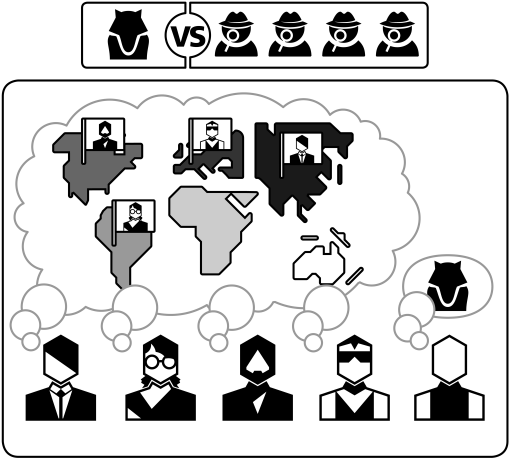
Description
One or more players are secretly assigned roles at the start of the game which has different win conditions and receives different starting information about the game state.
Discussion
In Hidden Roles (UNC-04), we speak of games where the “werewolves” have complete or nearly complete knowledge of the identities of the other players. The opposite dynamic is also possible, where the “werewolf” may know the identities of the other players, but is missing some other critical information that all the other players share. Generally, the goal for the “werewolf” is to figure out that secret, and the goal for the “villagers” is to both keep that secret safe and to guess the identity of the “werewolf.” In some games, one or the other is sufficient to secure the victory for the “villagers” and in others, both are required. In Spyfall, for example, players are told that they are at one of many potential locations. One player, the spy, doesn’t know the location, but their identity
as the spy is hidden from the other players. The spy attempts to deduce the location all the players are at, while the other players attempt to figure out who the spy is, through asking and answering questions related in some way to the location. Non-spy players must be careful to ask and answer in a way that signals only to other players that they know the location, without giving it away to the spy. The spy must ask and answer questions in a manner that doesn’t draw suspicion, even though they don’t know where they are! Another example that introduces a third role with Asymmetric Information is A Fake Artist Goes to New York. In this game, the moderator is a player and also wins or loses. The moderator chooses both a category and the secret word within the category and chooses who the fake artist will be by revealing only the category to them but not the secret word. The other players then each begin play, adding one line to a shared drawing on their turn, attempting to signal to other players that they know what the secret word is. Similar to Spyfall, the players don’t want to give away what they’re drawing, since the fake artist wins if they can guess the secret word. The moderator is aligned with the fake artist and is thus incentivized to choose a category and word that will make it easy for the fake artist to correctly guess the word. The moderator is the only player at the table with complete knowledge of the game state. There is a genre of games which leverages this same type of informational asymmetry, but with less emphasis on player roles. For example, games in which cards or tiles are held facing out, like Hanabi and Abracada… What?, don’t put players into different roles, but each player is denied knowledge of only their own hand. Each of these is subtly different: Abracada … What? is closest to Spyfall in that each player faces the tension of acting despite ignorance, but there is no doubt as to the player’s identity or goals in the game from the perspective of the other players. Hanabi is cooperative, and the dramatic irony that the inactive players feel because they can see the active player’s hand as they agonize over the right play is part of what makes that game special. The mass-market game Headbanz, in which one player tries to guess at a word on a card that all the other players can see, leverages this type of hidden information that isolates a single player, whether for the whole game or just for their turn, through sharp informational asymmetry. So does the absurdist Win, Lose, or Banana, where the player who draws the “Win” card tries to guess which player holds the Banana card but is the only player who doesn’t know the disposition of all the cards. What’s notable about these
games is that the social dynamic of being the only person not in the know creates enormous pressure, tension, and the possibility for humor—often at one player’s expense. This technique does not have to be used only in competitive games. Cooperative games may put communication restrictions on one or more players, and challenge them to convey information to other players (STR02). Mysterium places one player in the role of a ghost, who needs to get the other players to correctly identify the elements of a mystery (location, person, and weapon), but can only communicate by playing one or more elaborately illustrated cards to the players as a “dream.” Tough hidden information not generated by player actions is everywhere, little of it exists in classic European-style games. Tough we often draw the line between these styles based on whether they employ input randomness or output randomness, the element of having only public information also aligns closely with the European design school.
Sample Games
Abracada … What? (Kim, 2014) A Fake Artist Goes to New York (Sasaki, 2012) Hanabi (Bauza, 2010) Headbanz (Glimne and Strandberg, 1991) Insider (Kwaji, Okano, Shinma, and Itoh, 2016) Mysterium (Nevskiy and Sidorenko, 2015) Nyctophobia (Stippell, 2018) Spyfall (Ushan, 2014) Werewords (Alspach, 2017) Win, Lose, or Banana (Cieslik, 2009)
描述
一名或多名玩家在游戏开始时被秘密分配具有不同胜利条件的角色,并接收有关游戏状态的不同起始信息(Roles with Asymmetric Information)。
讨论
在隐藏角色(UNC-04)中,我们谈论的是“狼人”对其他玩家身份拥有完全或几乎完全了解的游戏。相反的动态也是可能的,即“狼人”可能知道其他玩家的身份,但缺少所有其他玩家共享的一些其他关键信息。通常,“狼人”的目标是弄清楚那个秘密,而“村民”的目标是既要保护那个秘密的安全,又要猜出“狼人”的身份。在某些游戏中,其中一个足以确保“村民”的胜利,而在其他游戏中,两者都是必需的。例如,在《间谍危机》(Spyfall)中,玩家被告知他们处于众多潜在地点之一。一名玩家,间谍,不知道该地点,但他们的身份
作为间谍对其他玩家是隐藏的。间谍试图推断所有玩家所在的地点,而其他玩家试图通过询问和回答以某种方式与该地点相关的问题来弄清楚谁是间谍。非间谍玩家必须小心提问和回答,以向其他玩家发出信号表明他们知道该地点,但又不将其泄露给间谍。间谍必须以不引起怀疑的方式提问和回答,即使他们不知道自己在哪里!另一个在具有非对称信息的第三个角色中引入的例子是《A Fake Artist Goes to New York》。在这个游戏中,主持人是一名玩家,也会赢或输。主持人选择一个类别和该类别中的秘密单词,并选择谁将是假艺术家,只需向他们透露类别,但不透露秘密单词。然后其他玩家开始游戏,轮流在共享画作上添加一条线,试图向其他玩家发出信号,表明他们知道秘密单词是什么。类似于《间谍危机》,玩家不想泄露他们在画什么,因为如果假艺术家能猜出秘密单词,他们就赢了。主持人与假艺术家结盟,因此被激励选择一个能让假艺术家容易猜对单词的类别和单词。主持人是桌上唯一完全了解游戏状态的玩家。有一种游戏类型利用了这种相同类型的信息不对称,但不太强调玩家角色。例如,将卡牌或板块面朝外持有的游戏,如《花火》和《Abracada… What?》,并没有将玩家分为不同角色,但每个玩家都被剥夺了仅对自己手牌的了解。每一个都有微妙的不同:《Abracada… What?》最接近《间谍危机》,因为每个玩家都面临着尽管无知也要行动的紧张感,但从其他玩家的角度来看,该玩家的身份或游戏目标是毫无疑问的。《花火》是合作的,非活跃玩家因为能看到活跃玩家的手牌而对其正确出牌感到痛苦,这种戏剧性的讽刺感是使该游戏特别的一部分。大众市场游戏《Headbanz》,其中一名玩家试图猜出所有其他玩家都能看到的卡上的单词,利用这种类型的隐藏信息,通过敏锐的信息不对称将单个玩家隔离,无论是整场游戏还是仅在那一轮。荒诞主义的《Win, Lose, or Banana》也是如此,抽到“赢”卡的玩家试图猜测哪个玩家持有香蕉卡,但他是唯一不知道所有卡牌处置情况的玩家。值得注意的是
这些游戏中,作为一个唯一不知情的人的社会动态创造了巨大的压力、紧张感和幽默的可能性——通常以牺牲一名玩家为代价。这种技术不必仅用于竞争性游戏。合作游戏可能会对一名或多名玩家施加通信限制,并挑战他们向其他玩家传达信息(STR02)。《Mysterium》让一名玩家扮演鬼魂的角色,他需要让其他玩家正确识别谜团的元素(地点、人物和武器),但只能通过向玩家打出一张或多张插图精美的卡片作为“梦”来交流。虽然不是由玩家行动产生的隐藏信息无处不在,但在经典的欧式游戏中却很少存在。虽然我们经常根据它们是采用输入随机性还是输出随机性来划分这些风格,但仅拥有公共信息的元素也与欧式设计学派紧密一致。
游戏范例
Abracada … What? (Kim, 2014) - 《阿布拉卡……什么?》 A Fake Artist Goes to New York (Sasaki, 2012) - 《A Fake Artist Goes to New York》 Hanabi (Bauza, 2010) - 《花火》 Headbanz (Glimne and Strandberg, 1991) - 《Headbanz》 Insider (Kwaji, Okano, Shinma, and Itoh, 2016) - 《Insider》 Mysterium (Nevskiy and Sidorenko, 2015) - 《诡秘庄园/Mysterium》 Nyctophobia (Stippell, 2018) - 《Nyctophobia》 Spyfall (Ushan, 2014) - 《间谍危机》 Werewords (Alspach, 2017) - 《狼人真言》 Win, Lose, or Banana (Cieslik, 2009) - 《Win, Lose, or Banana》