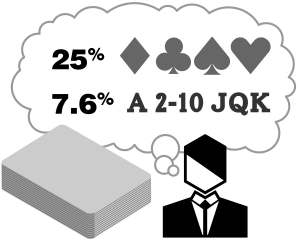
Description
Aspects of the game state are unknown to all players but lie within a known range.
Discussion
There are three categories of hidden-yet-knowable information: information known to no players, information known to one or more players, and information known to all but one player. Unknown Information creates uncertainty during any given play of a game and creates variety in repeated plays. Event decks are a good example of this kind of uncertainty. Players know the range of possible results, and often the cadence by which information will be revealed, but they don’t know the specifics, and the specifics can substantially impact strategy. In an initial play, players may not even know the true range of possibilities, and indeed, some game instructions encourage players to look through the deck to familiarize themselves with the possibilities or provide a card manifest or similar catalog of possibilities. Pandemic’s infection deck generates enormous tension precisely because the uppermost cards, formerly the discard pile, are known to the players. How unknown information will impact players on reveal can vary mechanically too. When modeling exploration, like the face-down sector tiles of Eclipse, explored tiles are revealed to all players. In Karuba, a new path tile is revealed each turn but each player may use the tile differently, either adding it to their personal board or discarding it for movement. Cards that enter a market, like the ability cards in King of Tokyo, can be seen by all
players, but an acquisition mechanism limits and determines who can take advantage of them. In tile-laying games like Carcassonne, where players don’t have a hand, the new tile drawn is known to all players, but only one player has agency over its placement.
Sample Games
Carcassonne (Wrede, 2000) Eclipse (Tahkokallio, 2011) Karuba (Dorn, 2013) King of Tokyo (Garfield, 2011) Pandemic (Leacock, 2008)
描述
游戏状态的某些方面对所有玩家来说都是未知的(Unknown Information),但在已知范围内。
讨论
有三类隐藏但可知的信息:没有任何玩家知道的信息,一个或多个玩家知道的信息,以及除一个玩家外所有人都知道的信息。未知信息在任何给定的游戏过程中都会产生不确定性,并在重复游戏中产生多样性。事件牌堆是这种不确定性的一个很好的例子。玩家知道可能结果的范围,通常也知道信息揭示的节奏,但他们不知道具体细节,而具体细节会对策略产生重大影响。在初次游戏中,玩家甚至可能不知道真正的可能性范围,确实,有些游戏说明书鼓励玩家浏览牌堆以熟悉可能性,或提供卡片清单或类似的可能性目录。《瘟疫危机》(Pandemic)的感染牌堆产生了巨大的紧张感,正是因为最上面的卡片(以前的弃牌堆)是玩家已知的。未知信息在揭示时如何影响玩家在机制上也可能有所不同。当模拟探索时,就像《Eclipse》的面朝下扇区板块一样,探索过的板块会向所有玩家揭示。在《Karuba》中,每回合都会揭示一个新的路径板块,但每个玩家可能会以不同的方式使用该板块,要么将其添加到他们的个人版图中,要么将其丢弃以进行移动。进入市场的卡片,如《King of Tokyo》中的能力卡,所有玩家都可以看到
但获取机制限制并决定了谁可以利用它们。在像《卡卡颂》(Carcassonne)这样的板块放置游戏中,玩家没有手牌,抽取的新板块对所有玩家都是已知的,但只有一个玩家对其放置有代理权。
游戏范例
Carcassonne (Wrede, 2000) - 《卡卡颂》 Eclipse (Tahkokallio, 2011) - 《星蚀》 Karuba (Dorn, 2013) - 《Karuba》 King of Tokyo (Garfield, 2011) - 《东京之王》 Pandemic (Leacock, 2008) - 《瘟疫危机》