Description
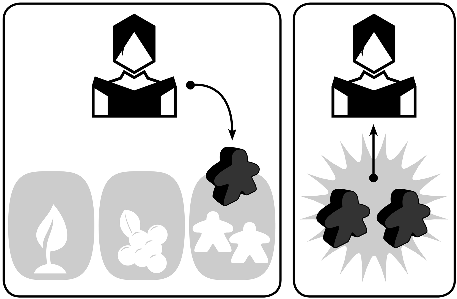
Workers beyond the original complement may be acquired in some manner, either temporarily or permanently. Workers may also be lost as the game progresses.
Discussion
Rather than improving existing workers, many games allow the acquisition of new workers. These new workers represent substantial growth in a player’s overall action budget, and as such, acquiring more workers is often a dominant strategy. In Stone Age, the reproduction hut is typically chosen first or second in every round. Because of the power of adding workers, designers have taken to metering worker growth. In Lords of Waterdeep, all players receive a new worker on a fixed turn in the middle of the game. Caverna requires that players build housing for new workers to acquire them—an investment of resources up front that the new worker’s productivity will pay for in the future. Any kind of purchase price on a worker has to be considered in light of the number of actions that the worker will be able to take and the returns those actions will provide. Usually, buying workers early has a higher payout than buying them late for this reason. In Last Will, the number of workers a player may deploy varies each turn based on the place in turn order that they choose. More workers mean going
later in the turn order, thus reducing the expected value of those additional workers, since the best spots will be taken by the time those extra workers are up for placement. Euphoria sets a hard cap on the total value of pips that can be showing in a player’s pool of available worker dice, which sharply limits a player’s incentive to collect more workers. Temporary additional workers are featured in Snowdonia, Russian Railroads, and Power Grid: Factory Manager. These workers will return to the general pool after use and must be hired or acquired again for reuse. A similar way to throttle player appetites for more workers is through a feeding or worker upkeep cost for permanent workers. Agricola is famous for the unforgiving tightness of its feeding mechanism and the substantial penalties incurred for failing to feed your family, while Stone Age’s toothless approach makes a starvation strategy quite viable. Worker attrition is the flipside of this dynamic of gaining workers. Euphoria’s workers may get too smart and, as a group, have too high a pip value, at which point one escapes (or perhaps, is sent for re-education …). The aging workers of Village eventually pass on, and the workers in Praetor retire. Other games actively encourage sacrificing workers for a benefit. Asgard is a visceral example, but discarding a die in Alien Frontiers, themed as landing a spaceship (the die) on a planet to establish a colony, is mechanically identical.
Sample Games
Agricola (Rosenberg, 2007) Asgard (Zizzi, 2012) Caverna: The Cave Farmers (Rosenberg, 2013) Euphoria: Build a Better Dystopia (Stegmaier and Stone, 2013) Last Will (Suchy, 2011) Lords of Waterdeep (Lee and Tompson, 2012) Power Grid: Factory Manager (Friese, 2009) Praetor (Novac, 2014) Russian Railroads (Ohley and Orgler, 2013) Snowdonia (Boydell, 2012) Stone Age (Brunnhofer, 2008) Village (Brand and Brand, 2011)
描述
玩家可以通过某种方式获得超出初始配额的工人,这些工人可能是临时的,也可能是永久的。随着游戏的进行,工人也可能会流失。
讨论
相比改进现有工人,许多游戏允许玩家获得新工人。这些新工人代表着玩家总体行动预算的大幅增长,因此,获取更多工人往往成为主导策略。在《石器时代》(Stone Age)中,繁殖小屋通常在每轮中被作为首选或次选。由于增加工人的强大作用,设计师们开始对工人增长进行调控。在《深水城领主》中,所有玩家在游戏中期的固定回合会获得一个新工人。《洞穴农夫》(Caverna)要求玩家为新工人建造住房才能获得他们——这是一项前期资源投资,新工人的生产力将在未来回本。工人的任何购买成本都必须综合考虑该工人能够执行的行动次数以及这些行动将带来的收益。通常,基于这个原因,早期购买工人的回报比后期购买更高。在《遗愿》(Last Will)中,玩家每回合可以部署的工人数量取决于他们选择的行动顺序位置。拥有更多工人意味着在行动顺序中更靠后
从而降低这些额外工人的预期价值,因为当这些额外工人轮到放置时,最佳位置已被占据。《欢乐建造》(Euphoria)在玩家可用工人骰池中可显示的总点数上设置了硬性上限,这大大限制了玩家收集更多工人的动机。临时额外工人出现在《斯诺登尼亚》(Snowdonia)、《俄罗斯铁路》(Russian Railroads)和《电力公司:工厂经理》(Power Grid: Factory Manager)中。这些工人使用后会返回公共池,必须重新雇用或获取才能再次使用。限制玩家对更多工人需求的另一种类似方法是对永久工人设置喂养或维护成本。《农场主》(Agricola)以其严苛的喂养机制和无法喂饱家人所招致的严重惩罚而闻名,而《石器时代》宽松的处理方式使饥饿策略也颇具可行性。工人流失是获得工人这一动态的另一面。《欢乐建造》中的工人可能会变得过于聪明,当他们作为一个群体的点数值过高时,会有一个工人逃脱(或者说,被送去再教育……)。《村庄》(Village)中年老的工人最终会去世,《执政官》(Praetor)中的工人会退休。其他游戏则积极鼓励为了获得利益而牺牲工人。《阿斯加德》(Asgard)是一个生动的例子,在《外星前线》(Alien Frontiers)中弃掉一个骰子的机制也与之相同——其主题是让宇宙飞船(骰子)降落在行星上建立殖民地。
游戏范例
Agricola (Rosenberg, 2007) - 《农场主》 Asgard (Zizzi, 2012) - 《阿斯加德》 Caverna: The Cave Farmers (Rosenberg, 2013) - 《洞穴农夫》 Euphoria: Build a Better Dystopia (Stegmaier and Stone, 2013) - 《欢乐建造:建造更好的反乌托邦》 Last Will (Suchy, 2011) - 《遗愿》 Lords of Waterdeep (Lee and Tompson, 2012) - 《深水城领主》 Power Grid: Factory Manager (Friese, 2009) - 《电力公司:工厂经理》 Praetor (Novac, 2014) - 《Praetor》 Russian Railroads (Ohley and Orgler, 2013) - 《俄罗斯铁路》 Snowdonia (Boydell, 2012) - 《斯诺登尼亚》 Stone Age (Brunnhofer, 2008) - 《石器时代》 Village (Brand and Brand, 2011) - 《村庄》