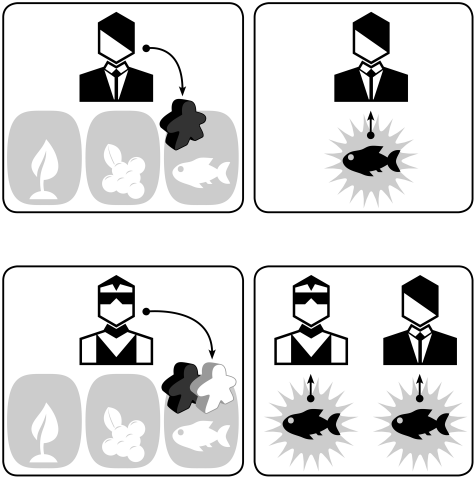
Description
Buildings can offer varying rewards to different players, based on ownership and turn order, or they may be upgraded to increase their rewards to all players.
Discussion
Buildings may offer a greater reward for the first player to claim the building and lesser rewards for players following. This is quite similar to selection bonuses in a role-selection game, a flavor of Action Drafting (ACT-02). Other versions of reward choice allow for the player to choose among one of two or more rewards, as in Caylus, where players may sometimes take two of one resource or one of another. Yedo offers an extreme version of this mechanism: players place workers in districts, rather than specific buildings, and may choose from a variety of possible resolutions, including collecting resources, purchasing weapons, or completing a mission specific to that district. One way buildings can vary in rewards is through improvements of different kinds. In Wisdom of Solomon (originally released as Kingdom of Solomon),
players can build roads between different spaces, creating resource regions that yield the cumulative benefit of all the connected spaces when activated by a worker. In Agricola and other Uwe Rosenberg designs, some spaces will accumulate an additional resource from turn to turn, growing richer and richer until a player finally selects them. Various games offer cards or special abilities that improve the conversion rate of some building or set of buildings that have a cost or offer some exchange. Conversely, buildings may become deactivated or workers may be hindered from doing their work, as with the Provost in Caylus or the City Watch in Yedo. A radical approach to varying buildings can be seen in Fabled Fruit, in which buildings can be replaced entirely with others in mid-play.
Sample Games
Agricola (Rosenberg, 2007) Caylus (Attia, 2005) Fabled Fruit (Friese, 2016) Wisdom of Solomon (duBarry, 2018) Yedo (Ginste and Plancke, 2012)
描述
建筑可以根据所有权和回合顺序向不同的玩家提供不同的奖励,或者可以升级以增加对所有玩家的奖励。
讨论
建筑可能为第一个声称建筑的玩家提供更大的奖励,而为后续玩家提供较小的奖励。这与角色选择游戏中的选择奖励非常相似,这是行动轮抽(ACT-02)的一种风格。其他版本的奖励选择允许玩家从两个或更多奖励中选择一个,如在《凯吕斯》中,玩家有时可能会选择两个某种资源或一个另一种资源。《江户》(Yedo)提供了这一机制的极端版本:玩家将工人放置在区域中,而不是特定的建筑中,并可以从各种可能的解决方案中进行选择,包括收集资源、购买武器或完成该区域特定的任务。建筑可以通过不同类型的改进来改变奖励。在《所罗门的智慧》(Wisdom of Solomon)(最初作为《所罗门王国》发布)中,
玩家可以在不同空间之间建造道路,创建资源区域,当被工人激活时,这些区域会产生所有连接空间的累积利益。在《农场主》和其他Uwe Rosenberg设计的游戏中,一些空间会从一个回合到另一个回合累积额外的资源,变得越来越丰富,直到玩家最终选择它们。各种游戏提供卡牌或特殊能力,可以提高某些建筑或一组建筑的转换率,这些建筑有成本或提供某种交换。相反,建筑可能会被停用,或者工人可能会被阻止完成工作,如《凯吕斯》中的教务长(Provost)或《江户》中的城市守卫(City Watch)。在《寓言水果》中可以看到改变建筑的激进方法,在这个游戏中,建筑可以在游戏中期完全被其他建筑替换。
游戏范例
Agricola (Rosenberg, 2007) - 《农场主》 Caylus (Attia, 2005) - 《凯吕斯》 Fabled Fruit (Friese, 2016) - 《寓言水果》 Wisdom of Solomon (duBarry, 2018) - 《所罗门的智慧》 Yedo (Ginste and Plancke, 2012) - 《江户》