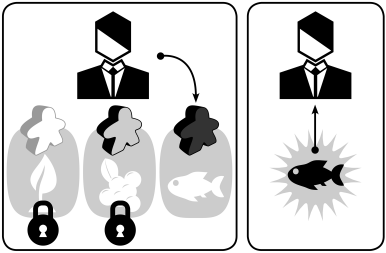
Description
Players control only a Single primary Worker and cannot acquire more workers.
Discussion
On the far end of the worker placement spectrum are the Single-Worker games, which we include in our definition only when they retain a blocking element—otherwise, we characterize these as Action Point games (ACT- 01) when players can’t interfere with or block each other at all, and Action Drafting games (ACT-02) when players can block each other absolutely. In the intermediate space between these lies a game like Kanban. Players block and influence each other’s placements along at least three different axes: (1) players cannot take an action space occupied by another player, (2) they cannot take an action space in the same department they occupied the last turn, and (3) they must consider the role Sandra, the neutral boss, will play. In Easy mode, Sandra’s presence in a department may encourage players to work in that department in order to win her approval. In Hard mode, they may choose to avoid Sandra’s critical eye and the penalties that accompany it. Another Vital Lacerda game, The Gallerist, takes an opposite approach to Single-Worker blocking. Players have a primary worker and can acquire several assistants. When players move their primary workers to a new space, they may choose to leave an assistant behind. If that assistant gets bumped by another player, the assistant will be able to take an action as
compensation. In a sense, the game records a kind of history of where each player has been and enforces consequences for collisions, snake-like, between the head of one player and the tail of another. It is arguable whether this actually qualifies for our definition of worker placement, though, since no cost is imposed on the placing player in a manner that could be construed as blocking. Instead, a benefit is given to the player whose assistant is being bumped. Istanbul implements this trail concept more fully and is perhaps the game that most successfully implements substantial movement and spatial relationships within a worker placement framework. Here, blocking is more fully realized, as the placing player must pay the blocker to use the space. Single-Worker games are quite similar not only to role-selection games, as mentioned above, but also to Rondel Games (ACT-10) and Time-Track Games (TRN-13). The worker metaphor and the use of meeples and similar tokens have as much to do with how we categorize the games as the underlying action selection method itself.
Sample Games
Fabled Fruit (Friese, 2016) The Gallerist (Lacerda, 2015) Istanbul (Dorn, 2014) Kanban (Lacerda, 2014)
描述
玩家只控制一个单一的主工人,无法获得更多工人。
讨论
在工人放置光谱的远端是单工人游戏,我们在定义中只有在它们保留阻挡元素时才包括它们——否则,当玩家根本无法相互干扰或阻挡时,我们将这些游戏归类为行动点数游戏(ACT-01),当玩家可以完全相互阻挡时,归类为行动轮抽游戏(ACT-02)。在这两者之间的中间空间中有一个像《看板》(Kanban)这样的游戏。玩家沿着至少三个不同的轴相互阻挡和影响彼此的放置:(1)玩家不能占据另一名玩家占据的行动空间,(2)他们不能占据他们上一回合占据的同一部门的行动空间,以及(3)他们必须考虑中立老板桑德拉将扮演的角色。在简单模式下,桑德拉在一个部门的存在可能会鼓励玩家在该部门工作以获得她的批准。在困难模式下,他们可能会选择避开桑德拉的批判性眼光和伴随的惩罚。另一个Vital Lacerda游戏《画廊家》(The Gallerist)对单工人阻挡采取了相反的方法。玩家有一个主工人,可以获得几个助手。当玩家将他们的主工人移动到一个新空间时,他们可以选择留下一个助手。如果该助手被另一名玩家碰撞,助手将能够采取行动作为
补偿。从某种意义上说,游戏记录了每个玩家去过哪里的历史,并像蛇一样,对一个玩家的头和另一个玩家的尾巴之间的碰撞执行后果。然而,这是否真正符合我们对工人放置的定义是有争议的,因为没有对放置玩家施加可以被解释为阻挡的成本。相反,给被碰撞的玩家的助手一个好处。《伊斯坦布尔》(Istanbul)更全面地实现了这个轨迹概念,也许是在工人放置框架内最成功实现实质性移动和空间关系的游戏。在这里,阻挡更充分地实现,因为放置玩家必须向阻挡者支付费用才能使用空间。单工人游戏不仅与上面提到的角色选择游戏非常相似,而且还与轮盘游戏(ACT-10)和时间轨道游戏(TRN-13)非常相似。工人隐喻和米宝及类似代币的使用与基本的行动选择方法本身一样,与我们如何对游戏进行分类有很大关系。
游戏范例
Fabled Fruit (Friese, 2016) - 《寓言水果》 The Gallerist (Lacerda, 2015) - 《画廊家》 Istanbul (Dorn, 2014) - 《伊斯坦布尔》 Kanban (Lacerda, 2014) - 《看板》