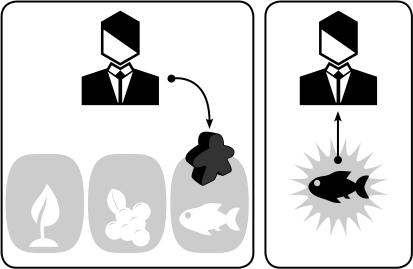
Description
Players select actions, in turn order, by placing a worker from their supply on a building associated with a specific action and then execute that action immediately. The round ends when all workers have been placed, at which point they return to their owners’ pools and a new round begins.
Discussion
This familiar structure, typified by games like Lords of Waterdeep and Agricola, is an improvement over the ur-game, Caylus, in which buildings resolved after all Worker Placements were complete. The immediate resolution makes for faster play and obviates the need for players to remember which resources they will receive when making their next placement. Later games, like The Manhattan Project and Tzolk’in: The Mayan Calendar, have workers returning only when their owners recall them. In the former, players get the building’s reward on placement, while in the latter, the reward is tied to the moment of recall, since the reward escalates the longer the worker is left out on the board. With each passing turn in Tzolk’in, workers rotate over on the ingenious gear system to a higher tier of rewards that will be distributed when the worker is recalled. Most Worker Placement games employ the mechanism for all actions in the game. Turn order is typically set by placing a worker on a building that grants turn order priority. Increasing the number of actions that may be taken in a turn is themed as getting new workers, which is an action tied to a building. Maintenance costs are represented as feeding or paying for your workers.
Increasingly, there are games that incorporate some Worker Placement elements in the context of a broader game. Examples include Copycat, Rococo, and Belfort.
Sample Games
Agricola (Rosenberg, 2007) Belfort (Cormier and Lim, 2011) Caylus (Attia, 2005) Charterstone (Stegmaier, 2017) Copycat (Friese, 2012) For Sale (Dorra, 1997) Jórvík (Feld, 2016) Lords of Waterdeep (Lee and Tompson, 2012) The Manhattan Project (Tibbetts, 2012) Mint Works (Blaske, 2017) Orleans (Stockhausen, 2014) Robinson Crusoe: Adventures on the Cursed Island (Trzewiczek, 2012) Rococo (Cramer, Malz, and Malz, 2013) Roll for the Galaxy (Huang and Lehmann, 2014) Spyrium (Attia, 2013) Terraforming Mars (Fryxelius, 2016) Trough the Ages: A Story of Civilization (Chvátil, 1986) Tribune: Primus Inter Pares (Schmiel, 2007) Tzolk’in: The Mayan Calendar (Luciani and Tascini, 2012)
描述
玩家按回合顺序,从他们的供应池中将一个工人放置在与特定行动相关的建筑上来选择行动,然后立即执行该行动。当所有工人都被放置后,回合结束,此时工人返回其所有者的工人池,新的回合开始。
讨论
这种熟悉的结构,以《深水城领主》(Lords of Waterdeep)和《农场主》(Agricola)等游戏为代表,是对原始游戏《凯吕斯》(Caylus)的改进,在后者中,建筑在所有工人放置完成后才解决。立即解决使游戏速度更快,并免除了玩家在进行下一次放置时需要记住他们将获得哪些资源的需求。后来的游戏,如《曼哈顿计划》(The Manhattan Project)和《卓尔金:玛雅历法》(Tzolk’in: The Mayan Calendar),只有在所有者召回工人时才让工人返回。在前者中,玩家在放置时获得建筑的奖励,而在后者中,奖励与召回的时刻相关,因为奖励随着工人在棋盘上停留的时间越长而提升。在《卓尔金》中,随着每一回合的过去,工人在巧妙的齿轮系统上旋转到更高层级的奖励,这些奖励将在召回工人时分发。大多数工人放置游戏将该机制用于游戏中的所有行动。回合顺序通常通过将工人放置在授予回合顺序优先权的建筑上来设置。增加一个回合中可以采取的行动数量的主题是获得新工人,这是一个与建筑相关的行动。维护成本表现为喂养或支付工人。
越来越多的游戏在更广泛的游戏背景下结合了一些工人放置元素。例子包括《Copycat》、《洛可可》(Rococo)和《Belfort》。
游戏范例
Agricola (Rosenberg, 2007) - 《农场主》 Belfort (Cormier and Lim, 2011) - 《Belfort》 Caylus (Attia, 2005) - 《凯吕斯》 Charterstone (Stegmaier, 2017) - 《特许城镇》 Copycat (Friese, 2012) - 《Copycat》 For Sale (Dorra, 1997) - 《房产拍卖》 Jórvík (Feld, 2016) - 《约克》 Lords of Waterdeep (Lee and Tompson, 2012) - 《深水城领主》 The Manhattan Project (Tibbetts, 2012) - 《曼哈顿计划》 Mint Works (Blaske, 2017) - 《薄荷工厂》 Orleans (Stockhausen, 2014) - 《奥尔良》 Robinson Crusoe: Adventures on the Cursed Island (Trzewiczek, 2012) - 《鲁宾逊漂流记》 Rococo (Cramer, Malz, and Malz, 2013) - 《洛可可》 Roll for the Galaxy (Huang and Lehmann, 2014) - 《掷骰银河》 Spyrium (Attia, 2013) - 《Spyrium》 Terraforming Mars (Fryxelius, 2016) - 《殖民火星》 Trough the Ages: A Story of Civilization (Chvátil, 1986) - 《历史巨轮》 Tribune: Primus Inter Pares (Schmiel, 2007) - 《Tribune》 Tzolk’in: The Mayan Calendar (Luciani and Tascini, 2012) - 《卓尔金:玛雅历法》