Description
Worker placement is ultimately a drafting mechanism, and the order by which actions are selected and resolved is an opportunity for design variations.
Discussion
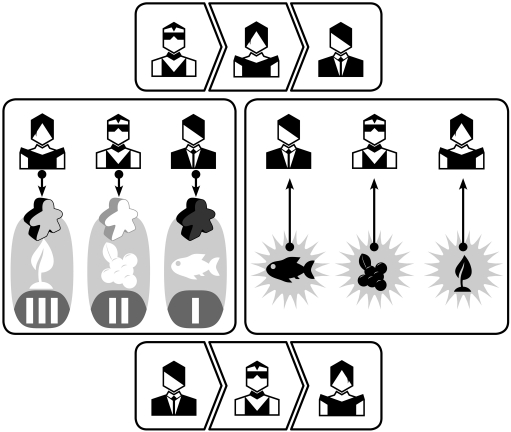
Allocation of resources is a foundational concern of nearly every game, and allocation by draft means that Turn Order is crucial. While some worker placement games simply rotate Turn Order clockwise, like Stone Age, most fold Turn Order into the worker placement engine itself. The simplest approach is a building that grants Turn Order priority, as in Lords of Waterdeep. While this is a simple approach, it has a substantial drawback in that it’s a choice with strong left–right binding. In other words, the impacts on the players adjacent to the new starting player are large: the player to the left gains an unearned windfall because they get to go second, and the player to the right, through no fault of their own, is pushed to the end of the line. One design answer is to allow for multiple players to play into the Turn Order building, with the player playing earliest getting the most favorable placement. More discussions of this topic are in Claim Turn Order Action (TRN-05).
As discussed in Acquiring and Losing Workers (WPL-03), Last Will has players draft a combination of Turn Order, workers available, and assistant actions in one. Earlier positions in Turn Order have fewer workers and abilities, while later positions have more. An especially unusual mechanism for Turn Order is the master builder token-pull system in Pillars of the Earth. Each player’s master builders are placed in a bag and pulled at random, one at a time. The player whose builder is pulled may choose to pay the current price in gold to take the action or may pass and accept a much later position in Turn Order. The price of the action is then decreased by one gold. If this sounds familiar, it’s because it’s another variation on the Vickrey auction (AUC-08, Dutch Auction). See also Random Turn Order (TRN-11). The randomness of this mechanism drew widespread critique, but it did have a spiritual successor. In Lords of Waterdeep, up to three players can visit Waterdeep Harbor to play an Intrigue card. In addition, once all players have exhausted their available workers, the workers assigned to Waterdeep Harbor can be reassigned to any available actions space. The similarity to the mechanism in Pillars of the Earth is that placing a worker in Waterdeep Harbor offers the reward of playing an Intrigue card, at the cost of having to wait for the remaining workers to be placed before getting another choice at an action with that worker. This implied cost goes down with every succeeding turn, just as the explicit cost of the master builder goes down with each player’s turn. The random aspect of Pillars of the Earth was not reproduced, but the core notion of variable price for placement priority was retained. the following phase set by the previous phase. The player who takes the fewest actions in the first phase goes first in the next phase. Belfort allows players to spend a worker to exchange Turn Order position with another player during the placement phase. However, the game features a strong polarity in the benefits of Turn Order. In the worker placement phase, going early is best, but in the building phase, which features an area majority contest, going last is most advantageous. This phase difference brings up another point of design distinction, which is when worker actions get placed versus when they get resolved. The simplest placement rule is that each player places one worker on their turn (Agricola), which encourages good pace in play. Increasing the complexity, players may be allowed to claim a building, even if it requires more
worker or assign all their remaining workers to a group of public action (Belfort). Sometimes, each player places all their workers on their turn (Alien Frontiers). Placement is not synonymous with a resolution, however. Caylus resolved placements and distributed rewards only at the end of the placement phase, when all workers are out. This delay in resolution creates space for the provost mechanism, which may cause buildings too far down the road to fail to activate, even though they are staffed by workers. It also allows players to set up combos, where resources gained earlier along the road can be used by workers further down the road, regardless of the order that those workers were placed in. Similarly, the Tzolk’in escalating rewards case requires resolution to occur when workers are recalled, rather than placed. However, in Tzolk’in, the decision is to either place a worker or return all workers from one building, rather than recalling the whole class of workers from across the board. Belfort workers don’t collect their goods until all players have completed placement, because the player with the most workers gathering in each building will gain a bonus resource. When workers return home is another element of the worker placement mechanism that designers have experimented with. In The Manhattan Project, players resolve their actions on worker placement but must spend a turn retrieving workers. This tends to create a strong blocking dynamic, since players receive benefits up front, and their workers continue to block other players until they are retrieved. Timing your retrievals relative to other players is critical for effective play. In Istanbul, workers can be retrieved for free by moving back through the spaces they were left on or by spending a valuable action recalling all workers to the fountain in the center of the bazaar. Trough careful planning, players can plot efficient courses, recover workers for free, and gain an action advantage over their opponents.
Sample Games
Agricola (Rosenberg, 2007) Alien Frontiers (Niemann, 2010) Belfort (Cormier and Lim, 2011) Caylus (Attia, 2005) Istanbul (Dorn, 2014)
Last Will (Suchy, 2011) Lords of Waterdeep (Lee and Tompson, 2012) The Manhattan Project (Tibbetts, 2012) Pillars of the Earth (Rieneck and Stadler, 2006) Stone Age (Brunnhofer, 2008) Tzolk’in: The Mayan Calendar (Luciani and Tascini, 2012)
Movement ў ў Perhaps the most common dynamic in games is movement. In large part, this is because movement is inherent in what games model, whether it’s an armed conflict, a journey, or a race. Movement is an incredibly effective and powerful tool in the designer’s arsenal because of how dense movement can be in terms of information. Moving a single piece changes its relationship to every other piece on the board. And yet, signaling that change, communicating that it has occurred, is as simple as picking up a piece and placing it down again. The most ancient board games we know of, like the Egyptian games Mehen and Senet, have pieces moving around a board. Chess, Checkers, Shogi, Parcheesi, Backgammon, Monopoly, and Candyland all feature movement as a key mechanism. Some of these games feature movement in a single direction, along a fixed path, while others offer greater choice, or even free play within a two-dimensional space. In some games, the pieces on the board are all identical, while in others the power to move is encoded in the pieces themselves. Some games have specific spaces that are more valuable to occupy, while in others, the positional value of any space can change as the board develops Movement is a way of creating dynamic and evolving situations that can force players to change their plans and react to their opponents. Done well, movement rules are easily understood, yet lead to emergent gameplay. But movement rules are hard to get right. Dealing with questions like blocking, line of sight, terrain types, movement along a diagonal, and more can turn what seems like an elegant and simple concept into a tangle of conflicting and confusing rules. Among the innovations of the European design school was an increasing abstraction of movement rules or even total abandonment of movement. DOI: 10.1201/9781003179184-10
Despite the challenges, the movement remains a durable feature of many board games. Movement is fun, and it lends itself well to many different kinds of games in a huge variety of implementations and specific mechanisms, while being conceptually familiar and intuitive, no matter what the context.
描述
工人放置最终是一种轮抽机制,行动被选择和解决的顺序是设计变化的机会。
讨论
资源分配是几乎每个游戏的基础关注点,通过轮抽进行分配意味着回合顺序至关重要。虽然一些工人放置游戏简单地顺时针旋转回合顺序,如《石器时代》,但大多数将回合顺序折叠到工人放置引擎本身中。最简单的方法是授予回合顺序优先权的建筑,如在《深水城领主》中。虽然这是一个简单的方法,但它有一个重大缺点,即它是一个具有强烈左右绑定的选择。换句话说,对与新起始玩家相邻的玩家的影响很大:左边的玩家获得了不劳而获的意外之财,因为他们可以排在第二位,而右边的玩家,尽管没有自己的过错,却被推到了队伍的末尾。一个设计答案是允许多个玩家进入回合顺序建筑,最早玩的玩家获得最有利的位置。关于这个主题的更多讨论在声称回合顺序行动(TRN-05)中。
如在获得和失去工人(WPL-03)中讨论的,《遗愿》让玩家在一个中轮抽回合顺序、可用工人和助手行动的组合。回合顺序中较早的位置有较少的工人和能力,而较晚的位置有更多。回合顺序的一个特别不寻常的机制是《地球支柱》中的大师建造者代币抽取系统。每个玩家的大师建造者被放置在一个袋子中并一次抽取一个。抽到建造者的玩家可以选择支付当前的金币价格来采取行动,或者可以跳过并接受回合顺序中更晚的位置。然后行动的价格减少一金币。如果这听起来很熟悉,那是因为它是维克瑞拍卖(AUC-08,荷兰拍卖)的另一个变体。另见随机回合顺序(TRN-11)。这种机制的随机性引起了广泛的批评,但它确实有一个精神继承者。在《深水城领主》中,最多三名玩家可以访问深水港(Waterdeep Harbor)以打出阴谋卡。此外,一旦所有玩家都耗尽了他们的可用工人,分配给深水港的工人可以重新分配到任何可用的行动空间。与《地球支柱》中的机制的相似之处在于,将工人放置在深水港提供了打出阴谋卡的奖励,代价是必须等待剩余工人被放置,然后才能用该工人再次选择行动。这种隐含的成本随着每一个后续回合而降低,就像大师建造者的明确成本随着每个玩家的回合而降低一样。《地球支柱》的随机方面没有被复制,但放置优先权的可变价格的核心概念被保留了。下一个阶段由前一个阶段设置。在第一阶段采取最少行动的玩家在下一阶段最先行动。《Belfort》允许玩家在放置阶段花费一个工人与另一名玩家交换回合顺序位置。然而,游戏在回合顺序的好处方面具有强烈的极性。在工人放置阶段,早行动是最好的,但在建筑阶段,它具有区域多数竞赛,最后行动是最有利的。这种阶段差异引出了另一个设计区别点,即工人行动何时被放置与何时被解决。最简单的放置规则是每个玩家在他们的回合中放置一个工人(《农场主》),这鼓励游戏中的良好节奏。增加复杂性,玩家可能被允许声称一栋建筑,即使它需要更多
工人或将他们所有剩余的工人分配给一组公共行动(《Belfort》)。有时,每个玩家在他们的回合中放置所有工人(《外星前线》)。然而,放置并不等同于解决。《凯吕斯》仅在放置阶段结束时,当所有工人都出去后,才解决放置并分发奖励。这种解决的延迟为教务长机制创造了空间,即使建筑配备了工人,它也可能导致道路太远的建筑无法激活。它还允许玩家设置连击,在道路上较早获得的资源可以被道路上较远的工人使用,无论这些工人被放置的顺序如何。类似地,《卓尔金》的递增奖励情况要求在召回工人时发生解决,而不是放置时。然而,在《卓尔金》中,决定是放置一个工人或从一个建筑返回所有工人,而不是从整个棋盘上召回整个类别的工人。《Belfort》工人在所有玩家完成放置之前不会收集他们的商品,因为在每栋建筑中收集的工人最多的玩家将获得奖励资源。工人何时回家是设计师试验过的工人放置机制的另一个元素。在《曼哈顿计划》中,玩家在工人放置时解决他们的行动,但必须花费一个回合来检索工人。这倾向于创建强大的阻挡动态,因为玩家预先获得好处,并且他们的工人继续阻挡其他玩家,直到他们被检索。相对于其他玩家安排你的检索时间对于有效的游戏至关重要。在《伊斯坦布尔》中,工人可以通过移动回他们被留下的空间免费检索,或者通过花费一个宝贵的行动将所有工人召回到集市中心的喷泉。通过仔细的规划,玩家可以规划有效的路线,免费恢复工人,并获得相对于对手的行动优势。
游戏范例
Agricola (Rosenberg, 2007) - 《农场主》 Alien Frontiers (Niemann, 2010) - 《外星前线》 Belfort (Cormier and Lim, 2011) - 《Belfort》 Caylus (Attia, 2005) - 《凯吕斯》 Istanbul (Dorn, 2014) - 《伊斯坦布尔》
Last Will (Suchy, 2011) - 《遗愿》 Lords of Waterdeep (Lee and Tompson, 2012) - 《深水城领主》 The Manhattan Project (Tibbetts, 2012) - 《曼哈顿计划》 Pillars of the Earth (Rieneck and Stadler, 2006) - 《地球支柱》 Stone Age (Brunnhofer, 2008) - 《石器时代》 Tzolk’in: The Mayan Calendar (Luciani and Tascini, 2012) - 《卓尔金:玛雅历法》
移动 ў ў 也许游戏中最常见的动态是移动。在很大程度上,这是因为移动是游戏建模的固有部分,无论是武装冲突、旅程还是比赛。移动是设计师武器库中一个极其有效和强大的工具,因为移动在信息方面可以有多么密集。移动一个棋子会改变它与棋盘上每一个其他棋子的关系。然而,发出该变化的信号,传达它已经发生,就像拿起一个棋子并再次放下它一样简单。我们知道的最古老的棋盘游戏,如埃及游戏Mehen和Senet,都有棋子在棋盘上移动。国际象棋、跳棋、将棋、帕切西、西洋双陆棋、大富翁和糖果乐园都将移动作为关键机制。这些游戏中的一些在单一方向上沿着固定路径移动,而其他游戏提供更大的选择,甚至在二维空间内自由移动。在某些游戏中,棋盘上的棋子都是相同的,而在其他游戏中,移动的力量被编码在棋子本身中。有些游戏有特定的空间,占据它们更有价值,而在其他游戏中,任何空间的位置价值都可以随着棋盘的发展而改变。移动是创建动态和不断发展的情况的一种方式,可以迫使玩家改变他们的计划并对他们的对手做出反应。做得好,移动规则很容易理解,但会导致涌现的游戏玩法。但是移动规则很难做对。处理诸如阻挡、视线、地形类型、对角线移动等问题可以将看似优雅和简单的概念变成一团纠缠和令人困惑的规则。欧洲设计学派的创新之一是移动规则的日益抽象化或甚至完全放弃移动。DOI: 10.1201/9781003179184-10
尽管存在挑战,移动仍然是许多棋盘游戏的持久特征。移动很有趣,它非常适合各种不同类型的游戏,有大量的实现和特定机制,同时在概念上熟悉和直观,无论背景如何。