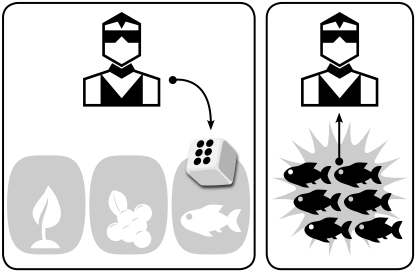
Description
Workers are represented by dice whose pip values impact play.
Discussion
Workers-As-Dice is a broad genre, and it is frequently accompanied by the mechanism of playing a combination of workers in a building. In Alien Frontiers, players allocate all of their dice on their turns to buildings that take a different combination of dice and values and have different requirements for placement. This approach leads to some analysis paralysis because of the large number of combinations that are possible with as many as six dice. Other titles, like Kingsburg, limit the dice pools to three dice. Each roll presents a substantially smaller set of placement permutations for players to consider, not only because of the smaller number of dice but because there are fewer valid buildings for any given combination. Workers-As-Dice can also function to determine the effectiveness of workers. In The Artemis Project, worker dice collect a number of resources equal to their pip value—as long as resources remain available in the supply. However, the higher pip value dice are awarded resources last, which may leave the placing player out of luck if the resources run out before they can collect the reward. Champions of Midgard features warrior dice whose faces represent attack strength. The dice are assigned to overcome monsters and are rolled together, summed, and compared to the monster’s strength. For some players, this is an unacceptable level, and type, of randomness in a worker placement game.
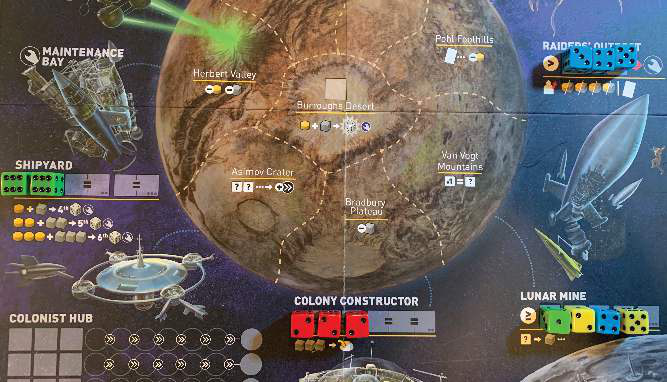
Whatever your position on the matter, it is representative of the ongoing hybridization of game styles and game mechanisms (Illustration 9.2). The manner in which the dice change values over the course of the game can vary. In some games, the dice are rolled each turn, giving a random distribution that players need to work with. Alien Frontiers works in this way. In other games, the players obtain the dice on a certain side or have to expend resources to change them to other, perhaps more powerful, sides.
Sample Games
Alien Frontiers (Niemann, 2010) The Artemis Project (Chow and Rocchi, 2019) Champions of Midgard (Steiness, 2015) Kingsburg (Chiarvesio and Iennaco, 2007) Illustration 9.2 The Alien Frontiers board, with various spaces occupied by dice. The Shipyard requires matching pairs of dice. All dice in the Colony Constructor must be the same value, while the Raider’s Outpost requires a “run” of increasing values. Finally, dice placed in the Lunar Mine must be increasing but do not need to be consecutive.
描述
工人由骰子表示,其点数值影响游戏。
讨论
工人作为骰子(Workers-As-Dice)是一个广泛的类型,它经常伴随着在建筑中打出工人组合的机制。在《外星前线》(Alien Frontiers)中,玩家在他们的回合中将所有骰子分配到建筑物上,这些建筑物需要不同的骰子组合和点数,并且对放置有不同的要求。这种方法会导致一些分析瘫痪,因为多达六个骰子可能产生大量组合。其他游戏,如《王国堡》(Kingsburg),将骰子池限制为三个骰子。每次掷骰为玩家提供了一组更小的放置排列供考虑,不仅因为骰子数量较少,还因为对于任何给定的组合,有效建筑物更少。工人作为骰子还可以用来确定工人的有效性。在《阿尔忒弥斯计划》(The Artemis Project)中,工人骰子收集等于其点数值的资源数量——只要供应中仍有可用资源。然而,较高点数值的骰子最后获得资源,如果在他们可以收集奖励之前资源耗尽,这可能会让放置玩家运气不佳。《米德加德的勇士》(Champions of Midgard)具有战士骰子,其面代表攻击强度。骰子被分配来克服怪物,并一起掷出、求和,然后与怪物的强度进行比较。对于一些玩家来说,这在工人放置游戏中是不可接受的随机性水平和类型。
无论你对此事的立场如何,它都代表了游戏风格和游戏机制的持续混合(插图9.2)。骰子在游戏过程中改变点数的方式可以有所不同。在某些游戏中,骰子每回合掷一次,给出玩家需要处理的随机分布。《外星前线》以这种方式工作。在其他游戏中,玩家在某一面获得骰子,或者必须消耗资源将它们改变为其他可能更强大的面。
游戏范例
Alien Frontiers (Niemann, 2010) - 《外星前线》 The Artemis Project (Chow and Rocchi, 2019) - 《阿尔忒弥斯计划》 Champions of Midgard (Steiness, 2015) - 《米德加德的勇士》 Kingsburg (Chiarvesio and Iennaco, 2007) - 《王国堡》 插图9.2 《外星前线》棋盘,各种空间被骰子占据。造船厂需要匹配的骰子对。殖民地建造者中的所有骰子必须是相同的值,而掠夺者前哨需要递增值的”顺子”。最后,放置在月球矿的骰子必须递增,但不需要连续。