Description
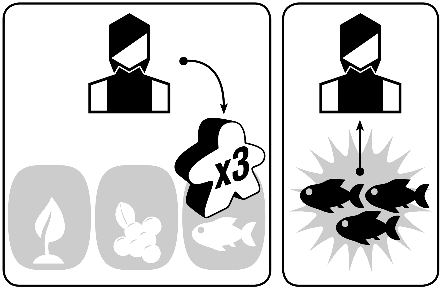
Workers can differ in abilities, or can be upgraded and downgraded, or are valid for placement in different areas and buildings.
Discussion
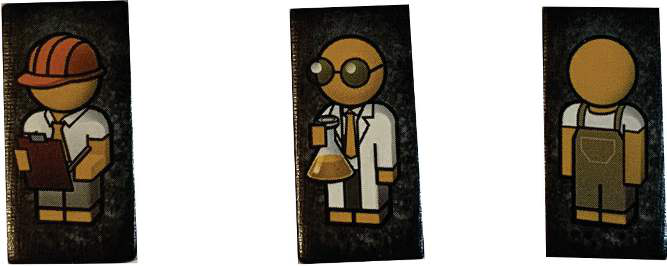
Improved workers are a common variation on standard worker placement. Improved workers can count as more than one basic worker as in Belfort, or they may allow you to break standard placement rules, as in Leonardo Da Vinci. Tzolk’in puts a different spin on this idea by having the rewards for a space improve the longer that a worker is allowed to stay out on that space. Tematically, this can be understood as a worker spending more time working. Another take on this idea is the notion that workers can improve. In both Praetor and Euphoria: Build a Better Dystopia, workers, represented as dice, are more capable and provide better returns when they show higher numbers. Players can take actions to increase the values of these worker dice. In Village, workers can age and gain experience, which improves their effectiveness (Illustration 9.1). Some games have workers who participate in different placement contests or have buildings that can only be accessed by certain types of workers. Pillars of the Earth has workers who can collect resources and master builders, who are placed during the second round of placement and who can access other actions besides resource collection. The Manhattan Project similarly features specialists, like scientists and engineers, and certain buildings require those
specialists to operate. Glenn Drover’s Empires: Galactic Rebellion (previously known as Age of Empires III: The Age of Discovery) and Viticulture feature as many as eight different kinds of workers who might participate in majority contests and even battles in addition to taking actions.
Sample Games
Age of Empires III: The Age of Discovery (Drover, 2007) Belfort (Cormier and Lim, 2011) Euphoria: Build A Better Dystopia (Stegmaier and Stone, 2013) Glenn Drover’s Empires: Galactic Rebellion (Drover, 2016) Leonardo Da Vinci (Acchittocca, Brasini, Gigli, Luperto, and Tinto, 2006) The Manhattan Project (Tibbetts, 2012) Pillars of the Earth (Rieneck and Stadler, 2006) Praetor (Novac, 2014) Tzolk’in: The Mayan Calendar (Luciani and Tascini, 2012) Village (Brand and Brand, 2011) Viticulture (Stegmaier and Stone, 2013) Illustration 9.1 Three different workers from Manhattan Project—Engineer, Scientist, and Laborer. Some placement spaces only allow specific types of workers to be placed there.
描述
工人可以在能力上有所不同,或者可以升级和降级,或者在不同的区域和建筑中有效放置。
讨论
改进型工人是标准工人放置的常见变体。改进型工人可以像在《Belfort》中那样计为多个基本工人,或者它们可能允许你打破标准放置规则,如在《达芬奇》(Leonardo Da Vinci)中。《卓尔金》(Tzolk’in)对这个想法进行了不同的诠释,即允许工人在空间上停留的时间越长,该空间的奖励就会提高。从主题上讲,这可以理解为工人花更多时间工作。这个想法的另一个诠释是工人可以改进的概念。在《Praetor》和《欢乐建造:建造更好的反乌托邦》(Euphoria: Build a Better Dystopia)中,工人用骰子表示,当它们显示更高的数字时更有能力并提供更好的回报。玩家可以采取行动来增加这些工人骰子的点数。在《村庄》(Village)中,工人可以变老并获得经验,这提高了他们的效率(插图9.1)。有些游戏有参与不同放置竞赛的工人,或有只能由某些类型的工人访问的建筑。《地球支柱》(Pillars of the Earth)有可以收集资源的工人和大师建造者,后者在第二轮放置期间放置,可以访问除资源收集之外的其他行动。《曼哈顿计划》同样包括专家,如科学家和工程师,某些建筑需要这些
专家来运作。《格伦·德罗弗的帝国:银河叛乱》(Glenn Drover’s Empires: Galactic Rebellion)(以前称为《帝国时代3:探索时代》)和《葡萄园》(Viticulture)拥有多达八种不同类型的工人,他们除了采取行动外,还可能参加多数竞赛甚至战斗。
游戏范例
Age of Empires III: The Age of Discovery (Drover, 2007) - 《帝国时代3:探索时代》 Belfort (Cormier and Lim, 2011) - 《Belfort》 Euphoria: Build A Better Dystopia (Stegmaier and Stone, 2013) - 《欢乐建造:建造更好的反乌托邦》 Glenn Drover’s Empires: Galactic Rebellion (Drover, 2016) - 《格伦·德罗弗的帝国:银河叛乱》 Leonardo Da Vinci (Acchittocca, Brasini, Gigli, Luperto, and Tinto, 2006) - 《达芬奇》 The Manhattan Project (Tibbetts, 2012) - 《曼哈顿计划》 Pillars of the Earth (Rieneck and Stadler, 2006) - 《地球支柱》 Praetor (Novac, 2014) - 《Praetor》 Tzolk’in: The Mayan Calendar (Luciani and Tascini, 2012) - 《卓尔金:玛雅历法》 Village (Brand and Brand, 2011) - 《村庄》 Viticulture (Stegmaier and Stone, 2013) - 《葡萄园》 插图9.1 《曼哈顿计划》中的三种不同工人——工程师、科学家和劳工。有些放置空间只允许特定类型的工人放置在那里。